
Blog
Advanced Planning and Scheduling in Manufacturing: Closing the Gap Between MRP Plans and Finite-Capacity Reality
By Vishnu Panda, Chief Executive Officer, Interwork Software Solution Pvt. Ltd. | Updated July 2026
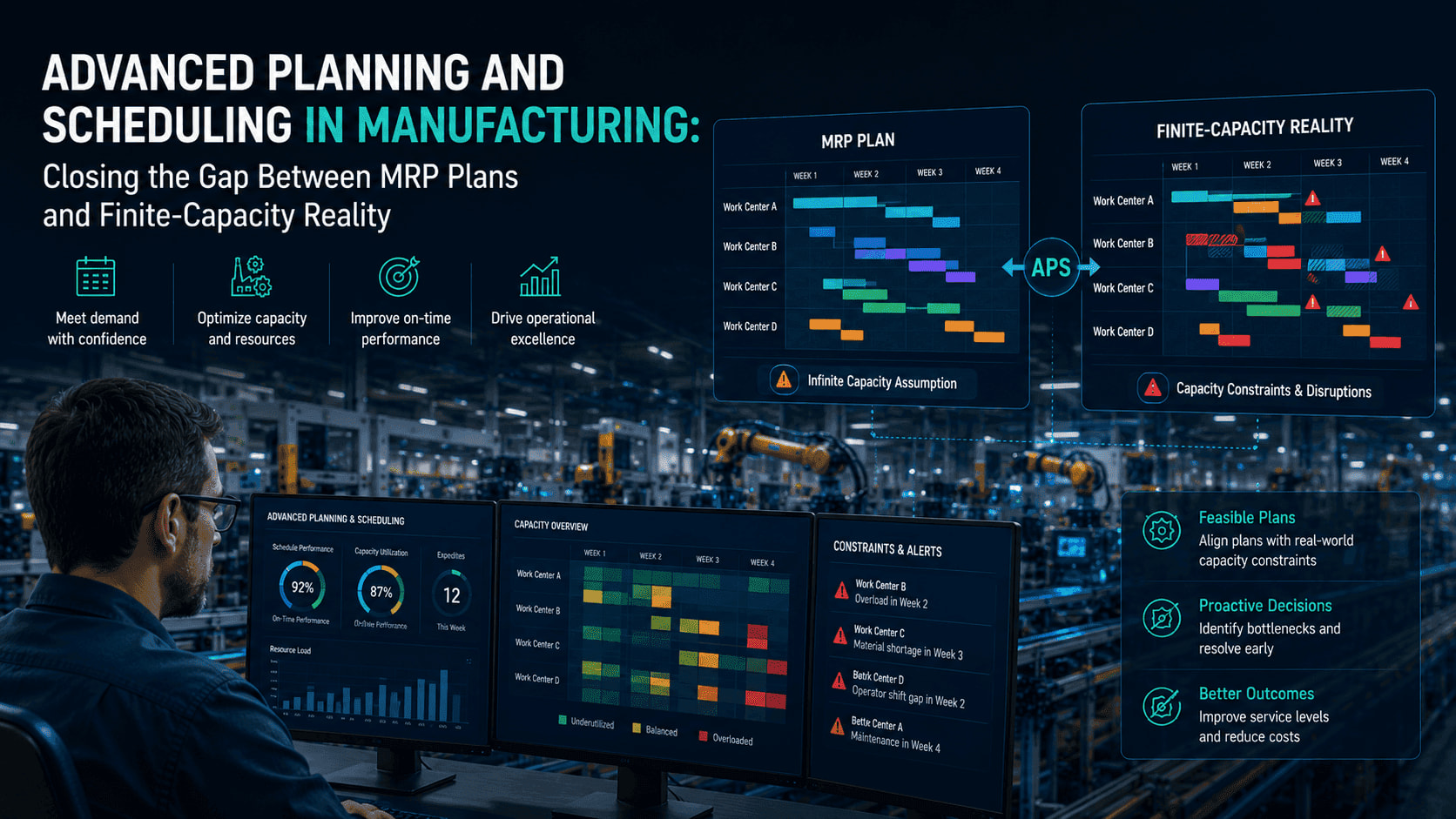
Every manufacturing enterprise running SAP, Oracle, or any ERP system has the same planning problem. The MRP module generates a production plan. It is mathematically consistent, it meets demand, and it accounts for lead times and bill-of-materials structure. It is also frequently impossible to execute on the actual factory floor, because it was calculated assuming infinite capacity, ignoring the real-world constraints that production planners spend hours every day working around manually.
Key Takeaways
- The global APS software market was valued at $4.2 billion in 2025 and is projected to reach $9.8 billion by 2034 at a 9.9% CAGR, with 76% of large-scale manufacturers already running APS solutions (DataIntelo, April 2026).
- 84% of APS adopters report improvements in capacity utilization, and 68% of enterprises using APS tools report full ERP integration, achieving a 31% improvement in overall production planning efficiency (Market Growth Reports, 2025).
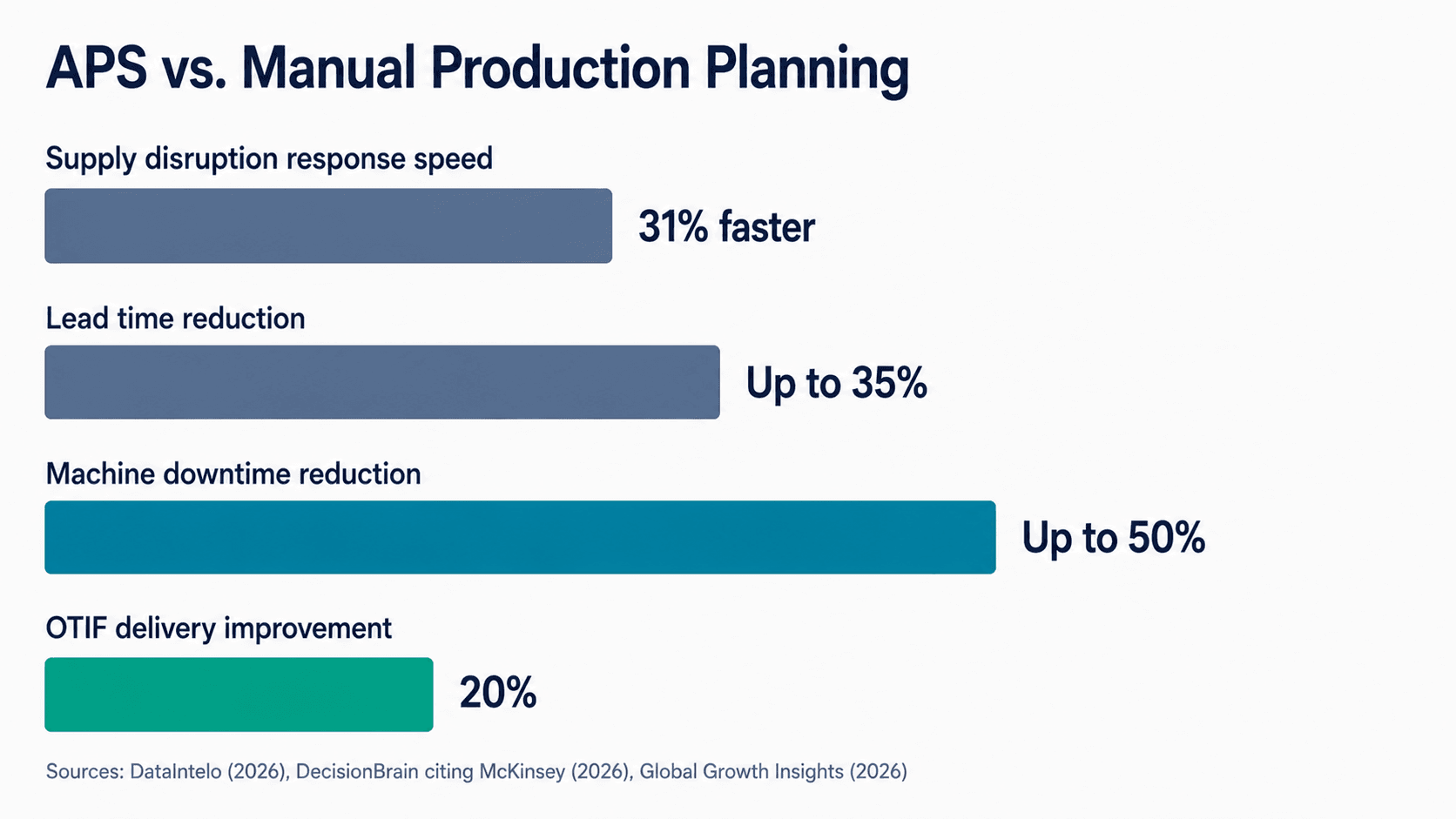
- McKinsey's Lighthouse manufacturing benchmarks attribute 10 to 30% throughput increases, 10 to 20% inventory reduction, and up to 50% reduction in machine downtime to manufacturers deploying digital planning optimization at the APS level (DecisionBrain, citing McKinsey, 2026).
- APS-driven manufacturers report a 20% improvement in on-time-in-full (OTIF) delivery compared to manual and MRP-only planning environments (Global Growth Insights, February 2026).
- Interwork's approach to APS-ERP integration uses the same API-led, bidirectional connector architecture behind the Connected Shop Floor Execution Platform, so schedule confirmations and capacity reservations post back to SAP or Oracle without manual reconciliation.
- The fastest-returning component of an APS business case is usually planning labor recovery, typically 2 to 5 hours per planner per day, followed by changeover time reduction and delivery penalty avoidance.
This is the gap that Advanced Planning and Scheduling (APS) closes. Not by doing what ERP planning modules already do, but by doing what they cannot: generating finite-capacity, multi-constraint schedules that account simultaneously for machine availability, tooling requirements, labor shift patterns, material lead times, and customer priority tiers. The result is a production schedule that a Plant Head can hand to a shift supervisor with confidence that it can actually be executed. For most enterprises, advanced planning and scheduling APS manufacturing programs are also where an Industry 4.0 digital transformation roadmap starts producing measurable floor-level results, rather than staying a slide-deck initiative.
The question we ask at the start of every APS readiness assessment is simple: how long does your production planning team spend each day converting the ERP's MRP plan into a schedule the floor can actually run? In most manufacturing enterprises without APS, the honest answer is 2 to 5 hours of senior planner time, every day. Multiply that by 250 working days and you are looking at 500 to 1,250 hours of experienced planning capacity consumed annually by a problem that finite capacity scheduling exists to eliminate. The ROI calculation starts there, before any throughput or lead-time improvement is counted.
Why Do ERP Planning Modules Leave Plant Heads With Unexecutable Schedules?
The gap between MRP output and executable production schedules exists because ERP planning was designed to answer a different question than the one the factory floor needs answered. MRP answers what quantities need to be produced, procured, or moved, and by when, to meet customer demand. It answers that question well. The problem is that it answers it by assuming all production resources are always available.
In practice, Machine 4 is reserved for a preventive maintenance window on Tuesday afternoon. The specialist tooling for Product Family B is shared between two lines. The second shift has three fewer operators than the first. The material for Order 47 will not arrive until Thursday morning. MRP's infinite-capacity plan does not know about any of these constraints. The production planner does, and the planner spends the first two to four hours of every workday reconciling the plan the ERP generated with the physical reality of the floor.
That manual reconciliation is not just a labor cost. It is a source of schedule instability that compounds throughout the day. When a machine goes down mid-shift, the planner reconciles again. When a priority customer calls to expedite an order, the planner reconciles again. Each reconciliation takes time, introduces the possibility of error, and frequently displaces other orders in ways that are not fully visible until a different customer misses their delivery window.
APS addresses this at the algorithm level, not the reporting level, and it is one of the clearer examples of business process automation solutions replacing a manual coordination task rather than just digitizing it. A finite capacity scheduling engine knows which machines are available, which tooling is required for which product families, which labor configurations are scheduled for which shifts, and which materials are confirmed in inventory versus expected but not yet received. It generates schedules that are feasible against all of those constraints simultaneously, not plans that require manual constraint enforcement before they are usable.
What Is APS and What Does Finite-Capacity, Multi-Constraint Scheduling Actually Solve?
Advanced Planning and Scheduling software uses constraint-based optimization algorithms to generate production schedules that simultaneously satisfy multiple competing requirements: machine capacity limits, tooling availability, labor shift structures, material supply timing, setup time dependencies between product families, customer priority tiers, and due-date commitments. No manual planning process and no standard ERP planning module solves all of those constraints simultaneously. They solve them sequentially, which means the solution to one constraint creates a conflict with another that has to be resolved in the next iteration.
The multi-constraint engine is what makes APS schedules executable. When the engine generates a schedule, it has already verified that every machine assignment is within capacity for the planning horizon, every material requirement is met by confirmed supply or realistic procurement timing, every setup transition between product families respects the sequence-dependent setup time matrix, and every customer due-date commitment is met within the priority tier structure the planner defined. The output is a schedule that can go to the floor as an operational yield improvement, not a starting point for more manual adjustment. This is the core of ERP-driven manufacturing done properly: the schedule is a live extension of the ERP's own production order data, not a parallel spreadsheet the planner maintains by hand.
How Does APS Connect to ERP Systems for Bidirectional Production Intelligence?
APS does not replace ERP production planning. It extends it. The ERP continues to handle demand management, MRP explosion, procurement planning, and the financial dimensions of production order management. APS sits between the ERP's MRP output and the shop floor execution layer, taking the MRP's infinite-capacity plan and converting it into a finite-capacity, executable schedule.
The bidirectional integration is what makes this operationally effective. From the ERP, APS receives demand signals, confirmed inventory positions, approved production orders, and supplier delivery confirmations that update material availability. From the shop floor, typically through the MES layer, APS receives machine status, production order progress, actual cycle times against planned cycle times, and quality holds that affect available inventory. APS uses all of this to continuously update the schedule and re-optimize when deviations occur, which is the same principle behind real-time inventory synchronization on the Connected Shop Floor Execution Platform, just applied one layer up in the planning stack.
Back to the ERP, APS posts schedule confirmations that update production order timing, capacity reservations that inform procurement of planned material consumption windows, and performance data that feeds into the financial reporting of production efficiency. This bidirectional flow is what eliminates the operational silos between the ERP's planning layer and the factory floor's execution reality, and it is the same design principle we apply anywhere we eliminate operational silos across a manufacturing technology stack.
Interwork's approach to APS-ERP integration is built on the same API-led, bidirectional connector architecture used in the Connected Shop Floor Execution Platform. Near real-time data synchronization between APS schedule outputs and ERP production order records keeps the financial ledger accurate without requiring manual reconciliation steps. The Production Order Confirmation Module confirms completed production back to the ERP as units are produced, closing the loop between the scheduled plan and the actual output record. This bidirectional pattern is exactly why 68% of enterprises using APS tools report full ERP integration, and why those integrated deployments see a 31% improvement in overall production planning efficiency compared to organizations that keep APS and ERP only loosely connected (Market Growth Reports, 2025).
The integration decision that most frequently determines APS program success is whether to give the APS engine read and write access to the ERP production order database, or to build a separate scheduling layer that the planner then manually implements in the ERP. The read and write approach is more complex to implement and requires more careful governance design. But organizations that implement it with proper validation controls consistently achieve the full planning efficiency gain. Organizations that keep APS as a separate recommendation engine get roughly 40% of the benefit, because the manual translation step from APS recommendation to ERP production order reintroduces the delay and error risk that APS was supposed to eliminate.
Which Manufacturing Operations Gain the Most from APS?
APS delivers the highest ROI in manufacturing environments where three conditions exist simultaneously: high product mix complexity, constrained shared resources, and customer delivery commitments that create meaningful penalty or revenue impact when missed.
Discrete manufacturing with high changeover variability is the strongest APS use case. Automotive component manufacturers, white goods producers, and electronics assembly operations run dozens of product variants across shared machine capacity as part of otherwise well-run smart factory systems. Changeover time between product families varies significantly depending on sequence, and the optimal production sequence is a combinatorial optimization problem that no human planner can solve quickly at scale. APS sequence-dependent setup optimization routinely reduces total changeover time by 15 to 25% on mixed-product lines, directly increasing available production capacity without adding machines.
Multi-site manufacturing networks benefit from APS at the cross-plant scheduling level. When demand can be allocated between multiple plants based on their current capacity positions, and when semi-finished goods move between plants in a production network, APS coordinates the scheduling across sites in a way that balances load, minimizes inter-plant transfer costs, and meets consolidated delivery commitments. Without APS, multi-site load balancing is typically a weekly manual exercise that misses the intra-day rebalancing opportunities that would improve overall network output across connected factory floors.
Pharmaceutical and food manufacturing with batch sequencing constraints benefit from APS's ability to handle the regulatory-driven scheduling rules that govern production sequence. Clean-in-place requirements, cross-contamination avoidance protocols, batch traceability rules, and regulatory review windows are constraint types that standard MRP cannot model. APS handles them as hard constraints in the scheduling engine, generating sequences that comply with regulatory requirements while still optimizing throughput and changeover efficiency. It is one reason 57% of global manufacturers listed APS as a top-three digital priority (Market Growth Reports, 2025), well ahead of many other Industry 4.0 digital transformation initiatives competing for the same budget.
How Does APS-Integrated Supply Chain Management Improve On-Time Delivery Performance?
Supply chain visibility and APS integration are closely connected because most production schedule failures originate upstream. A production plan that is feasible based on planned material arrivals becomes infeasible when a supplier delivers late, a quality hold takes a batch out of available inventory, or an expedited customer order pulls material away from a previously planned production run.
APS systems connected to supply chain data handle these disruptions through dynamic rescheduling rather than manual replanning. When a confirmed purchase order delivery date changes in the ERP, the APS engine immediately assesses the impact on the affected production orders, identifies the orders that will be delayed, calculates the ripple effects through subsequent scheduled orders, and generates a revised schedule that minimizes the total customer impact given the new material availability constraint. The production planner sees the disruption, its impact, and the revised schedule simultaneously, rather than discovering the supply problem through a phone call and then spending hours manually working out the consequences. That real-time inventory synchronization between confirmed supply and the active schedule is what turns a purchasing exception into a two-minute replan instead of a half-day fire drill.
APS-driven manufacturers report a 20% improvement in OTIF delivery compared to manual and MRP-only planning environments (Global Growth Insights, February 2026), and the automotive industry alone has reported a 28% enhancement in delivery reliability through APS deployment (Market Growth Reports, 2025).
Integrated supply chains that connect APS scheduling with our Digital Supply Chain Engines and Freight-Centric TMS extend this supply chain visibility into the inbound logistics layer. When inbound freight tracking data updates the expected delivery time of a critical material from Thursday afternoon to Friday morning, the APS integration reflects that change in the production schedule automatically, rather than requiring a logistics coordinator to call a production planner who then manually adjusts the schedule in the ERP. Eliminating that manual hand-off is what makes integrated supply chains a systematic capability rather than an individual-coordination skill, and it is a large part of what operational yield optimization actually looks like on the ground.
How Do Plant Heads and CTOs Build the Business Case for APS Investment?
APS investment decisions are most effectively justified through a three-layer financial model: labor cost savings from reduced manual planning, throughput gains from optimized scheduling, and penalty or revenue protection from improved delivery reliability.
Layer 1, planning labor recovery. Quantify how many hours of senior planner time are currently spent daily on manual schedule reconciliation, disruption response, and ERP plan adjustment. For most manufacturing enterprises without APS, this is 2 to 5 hours per planner per day across a planning team of 2 to 8 people. At a fully loaded cost of $80,000 to $120,000 per year for an experienced production planner, the labor recovery alone frequently justifies a significant portion of APS implementation cost in the first year.
Layer 2, throughput improvement. Model the production capacity impact of reducing changeover time by 15 to 25% on mixed-product lines through sequence optimization. For a plant running 250 production days per year with meaningful daily changeover time, the additional capacity recovered often translates to 3 to 8% more output from the same asset base, which is a direct, measurable form of operational yield optimization.
Layer 3, delivery penalty and revenue retention. Calculate the annual cost of late delivery penalties, customer chargebacks, and lost repeat orders attributable to schedule adherence failures. For manufacturing enterprises selling into automotive, aerospace, or retail channels with contractual delivery requirements, this number is often the largest single component of the APS business case.
The combination of these three layers, with conservative assumptions at each layer, typically produces an APS investment ROI of 2 to 3x over three years for manufacturers following proven implementation approaches (DecisionBrain, citing McKinsey and WEF Lighthouse benchmarks, 2026). Plant Heads building this case internally get the most traction when they present it plant by plant, since the labor recovery and changeover gains at one site rarely translate one-to-one to connected factory floors running a different product mix or shift structure.
The APS Implementation Roadmap: What Manufacturing IT Leaders Need to Get Right
Phase 1 is data foundation and constraint mapping, typically 30 to 60 days. APS scheduling accuracy depends on the quality of the constraint data feeding it. Before any scheduling engine is configured, the implementation team needs a verified machine capacity matrix, a tooling availability model, a sequence-dependent setup time matrix for all product-family transitions on all relevant machines, and confirmed material availability data from the ERP. Gaps in any of these datasets produce schedules that do not reflect physical constraints and undermine planner trust.
Phase 2 is APS-ERP integration with read and write production order access, typically 60 to 90 days. Configure the bidirectional API integration between APS and ERP production orders. Establish the data governance framework: which APS schedule fields update ERP records automatically, which require planner approval before posting, and what the audit trail looks like for schedule changes. The maker-checker validation principle applies here as it does in production data: automated updates need governance controls to prevent APS optimization errors from corrupting ERP records.
Phase 3 is a pilot on one production line or product family, typically 60 to 120 days. Implement APS scheduling for a contained scope, a single high-complexity product family, a single shared production line, or a single plant site. Measure schedule adherence, planner intervention frequency, changeover time, and throughput against a pre-APS baseline. Use the documented results to build the case for expansion.
Phase 4 is expansion to full plant and supply chain integration, typically 90 to 180 days. Extend APS coverage to the full plant, connect inbound supply chain data for dynamic disruption response, and add cross-site scheduling for multi-plant networks. Connect APS supply chain data to the digital supply chain engines layer for end-to-end visibility from supplier delivery confirmation through production schedule to outbound logistics commitment. By this phase, most manufacturers are also running mature smart factory systems on the shop floor itself, so the APS layer is coordinating machines that are already reporting real-time status rather than being retrofitted onto dark equipment.
Common APS Implementation Pitfalls
Treating APS as a reporting tool rather than a scheduling engine is the most common failure mode. APS generates value only when its output drives the production schedule that the floor actually works from. Organizations that run APS in parallel with manual scheduling, using it as a dashboard rather than the authoritative schedule source, get analytics without the operational improvement.
Implementing APS without cleaning constraint data first is the second. An APS engine fed inaccurate setup time matrices, incorrect machine capacity data, or stale tooling availability records generates schedules that are mathematically optimal against the wrong inputs. The data quality foundation is not a phase that can be deferred.
Skipping the ERP integration in favor of manual schedule transfer is the third. As with every manufacturing software implementation, the manual translation step between APS recommendation and ERP implementation reintroduces the delay and error risk that APS was supposed to eliminate. The integration is more complex to build, but it is where the planning efficiency improvement actually lives.
Underestimating change management for production planners rounds out the list. APS changes what production planners do. They shift from manual schedule construction to schedule supervision, exception management, and constraint refinement. Without adequate change management, experienced planners often continue to manually override APS-generated schedules, defeating the purpose of the system and generating data quality problems as manual overrides create discrepancies between the APS model and actual floor state. Most of these pitfalls come down to the same root cause as failed business process automation solutions elsewhere in the enterprise: the technology worked, but the organization never fully retired the manual process it was supposed to replace.
Frequently Asked Questions
What is the difference between APS and MRP/ERP production planning? MRP within ERP systems generates infinite-capacity production plans. They calculate what needs to be produced and when to meet demand, but assume all resources are always available. APS generates finite-capacity schedules that account simultaneously for machine availability, tooling constraints, labor shift structures, material supply timing, and customer priority tiers. MRP output requires manual adjustment before it is executable on the factory floor, while APS output is directly executable as generated.
What types of manufacturing operations benefit most from APS? The highest APS ROI occurs in discrete manufacturing with high product mix and changeover variability, multi-site manufacturing networks where cross-plant load balancing is required, and regulated environments like pharmaceutical and food manufacturing where batch sequencing is constrained by compliance rules. The common factor is constraint complexity that exceeds what manual planning can handle reliably at production speed.
How does APS integrate with SAP or Oracle ERP systems? APS integrates with ERP through API-led, bidirectional connectors. The ERP provides demand signals, confirmed inventory positions, approved production orders, and supplier delivery commitments. APS returns schedule confirmations, capacity reservations, and performance data to the ERP. Read and write ERP integration lets APS-generated schedules update production order timing directly, eliminating the manual translation step that undermines planning efficiency in read-only integrations.
What is finite capacity scheduling and why does MRP not provide it? Finite capacity scheduling generates production sequences and timings that respect the actual capacity limits of each machine, operator, and tooling set in the production environment. MRP calculates production requirements in time buckets without modeling individual resource capacity limits, producing plans that are feasible at the aggregate level but frequently infeasible at the machine level. Finite capacity scheduling solves for executable sequences where no resource is over-committed at any point in the planning horizon.
What ROI should manufacturing organizations expect from APS implementation? McKinsey's Lighthouse manufacturing benchmarks attribute 10 to 30% throughput increases, 10 to 20% inventory reduction, and up to 50% reduction in machine downtime to manufacturers deploying digital planning optimization. ROI over three years is typically 2 to 3x for manufacturers implementing APS with bidirectional ERP integration. The fastest-returning component is usually planning labor recovery, followed by changeover time reduction and delivery penalty avoidance.
What data does APS require to generate accurate finite-capacity schedules? APS requires a verified machine capacity matrix by shift, a sequence-dependent setup time matrix for all product-family transitions, a tooling availability model, confirmed material availability from ERP inventory and open purchase orders, and labor shift schedules by skill category. The accuracy of each constraint input directly determines schedule output accuracy, which is why a data quality audit covering all constraint inputs should be completed before APS configuration begins.
When Manual Planning Becomes the Bottleneck
Most manufacturing enterprises do not have a production capacity problem. They have a planning throughput problem. The capacity is there. The demand is there. The gap is a planning process that cannot generate a feasible, optimized, multi-constraint schedule fast enough to respond to the disruptions and priority shifts that define daily manufacturing operations.
APS closes that gap, not by adding more planners, and not by asking planners to work faster on a manual process with a fundamental complexity ceiling, but by replacing the combinatorial problem that exceeds human planning capacity with an optimization engine built specifically to solve it. 76% of large-scale manufacturers have already made that investment. The manufacturers who have not yet made it are competing against those who have, on delivery reliability, lead time, and operational yield, with a planning disadvantage that grows larger as product mix complexity and supply chain volatility increase.
Interwork Software Solutions designs and implements APS programs, ERP-connected production scheduling architectures, and digital supply chain intelligence frameworks for manufacturing enterprises across our Manufacturing & Retail practice, covering cement, automotive, pharmaceutical, white goods, and FMCG sectors. In every one of those engagements, the underlying goal is the same one that runs through this entire piece: eliminate operational silos between planning, execution, and the ERP ledger, so the schedule a Plant Head is handed each morning is one the floor can actually run.
About the Author
Vishnu Panda is the Chief Executive Officer of Interwork Software Solutions, bringing more than 25 years of experience in manufacturing technology and industrial automation. He leads Interwork's practice across Manufacturing Execution Systems, SCADA integration, IIoT telemetry architectures, and ERP-connected shop floor and scheduling programs for enterprise manufacturing clients across cement, pharmaceutical, automotive, and FMCG sectors.