
Blog
Cloud ERP Integration in Manufacturing: The Architecture Guide for CTOs, CIOs, and Cloud Infrastructure Heads
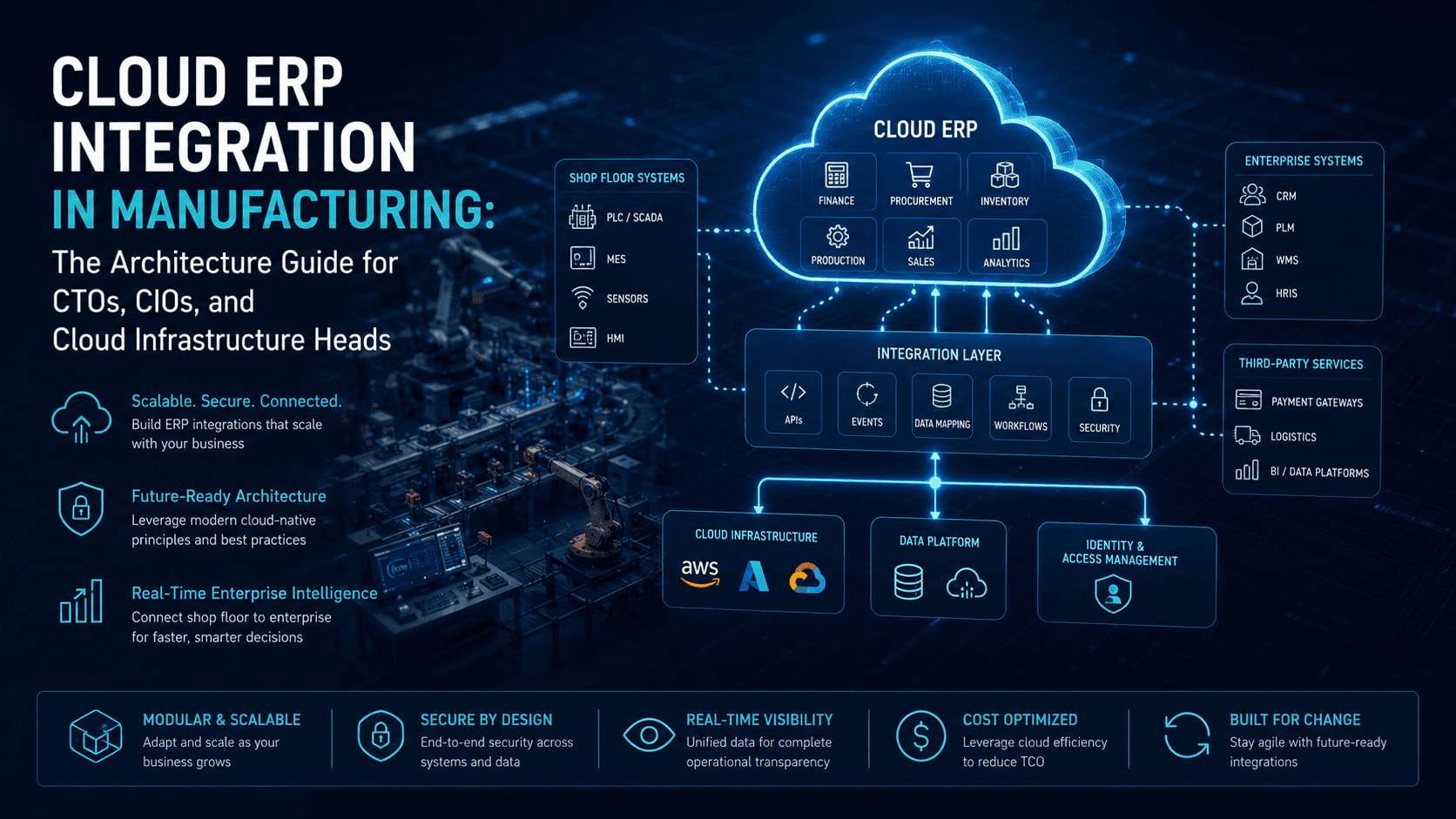
By Vishnu Panda, Chief Executive Officer, Interwork Software Solution Pvt. Ltd. | Updated July 2026
Most manufacturing enterprises have already decided to move their ERP to the cloud. What they have not decided, and what actually determines whether that migration pays off, is how the cloud ERP talks to the shop floor. A finance team with a modern cloud instance and a plant still posting production data through a nightly batch job has not modernized anything. It has just moved the same latency problem to a more expensive address.
Key Takeaways
- The global cloud ERP market was valued at $47.25 billion in 2025 and is projected to reach $138.56 billion by 2031 at a CAGR of 19.65 percent, with manufacturing holding 53.71 percent of cloud ERP market share in 2026, the largest of any industry segment (Mordor Intelligence, 2026; Fortune Business Insights, 2026)
- Around 87 percent of manufacturers had already embedded cloud solutions into their broader digital and operational strategies by 2025, with adopters commonly reporting 20 to 30 percent cost reductions and IT infrastructure costs declining by nearly 40 percent after migration (Market.us, 2025)
- Cloud ERP integration in manufacturing is an architecture decision, not a migration project: API-led ERP integration, industrial protocol translation, and event-driven exception handling are what separate an operational intelligence platform from an expensive financial reporting upgrade
- The Strangler Fig migration pattern lets Interwork extract specific ERP functions into cloud-native microservices while the legacy SAP or Oracle instance keeps running, avoiding the production risk of a big-bang cutover
- SMB manufacturers do not need a full four-phase enterprise program to get real value: the Connected Shop Floor Execution Platform's Production Order Confirmation Module gives a single-plant operation near real-time ERP visibility on a much smaller integration footprint
What Is the Real State of Cloud ERP in Manufacturing Right Now?
Cloud ERP in manufacturing has passed the adoption inflection point. Around 87 percent of manufacturers had embedded cloud solutions into their digital and operational strategies by 2025, and the manufacturing enterprises that completed the transition report 20 to 30 percent reductions in operational costs alongside IT infrastructure overhead declining by close to 40 percent compared to on-premise maintenance (Market.us, 2025).
The remaining challenge is not adoption. It is integration depth. Many manufacturers have moved core financials and HR modules to cloud ERP while leaving production management, shop floor execution, and supply chain operations on legacy on-premise systems. That partial migration creates the worst of both worlds: cloud licensing costs without the operational benefit, because the systems that generate the most manufacturing-critical data, MES, SCADA, and production order management, still sit behind a batch synchronization layer that updates the cloud ERP hours after floor events occur.
The two most common patterns in manufacturing cloud ERP assessments: manufacturers who moved to cloud ERP quickly and now have excellent financial visibility and poor operational visibility, and manufacturers who delayed cloud migration to protect legacy operational integrations and now have neither. The manufacturers winning on both dimensions built a phased integration roadmap that migrated financial modules first, established an API integration layer, and then connected shop floor systems progressively rather than attempting a simultaneous cutover.
Manufacturers getting the most from cloud ERP are the ones that built the integration architecture first. API-led ERP integration that posts production confirmations to SAP or Oracle in near real-time, bidirectional data flows between cloud ERP and manufacturing execution systems, and cloud-native frameworks that can ingest IIoT telemetry at the volumes smart factory environments generate. That is the architecture that converts cloud ERP from a financial reporting upgrade into an operational intelligence platform.
Why Are Manufacturing IT Leaders Moving Away from Monolithic ERP Architectures?
Monolithic ERP architectures, large single-instance on-premise SAP or Oracle systems covering every function from finance to production to supply chain, create a specific set of constraints that manufacturing enterprises hit when they try to scale smart factory systems.
The first constraint is update velocity. Monolithic ERP systems accumulate customizations over time: bespoke business logic, custom reporting modules, non-standard integrations built for specific production processes. Every system update requires testing against every customization, so update cycles that should run quarterly stretch to eighteen months, and capabilities that would improve production planning do not reach the users who need them.
The second constraint is data pipeline capacity. Smart factory environments generate telemetry at volumes that batch ERP architectures were not designed to ingest. An IIoT-connected factory floor running hundreds of machines producing sensor readings every few seconds generates a data volume a midnight batch process simply cannot turn into something a Plant Head can act on at ten in the morning.
The third constraint is multi-site scalability. Manufacturing enterprises with plants across multiple geographies need an architecture that gives corporate finance consolidated real-time visibility across all sites while giving each plant local autonomy over its own production workflows. A single-instance monolithic ERP cannot serve both needs without complex, expensive customization.
Application modernization frameworks solve all three constraints by separating what needs to remain stable, core financial ledgers, compliance processes, master data, from what needs to evolve rapidly, production management, IIoT integration, analytics. Monolithic-to-microservices migration using the Strangler Fig migration pattern lets manufacturing enterprises modernize incrementally, extracting specific functions into cloud-native microservices while the core ERP stays operational throughout.
The most difficult conversation in manufacturing cloud ERP projects is always about the custom ABAP code in the legacy SAP instance. Manufacturers that built complex production-specific logic directly into SAP over fifteen years are understandably reluctant to migrate it. The path that works is wrapping that logic in an API layer rather than rewriting it, then systematically replacing it with cloud-native microservices as the architecture stabilizes. Trying to rewrite fifteen years of ABAP in a single cloud migration project reliably produces multi-year delays. Wrapping and progressively extracting it typically produces a working cloud integration in under twelve months.
What Does API-Led ERP Integration Require in a Manufacturing Environment?
API-led ERP integration is the architectural pattern that makes cloud ERP useful in manufacturing operations rather than just in finance. It replaces point-to-point integrations, which break when either system changes, and batch file transfers, which introduce data latency, with a managed API layer that handles bidirectional, real-time data exchange between cloud ERP and every system it needs to talk to.
In a manufacturing environment, the API integration layer has to handle three data flows that generic enterprise API middleware does not accommodate well.
Production data flows. Production confirmations from MES need to post to ERP Process Orders in near real-time, with real-time transactional ledger synchronization rather than an overnight batch job. When a shift completes most of an order but not all of it, that confirmation needs to reach the cloud ERP financial ledger within the same shift. API-led ERP integration with gRPC or high-performance RESTful APIs handles this at manufacturing data volumes without the throughput limitations of SOAP-based legacy integrations.
Industrial protocol translation. Shop floor equipment speaks industrial protocols: Modbus, OPC-UA, MQTT, Profibus. Cloud ERP speaks REST APIs and database transactions. The integration layer needs industrial protocol translation that normalizes machine telemetry into structured data before it reaches the cloud ERP. Without this, teams build fragile custom connectors that break every time a machine firmware version changes.
Event-driven exception handling. Cloud ERP integration in manufacturing has to handle failure modes gracefully. Machines go offline. Network connectivity between plant and cloud drops during peak production. The integration architecture needs event-driven messaging with guaranteed delivery, using brokers like Kafka or RabbitMQ, so production events queue locally and post to the cloud ERP when connectivity restores, without data loss or manual reconciliation.
How Do You Migrate Legacy SAP or Oracle Systems to the Cloud Without Disrupting Production?
Zero-downtime migration from on-premise ERP to cloud ERP in a manufacturing environment is a sequencing problem as much as a technical one. The programs that get it wrong try to move everything simultaneously. The ones that get it right treat it as a multi-phase program with clear checkpoints.
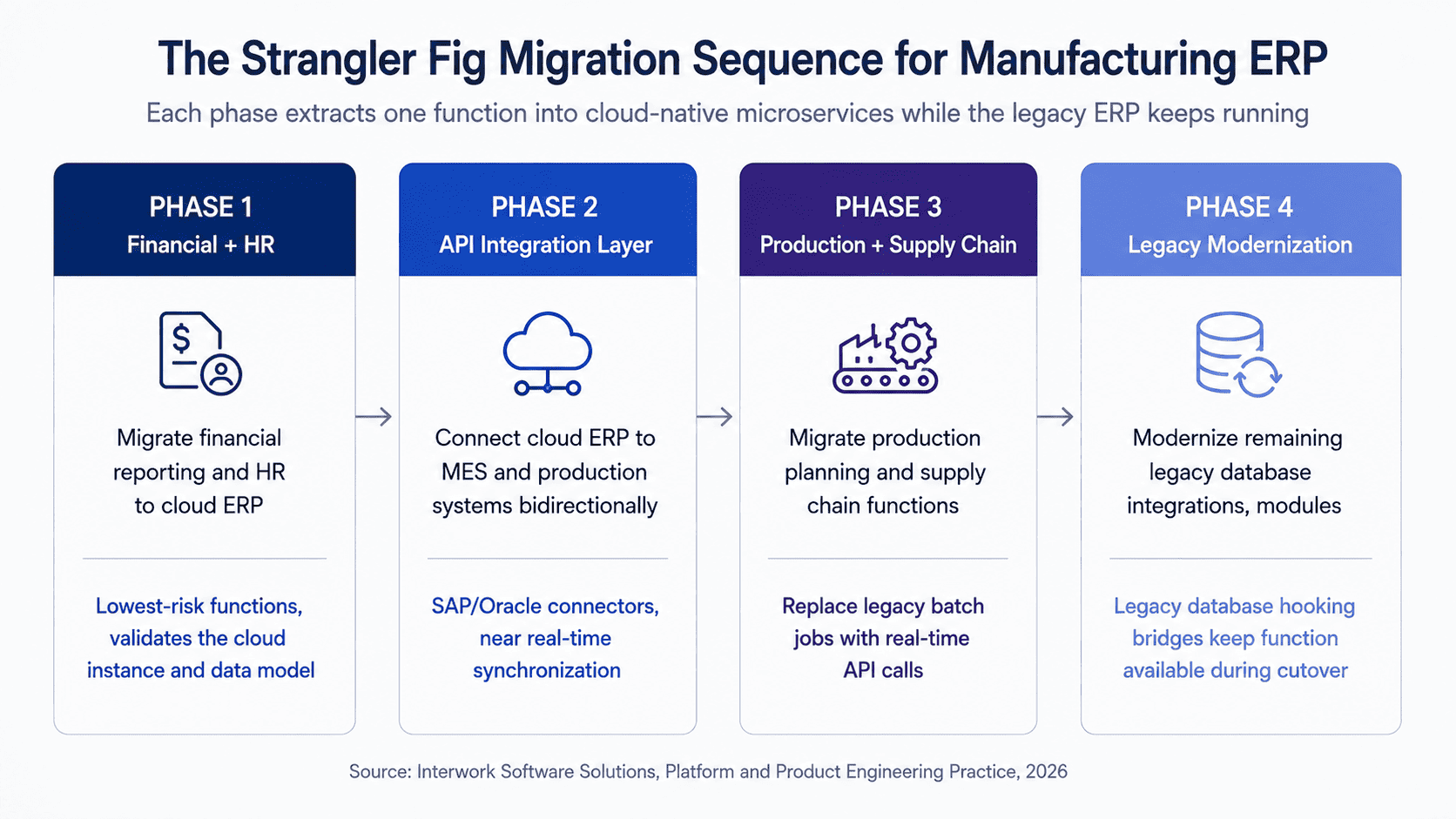
The Strangler Fig migration pattern is the most reliable approach for manufacturing ERP modernization. Rather than replacing the legacy system all at once, new cloud-native microservices are built around the existing ERP, gradually taking on specific functions until the legacy system handles only what it uniquely does well, typically financial ledgers, compliance records, and highly customized production logic. Each new microservice is tested against real production data before the legacy function is deprecated.
Phase one migrates financial reporting and HR to cloud ERP, establishing the cloud instance on the lowest-risk functions. Phase two establishes the API integration layer, connecting cloud ERP to MES and production systems with real-time transactional ledger synchronization through bidirectional connectors engineered for SAP or Oracle core database communication, part of the same ERP Development and Core Integration discipline, and the broader enterprise ERP integration practice, Interwork applies across its manufacturing engagements. Phase three migrates production planning and supply chain functions, progressively replacing legacy batch jobs with real-time API calls. Phase four modernizes remaining legacy database integrations and custom modules using legacy database hooking bridges, part of the broader Application Modernization framework, to keep existing functionality available while cloud-native equivalents are validated.
DevOps and CI/CD implementation is what makes this phased approach sustainable at manufacturing enterprise scale. Each phase requires controlled rollouts, automated regression testing against production data patterns, and rapid rollback capability. Infrastructure as Code using Terraform keeps cloud infrastructure version-controlled and reproducible across environments, and container orchestration through Kubernetes handles the scaling that production volume spikes demand without manual intervention.
How Does Cloud ERP Connect to Shop Floor Systems and OT Infrastructure?
The most technically demanding integration in a manufacturing cloud ERP program is connecting cloud ERP to operational technology: the PLCs, SCADA systems, and industrial IoT sensor networks that control physical production processes.
Most cloud ERP platforms are not designed to connect directly to OT infrastructure. They are designed to receive structured transaction data from business applications. The shop floor generates unstructured, high-frequency telemetry in industrial protocols that cloud ERP cannot natively ingest. Closing that gap requires IT-OT integration services, a layer that sits between the plant floor and the cloud ERP, normalizing OT data into structured transactions the cloud ERP can process.
Interwork's approach starts with the Connected Shop Floor Execution Platform, which acts as the structured data layer between plant floor operations and cloud ERP. The platform captures machine telemetry through its Automated Stoppage Management Module, records production volumes through its Production Order Confirmation Module, and ingests utility and fuel consumption through its Meter Reading Management Module. All three modules push validated, structured data to the cloud ERP through API-led bidirectional connectors engineered for SAP and Oracle suites, with near real-time synchronization that eliminates the multi-shift data delay of legacy batch integrations.
For cloud infrastructure heads, the observability layer on top of this integration matters just as much. Interwork's Unified Observability Platform for IT and OT Environments provides cross-domain monitoring that correlates cloud ERP system health with shop floor equipment status. When a cloud ERP API response time degrades, the observability layer flags which production workflows are at risk before they fail. When a machine anomaly generates an unplanned stoppage, the platform maps the financial impact to the live ERP record in near real-time.
The integration pattern that consistently produces the fastest time-to-value in manufacturing cloud ERP programs is connecting cloud ERP to the MES first, before any other shop floor system. The MES is the natural data broker for shop floor events: it already aggregates machine status, production order progress, and quality outcomes into structured records. Connecting cloud ERP to a well-implemented MES gives IT teams a clean, structured data integration to validate the API layer against, before adding the complexity of direct PLC and SCADA integration.
What Cloud Infrastructure Architecture Supports High-Volume Manufacturing ERP Data?
Manufacturing cloud ERP infrastructure requirements differ from standard enterprise cloud ERP deployments in two specific dimensions: data ingestion volume and regulatory complexity around data residency.
On data volume, a connected factory floor running Industry 4.0 digital transformation programs generates sensor telemetry, production events, and system logs at rates that require cloud infrastructure scaled for continuous high-volume ingestion rather than transactional enterprise workloads. Global connected IoT device counts are projected to grow from roughly 21 billion in 2025 to close to 39 billion by 2030, and manufacturing floors account for a growing share of that curve (IoT Analytics, 2025). Cloud architectures that were not designed for IIoT-scale ingestion are already showing the strain.
Cloud data warehouse design for manufacturing needs to separate hot data paths from cold data paths. Hot data, production confirmations, machine anomaly alerts, and inventory updates, needs near real-time processing and low-latency query access. Cold data, historical telemetry, compliance audit logs, and long-range quality records, needs cost-effective archival storage with scheduled batch analytics. A cloud architecture that routes everything through the same processing pipeline creates unnecessary cost for cold data workloads and unacceptable latency for hot data workloads.
On data residency, manufacturing enterprises operating across multiple geographies face regulatory requirements around where production data can be stored and processed. EU manufacturers under GDPR and sector-specific data sovereignty frameworks often cannot route certain categories of operational data through non-regional cloud infrastructure. Cloud ERP architectures for multi-site manufacturing enterprises need to accommodate regional data routing rules without creating multiple disconnected ERP instances that cannot be consolidated for executive reporting.
Enterprise Service Bus modernization addresses a related problem in large manufacturing organizations that built their integration architecture on legacy ESB middleware. As cloud ERP deployments displace the use cases that justified the ESB investment, modernizing to an event-driven API architecture using Kafka or RabbitMQ for guaranteed message delivery reduces both licensing cost and operational complexity, staged alongside the ERP migration using the same Strangler Fig migration pattern.
How Does Business Process Automation Amplify Cloud ERP Value in Manufacturing?
Cloud ERP's value ceiling is determined by how much of the data it holds gets acted on automatically versus how much requires manual human intervention at each step. Business process automation solutions built on top of cloud ERP infrastructure are what raise that ceiling.
In manufacturing operations, the highest-value automation implementations connect cloud ERP data triggers to downstream operational actions without requiring manual coordination. When cloud ERP production planning calculates a material shortage against confirmed production orders, an automated workflow generates and routes a procurement request to the approved supplier, attaches the relevant material specifications, and tracks acknowledgment, without a procurement coordinator initiating the process manually.
In manufacturing specifically, the rule-based tasks that consume the most coordinator time are purchase order generation, digitized Goods Received Note processing, freight bill verification, warranty claim routing, and production report distribution. Automating these through cloud ERP integration is exactly what Interwork's Freight-Centric TMS and Connected Shop Floor Execution Platform already do for manufacturing clients: automated freight bill verification against verified receipt notifications, and same-shift production order confirmations that remove the manual data entry step entirely. Reducing that administrative overhead frees operational staff for higher-judgment work across multi-site manufacturing operations.
BI and analytics frameworks built on cloud data warehouse design deliver the floor-sensor-to-boardroom dashboards that close the loop between operational data and executive decisions. Production performance, materials consumption, freight costs, and ERP system health become accessible in a single consolidated view, updated in near real-time, without requiring manual report compilation from multiple systems. That is the real-time corporate intelligence manufacturing leadership needs to make the decisions that determine operational yield across Manufacturing & Retail operations.
Can SMB Manufacturers Get Cloud ERP Integration Benefits Without an Enterprise Rollout?
A full four-phase migration program with a dedicated API integration layer, event-driven exception handling, and DMZ-grade observability is an enterprise build. An SMB manufacturer running a single plant and a standard ERP module does not need to build all of that at once to see real value.
The practical entry point is the same one Interwork uses for enterprise programs, just scoped down: production data flow first. A mid-sized plant can start with the Connected Shop Floor Execution Platform's Production Order Confirmation Module, which posts completed production volumes to the cloud ERP on a same-shift basis with N-1 booking flexibility for corrections, without requiring a full API integration layer or Strangler Fig program first. The Meter Reading Management Module adds validated utility and energy consumption tracking on the same lightweight integration path, using connectors that already exist for SAP and Oracle rather than a bespoke integration build.
That gives a single-plant operation same-shift ERP visibility on production and cost allocation immediately, without a full application modernization frameworks program on day one. Full API-led ERP integration against MES and SCADA, event-driven exception handling, and a formal Strangler Fig migration off legacy customizations are the natural second phase, once the plant has proven the ERP-side workflows on production data and is ready to scale toward multi-site smart factory systems.
Common Pitfalls for Manufacturing Cloud Infrastructure and IT Teams
Migrating the ERP without modernizing the integration architecture is the most common mistake. Moving SAP or Oracle to a cloud instance while keeping the same batch-based integration patterns with shop floor systems produces an expensive cloud ERP deployment with the same data latency problems as the on-premise system it replaced. Cloud ERP migration and API integration modernization need to be planned as one program.
Underspecifying cloud infrastructure for manufacturing data volumes is the second. Standard cloud ERP infrastructure sizing assumes enterprise transactional workloads. Manufacturing IIoT environments generate data at orders of magnitude higher volume. Cloud infrastructure for manufacturing ERP needs to be sized for sensor telemetry ingestion rates, not just business transaction volumes, or the gap surfaces after go-live as expensive rearchitecting work.
Treating data residency as a compliance detail rather than an architecture constraint is the third. Data residency requirements for manufacturing operational data determine where cloud infrastructure can be provisioned and how data can be routed between sites. Discovering these constraints after the cloud ERP architecture has been designed requires changes that are significantly more expensive than designing for them upfront.
Skipping the legacy database integration assessment is the fourth. Most manufacturing enterprises have critical production logic and historical data in legacy databases that will not migrate to cloud ERP in the first phase. Legacy database hooking and integration bridges are often the most complex and time-consuming part of cloud ERP migration programs, and starting that assessment late in the program consistently causes schedule delays.
Frequently Asked Questions
What is cloud ERP integration in manufacturing, and how does it differ from standard cloud ERP deployment?
Standard cloud ERP deployment moves financial and administrative functions to a cloud-hosted ERP instance. Cloud ERP integration in manufacturing extends this to connect the cloud ERP bidirectionally with shop floor systems: MES, SCADA, PLCs, and IIoT sensor networks. The integration layer posts production confirmations, material consumption, and machine status to the cloud ERP in near real-time, replacing batch synchronization that introduces multi-shift data latency into operational and financial records.
What is the Strangler Fig migration pattern, and why is it the preferred approach for manufacturing ERP modernization?
The Strangler Fig migration pattern migrates legacy ERP functionality incrementally by building new cloud-native microservices alongside the existing system, routing traffic progressively to the new services as they are validated, and deprecating legacy functions only after the replacement is proven in production. For manufacturing enterprises with complex ERP customizations, this avoids the production risk of a big-bang cutover and keeps legacy production logic operational throughout the migration.
How does API-led ERP integration differ from traditional ERP integration approaches?
Traditional ERP integration uses point-to-point connections, custom batch file transfers, or legacy ESB middleware to pass data between ERP and other systems. API-led ERP integration uses a managed API layer with high-performance RESTful or gRPC endpoints, event-driven messaging for guaranteed delivery, and standardized industrial protocol translation, decoupled from both the ERP and the connected systems so changes to either side do not break the integration.
What cloud infrastructure specifications are required for manufacturing ERP data volumes?
Manufacturing cloud ERP infrastructure needs to accommodate two distinct workload profiles: high-frequency IIoT telemetry ingestion, a hot data path requiring low-latency processing, and high-volume historical analytics, a cold data path requiring cost-effective archival storage. Infrastructure sizing should be based on peak sensor telemetry ingest rates from connected factory floor assets rather than transaction volume from business applications, with Kubernetes handling variable workload scaling during production demand peaks.
How does cloud ERP integration support multi-site manufacturing operations?
Multi-site cloud ERP integration uses a hub-and-spoke architecture where each plant site operates its own edge integration layer connecting local shop floor systems to the central cloud ERP instance. Regional data routing rules handle data residency requirements by keeping site-level operational data within the required geographic boundary while aggregated production and financial data flows to the central ERP for consolidated reporting.
Can a smaller manufacturing plant get cloud ERP integration benefits without a full enterprise rollout?
Yes. A plant can start with production data flowing through the Connected Shop Floor Execution Platform's Production Order Confirmation Module, which requires far less integration engineering than a full API-led architecture and Strangler Fig program. That gives same-shift ERP visibility on production and cost allocation immediately, with the fuller architecture added as a second phase once the plant is ready to scale.
Building an Integration Architecture That Lasts
Manufacturing enterprises that rushed cloud ERP migration without modernizing their integration architecture are now running a more expensive version of the same data latency problem they had on-premise. The ones that treated cloud ERP migration as an opportunity to replace batch integration with API-led, event-driven, near real-time data flows are running fundamentally different operations: shop floor events that reach the financial ledger in minutes instead of hours, production planning decisions made on current-shift data rather than yesterday's batch report, and cloud-native frameworks that scale with IIoT data volumes without manual intervention.
Cloud ERP integration in manufacturing is a program, not a project, whether it runs at single-plant SMB scale or across a multi-site enterprise footprint. It requires sequenced migration phases, an API integration architecture designed for industrial data volumes, a clear data residency plan, and a legacy database integration assessment completed before go-live rather than after.
Interwork Software Solutions designs and implements cloud ERP integration architectures, enterprise ERP integration and application modernization frameworks programs, IT-OT integration services, and connected shop floor execution platforms for manufacturing enterprises across cement, automotive, white goods, pharmaceutical, and FMCG sectors, at both single-plant and multi-site scale, in support of their broader Industry 4.0 digital transformation roadmap.
Schedule a cloud ERP architecture review with the Interwork manufacturing engineering team.
About the Author
Vishnu Panda is the Chief Executive Officer of Interwork Software Solutions, bringing more than 25 years of experience in manufacturing technology and industrial automation. He leads Interwork's practice across Manufacturing Execution Systems, SCADA integration, IIoT telemetry architectures, and ERP-connected shop floor programs for enterprise manufacturing clients across cement, pharmaceutical, automotive, and FMCG sectors.