
Blog
Connected Vehicle Diagnostics and OTA Management: A Technical Guide for Automotive OEM IT Leaders
By Arijit Mukherjee, Chief Technology Officer, Interwork Software Solution Pvt. Ltd. | Updated September 2025
The automotive OEM telematics market reached $34.6 billion in 2024 and is expanding at 14.1% annually toward a projected $125.7 billion by 2034. That growth is not driven by nice-to-have features. It is driven by a hard engineering reality: modern vehicles generate continuous diagnostic telemetry that legacy IT architectures were not designed to handle, and the gap between what the vehicle generates and what operations teams can actually act on is costing OEMs money every day.
For CTOs, CIOs, and Heads of IT and IoT at automotive OEMs, the challenge is not understanding that connected vehicles matter. It is building the automotive OEM software backend infrastructure to manage connected vehicle diagnostics at scale, deploy OTA firmware updates without catastrophic failure risk, and integrate dealer management systems with central ERP instances without creating new data silos.
This guide covers the architecture decisions that matter most, the failure modes that derail implementations, and how Interwork Software Solutions approaches each of these problems for automotive clients.
Key Takeaways
- The automotive OEM telematics market reached $34.6 billion in 2024 and is growing at 14.1% annually through 2034 (Global Market Insights).
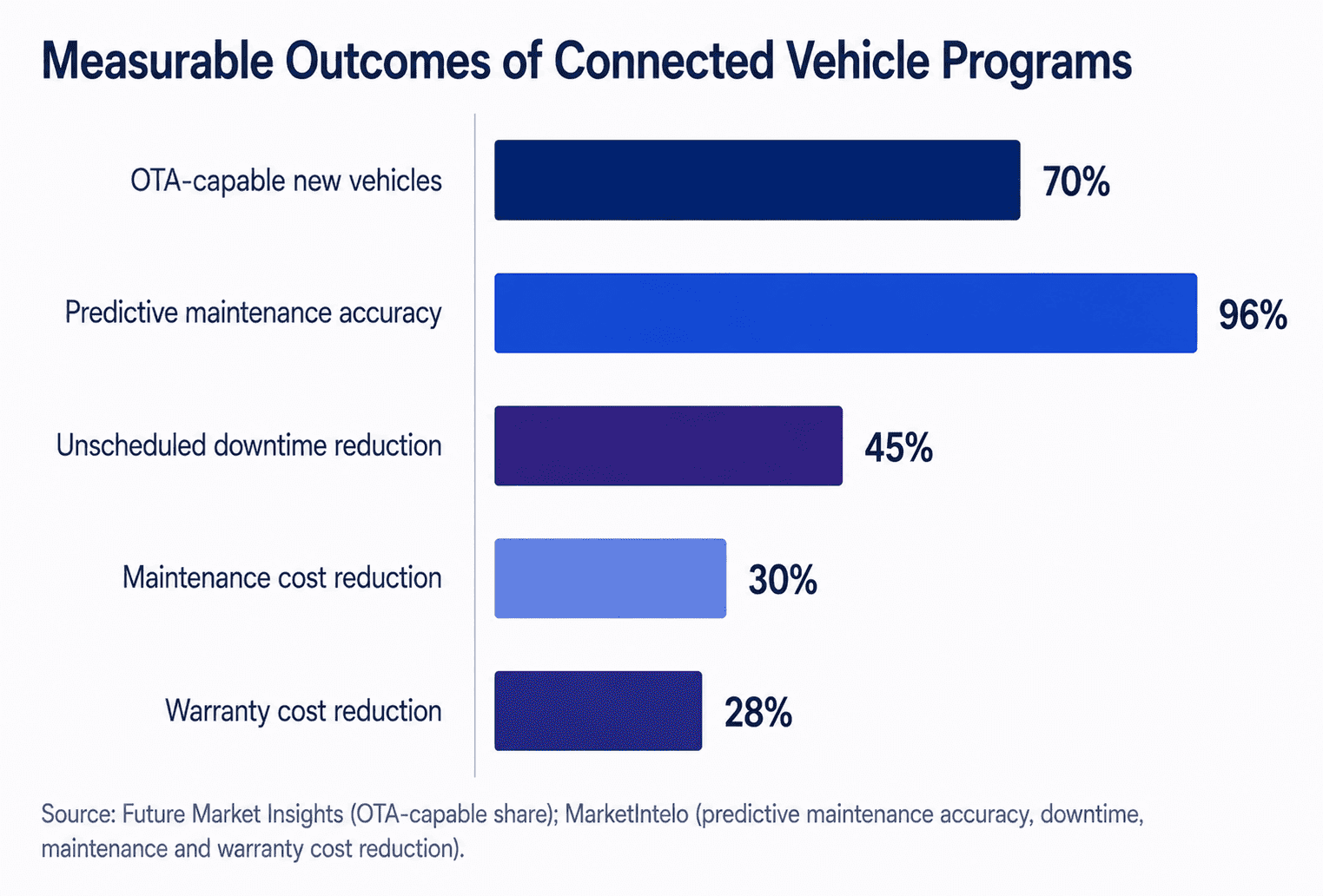
- Over 70% of new vehicles globally already ship with OTA capabilities, making secure firmware distribution infrastructure a current operational requirement, not a future roadmap item (Future Market Insights).
- The automotive OTA update platform market was valued at $4.8 billion in 2025 and is projected to reach $18.6 billion by 2034 at a 16.2% CAGR (DataIntelo).
- Modern predictive maintenance systems achieve 92 to 96% accuracy in identifying imminent component failures, up from 65 to 72% five years ago, and reduce unscheduled fleet downtime by up to 45% (MarketIntelo).
- The global automotive software market was valued at $19.8 billion in 2025 and is projected to reach $56.5 billion by 2035 at an 11.1% CAGR, reflecting the industry-wide shift toward software-defined vehicle architecture (Global Market Insights).
What Is Connected Vehicle Diagnostics, and Why Does Scale Change Everything?
Connected vehicle diagnostics is the continuous capture, transmission, and analysis of hardware and software telemetry from vehicles to centralized cloud infrastructure. At one vehicle, it is straightforward. At one million vehicles generating thousands of data points per second across distributed geographies, it is one of the harder engineering problems in enterprise software.
That complexity reflects the technical debt OEMs are clearing: ECU-level architecture that was not designed for continuous cloud connectivity, proprietary protocols that do not standardize across vehicle generations, and diagnostic data pipelines that were built for workshop access, not real-time cloud analysis.
The shift that is forcing investment is structural. OEMs are moving from periodic fault-code pulls at dealership service centers to always-on telemetry streams that feed into centralized observability platforms. This changes what is technically required at every layer: the vehicle's embedded communication stack, the edge gateway architecture, the ingestion pipeline, the data lake design, and the analytics layer that actually turns raw telemetry into maintenance decisions.
The most common mistake we see OEMs make when beginning connected diagnostics programs isn't the architecture at the vehicle edge. It's underspecifying the cloud ingestion layer. Most teams plan for peak concurrent connections from the vehicle fleet, then discover that burst events (market-specific model launches, recall-triggered diagnostic pulls, severe weather events) generate 8 to 12x normal ingestion volumes. Systems that weren't designed for that burst profile either drop data or impose throttling that defeats the purpose of real-time diagnostics.
Why Are Automotive OEM IT Leaders Under Platform Pressure Right Now?
The pressure is coming from three directions simultaneously, and most OEM IT teams are managing all three at once.
The transition to software-defined vehicles is compressing timelines. The global automotive software market was $19.8 billion in 2025 and is growing to $56.5 billion by 2035 at an 11.1% CAGR (Global Market Insights). Multiple major OEMs have moved beyond pilot programs into production deployment of centralized vehicle operating systems that decouple software from hardware, and Tier 1 suppliers are standardizing reference architectures around that same shift. These are not competitive edge moves anymore. They are the baseline. OEMs that have not begun building software-defined vehicles are now working against peer timelines, not just theoretical futures.
Regulatory frameworks are creating hard compliance deadlines. UNECE R155 requires cybersecurity management systems across the full vehicle lifecycle. EU data-access rules require OEMs to share vehicle operational data with independent repairers under specific governance frameworks. Neither is optional, and both have direct implications for how OEM IT leaders design their connected vehicle data architectures.
Dealer networks are generating operational friction that scales with vehicle volume. Fragmented dealer management systems, manual order tracking, slow warranty claims resolution, and low fleet asset utilization visibility all compound as vehicle-in-market numbers grow. The data exists in the vehicles and the DMS systems. The problem is that it does not flow in real time to the ERP instances where operations decisions get made.
When we start diagnostic architecture engagements with automotive clients, we ask one question first: "Where does a vehicle fault event currently end up, and how long does it take to get there?" In most traditional OEM IT environments, the answer involves a dealership visit, a technician scan, a manual entry into a service system, and a report that reaches fleet operations management two to five days later. That latency isn't a reporting problem. It's a data architecture problem.
How Do OTA Firmware Updates Work at Automotive OEM Scale, and What Can Go Wrong?
OTA firmware updates are now a core OEM capability, not a premium feature. Over 70% of new vehicles globally ship with OTA capabilities, and the automotive OTA update platform market is growing from $4.8 billion in 2025 toward a projected $18.6 billion by 2034 (DataIntelo).
The technical architecture of a production-grade OTA system for an automotive OEM requires four distinct, non-negotiable layers working correctly:
A secure distribution infrastructure. Firmware packages must be signed, encrypted, and distributed through channels that verify device identity before accepting an update payload. This is not a security enhancement. It is the regulatory baseline under UNECE R155. Any OTA architecture that cannot demonstrate cryptographic chain-of-custody for every firmware update is a compliance liability.
A phased rollout engine. No OEM deploys a firmware update to its entire vehicle fleet simultaneously. A phased rollout engine manages cohort selection (by vehicle model, production date, regional market, software version), defines rollout velocity, monitors telemetry signals during deployment, and has automated rollback triggers when anomalies exceed defined thresholds. Without this, a single bad update can generate recall-scale exposure across hundreds of thousands of vehicles before the operations team identifies the failure pattern.
A device state management system. Before an update deploys to any vehicle, the system needs current state: current firmware version, battery state (a firmware update on a vehicle with 12% battery charge is a risk vector), cellular connectivity quality, and whether the vehicle is stationary. These pre-flight checks need to execute at the device level, with results flowing back to a central update orchestrator before any package transmission begins.
A post-update telemetry verification loop. The update completing is not the endpoint. The endpoint is confirmation that the updated ECU or software module is operating within expected parameters after the update installs. Post-update telemetry checks, running automatically against baseline behavioral profiles, close the loop and feed back into the fleet-level update status dashboard.
At Interwork, we design OTA firmware update architectures around MQTT-based secure channels with delta-update capabilities (pushing only the changed bytes, not the full firmware image) and hardware-signed verification at the receiving ECU. The size of the update payload matters significantly at fleet scale. Pushing full images to a million vehicles simultaneously generates bandwidth costs and network congestion that delta-based systems avoid entirely.
What Does Real-Time Automotive Telemetry Architecture Look Like in Practice?
Real-time automotive telemetry is not a single data stream. It is hundreds of simultaneous signals from different vehicle subsystems, each with different update frequencies, criticality levels, and downstream consumers.
A production telemetry architecture for a connected vehicle program at OEM scale typically handles five categories of data simultaneously. Engine and powertrain diagnostics update every 100 to 500 milliseconds and feed into anomaly detection models. Battery and thermal management data, particularly critical for EV platforms, updates every 200 to 1,000 milliseconds and feeds into predictive maintenance scheduling. Location and telematics data updates every 1 to 5 seconds and feeds into fleet utilization dashboards and route optimization systems. Driver behavior data updates per-event and feeds into safety analytics and insurance telematics programs. Software state data captures ECU software versions, update status, and error logs and feeds into OTA campaign management systems.
The ingestion architecture has to handle all five simultaneously, at fleet scale, without data loss during burst events. This is where MQTT telemetry architecture does the heavy lifting: an MQTT broker cluster, fronted by edge gateways that apply local pre-processing before transmitting to cloud infrastructure, handles the latency requirements for time-sensitive signals. The edge layer also manages graceful degradation when cellular connectivity drops, buffering telemetry locally and transmitting when connectivity restores, rather than losing the data gap entirely.
The question we get most often from OEM IT architects is whether to build the telemetry ingestion layer on a public cloud telemetry service (AWS IoT, Azure IoT Hub) or on a self-managed MQTT cluster. The honest answer: it depends on your data residency requirements. European OEMs operating under EU data governance frameworks frequently can't use US-hosted managed services for raw vehicle telemetry without complex data routing workarounds. For those programs, a self-managed MQTT data lake on regional cloud infrastructure or on-premises is often the cleaner architectural choice, even if it requires more upfront engineering.
Predictive maintenance automotive programs are where telemetry investment returns the most measurable value. Modern predictive maintenance systems trained on historical component telemetry now achieve 92 to 96% accuracy in forecasting maintenance requirements before failure occurs, up from 65 to 72% five years ago, and reduce unscheduled fleet downtime by up to 45% while extending component lifespans by 25 to 35% (MarketIntelo). Fleet operators applying these models report maintenance cost reductions in the 20 to 30% range and warranty claim cost reductions of 18 to 28%, since components can be replaced proactively rather than after failure.
How Does DMS-to-ERP Integration Reduce Dealer Network Operational Friction?
Dealer network data gaps are one of the highest-cost operational problems for automotive OEMs, and one of the least visible at the IT architecture level until the scale of the problem becomes undeniable.
The typical state of a dealer network without modern integration: parts inventory data sits in dealer management systems that report to corporate on a batch basis, often daily. Warranty claims travel by email and manual entry. Purchase order status requires phone calls between dealership staff and corporate operations. Lorry receipt tracking is manual and paper-based. The result is information arriving at corporate ERP systems 24 to 72 hours after the underlying event, and decisions being made on stale data.
The fix is a bidirectional DMS SAP integration layer that replaces batch processes with event-driven data flows. When a part is sold at a dealership, inventory levels update at corporate ERP in near real-time. When a warranty claim is submitted, it enters an automated validation workflow rather than a manual email thread. When a vehicle arrives at a service center, a digital goods received note (GRN) triggers in the system immediately, feeding back to the fleet operator's dashboard rather than sitting in a paper log until someone enters it.
This is what Interwork's Dealer Experience & Support Orchestration Platform addresses at the architecture level. Deep SAP and DMS bidirectional integration, automated order tracking with transit webhook integration, digitized GRN workflows with mobile validation, and SLA-driven support ticket routing all replace the manual processes that slow dealer network operations and corrupt the data integrity of central ERP systems.
The business case is straightforward for OEM IT leaders: a parts inventory discrepancy at one dealership is an annoyance. The same discrepancy multiplied across hundreds of dealerships, each running a slightly different version of a manual process, is an operational data quality crisis that shows up as ERP inaccuracy, incorrect procurement decisions, and customer commitments that cannot be fulfilled.
How Do You Improve Fleet Asset Utilization With Connected Vehicle Data?
Fleet asset utilization is one of the most direct ROI metrics for automotive OEM connected vehicle programs. Vehicle idle time, underutilization of specific asset classes within a fleet, and routing inefficiencies driven by incomplete real-time location data all show up as direct cost in fleet operations.
Real-time automotive telemetry changes the utilization calculation. When a fleet operations center has live GPS data, current load status, maintenance state, and driver availability for every vehicle, dispatch optimization algorithms can allocate assets against demand in ways that manual scheduling simply cannot match. Routing decisions that previously required 20 to 30 minutes of coordinator time per vehicle can execute algorithmically in seconds, incorporating real-time traffic conditions, vehicle payload limits, and maintenance state simultaneously.
Remote vehicle tracking systems feeding into centralized fleet management software also surface utilization patterns that are not visible in manual reporting: vehicles that run high-mileage on urban routes but accumulate accelerated brake wear, asset classes that are consistently underbooked on specific days, geographic coverage gaps that lead to long repositioning runs. These patterns inform both operational decisions and fleet composition decisions in ways that periodic reporting simply cannot.
In our work with transit asset optimization for fleet operators, the first dashboard build almost always reveals utilization patterns that contradict what operations managers believed was true. The most common finding: vehicles that operations managers considered high-utilization turn out to have significant idle periods between assignments that don't show up in manual reporting because the idle time isn't logged consistently. Real-time telemetry doesn't just improve utilization. It corrects the measurement baseline that utilization decisions were previously made against.
Can a Mid-Size Fleet Operator or Regional OEM Build This Without Hyperscale Infrastructure?
Most connected vehicle architecture case studies describe million-vehicle OEM fleets, and it is easy for a regional OEM or a mid-size fleet operator managing a few thousand vehicles to assume this level of connected vehicle diagnostics and OTA firmware update infrastructure is out of reach. That assumption does not hold up against how these architectures actually scale down.
The four technical layers, secure distribution, phased rollout, device state management, and post-update verification, do not disappear at smaller fleet size. What changes is the deployment model. A cloud-managed MQTT broker service handles the ingestion and connectivity layer without requiring a regional OEM to stand up dedicated infrastructure, and a phased rollout engine scoped to a few hundred vehicles per cohort rather than tens of thousands still enforces the same safety discipline that prevents a bad update from becoming a fleet-wide incident. DMS SAP integration for a smaller dealer network follows the same event-driven architecture pattern, just with fewer endpoints to connect.
The economics also favor starting smaller and proving value before scaling. A mid-size fleet operator that instruments its highest-value vehicle class first, applying predictive maintenance automotive models to the assets with the worst unscheduled downtime record, gets a measurable result within one maintenance cycle rather than waiting on a multi-year, fleet-wide telemetry rollout. That documented result is what typically justifies expanding remote vehicle tracking systems and OTA firmware update infrastructure to the rest of the fleet.
The Technical Architecture That Connects It All
The architecture that enables connected vehicle diagnostics, OTA management, fleet telemetry, and dealer network integration is not four separate systems. It is one integrated data layer with purpose-built interfaces at each operational layer.
At Interwork, we build automotive connected vehicle programs on four integrated technical foundations:
Secure MQTT data lakes designed to capture, store, and evaluate edge telemetry logs from vehicle fleets at scale. The data lake architecture handles variable ingestion rates, supports historical querying for trend analysis and model training, and maintains the data lineage needed for regulatory compliance and audit requirements.
Predictive maintenance models built as background services that continuously score incoming telemetry against component-level failure probability models. These run asynchronously against the ingestion pipeline, flagging anomalies and generating maintenance scheduling recommendations without requiring manual query runs against the raw telemetry data.
OTA firmware update pipelines that design secure distribution paths for firmware and software updates to field devices. Delta-update compression, phased rollout cohort management, pre-flight device state verification, and post-update telemetry confirmation all operate as coordinated pipeline stages rather than manually managed processes.
Unified observability across IT and OT environments through Interwork's Unified Observability Platform for IT and OT Environments, which aggregates telemetry from vehicle fleets, dealer management systems, and central ERP infrastructure into a single operational view. Cross-domain incident correlation, MTTR and MTBF tracking, and single-pane-of-glass dashboards give OEM IT teams the visibility to manage connected vehicle programs without juggling eight separate monitoring tools.
All four connect to the central ERP through bidirectional integration, so that vehicle-level events such as a maintenance flag, a firmware update confirmation, or a dealer parts transaction reflect in corporate operational data in real time rather than in the next batch cycle.
Common Implementation Pitfalls for OEM IT Leaders
Underestimating the data governance requirement from day one. UNECE R155 cybersecurity compliance, EU data-access obligations, and the internal data classification requirements for vehicle telemetry (which frequently includes location data that triggers personal data obligations) create a governance framework that needs to be designed in at the architecture stage, not retrofitted after the ingestion pipeline is live. Every data element flowing from vehicle to cloud needs an owner, a retention policy, a deletion path, and an access control model.
Building the analytics layer before the data quality foundation. Predictive maintenance models that achieve 92 to 96% accuracy depend on clean, consistent, labeled historical telemetry. OEMs that rush to the analytics use case before establishing data quality standards in the ingestion pipeline end up with models trained on inconsistent data, generating anomaly alerts that do not map to real vehicle states. The result is alert fatigue in operations teams and loss of confidence in the system.
Treating dealer network integration as a separate program from fleet telemetry. The OEM IT teams that get the most value from connected vehicle programs are the ones that treat DMS integration, fleet telemetry, and OTA management as one connected data architecture. Dealer-level parts consumption data informs supply chain planning. Vehicle-level diagnostic data informs warranty claim verification. OTA update status informs service appointment scheduling. These connections only exist when the underlying data infrastructure is designed as an integrated system rather than a collection of separate projects.
Frequently Asked Questions
What is connected vehicle diagnostics, and how does it differ from traditional vehicle diagnostics?
Traditional vehicle diagnostics requires physical access to the vehicle, typically through an OBD-II port at a dealership service center, and produces a point-in-time snapshot of fault codes and sensor readings. Connected vehicle diagnostics uses embedded telematics control units and cellular or V2X connectivity to transmit continuous telemetry streams to cloud infrastructure, enabling real-time fault detection, anomaly flagging, and predictive maintenance scheduling without requiring a physical service visit.
What MQTT telemetry architecture is appropriate for high-volume OEM vehicle telemetry?
For OEM-scale vehicle telemetry ingestion, from tens of thousands to millions of concurrent connections, a clustered MQTT broker architecture with regional edge gateways is the standard approach. Edge gateways handle local pre-processing, apply protocol translation where legacy ECU systems use proprietary formats, buffer data during connectivity interruptions, and manage quality-of-service guarantees for high-priority telemetry signals. The cloud-side broker cluster handles fan-out to consumer applications including analytics pipelines, OTA management systems, and fleet dashboards.
How do OEMs deploy OTA firmware updates safely without risking fleet-wide failures?
Safe OTA deployment at fleet scale requires a phased rollout engine that manages cohort selection (by model, region, software version), defines maximum rollout velocity, monitors post-update telemetry against baseline behavioral profiles, and enforces automated rollback triggers when anomalies exceed thresholds. Pre-flight device state verification (battery level, connectivity quality, vehicle state) executes before any package transmission. Delta-update compression pushes only changed bytes rather than full firmware images, reducing bandwidth requirements and update duration.
What is the difference between a software-defined vehicle and a traditional ECU-based vehicle architecture?
A traditional ECU-based vehicle uses dedicated hardware controllers for specific functions (engine management, transmission control, ADAS), with software tightly coupled to the hardware it runs on. A software-defined vehicle centralizes compute into domain controllers or a central vehicle computer, decoupling software from hardware so that new features, performance improvements, and security patches can be deployed over the air without hardware changes. This architecture enables OEMs to treat the vehicle as a continuously evolving software platform rather than a fixed-function hardware product.
How does DMS-to-ERP integration improve dealer network operations?
DMS SAP integration replaces batch data transfers, daily or weekly updates between dealer management systems and central ERP, with event-driven bidirectional data flows. Parts inventory changes at the dealership level update at corporate ERP in near real-time. Warranty claims enter automated validation workflows. Order status becomes trackable through portal interfaces rather than phone calls. GRN digitization eliminates paper-based receiving processes. The net effect is data accuracy improvement at the ERP level and reduction of the administrative overhead that dealer support teams currently absorb through manual coordination.
What measurable ROI should OEM IT leaders expect from connected vehicle diagnostics programs?
Fleet operators implementing predictive maintenance automotive programs report maintenance cost reductions in the 20 to 30% range and warranty claim cost reductions of 18 to 28%, with unscheduled downtime reductions of up to 45% as accuracy models mature from roughly 65 to 72% five years ago to 92 to 96% today. OTA update programs reduce recall-related service costs by enabling software-remediated fixes to deploy remotely across affected vehicle cohorts rather than requiring physical service appointments at dealer locations.
Can a mid-size fleet operator or regional OEM implement this without hyperscale infrastructure?
Yes, by scoping the deployment model down rather than skipping any of the four core layers. Cloud-managed MQTT broker services remove the need to stand up dedicated ingestion infrastructure, phased rollout cohorts can be sized to a few hundred vehicles instead of tens of thousands, and DMS SAP integration follows the same event-driven pattern with fewer endpoints. Instrumenting the highest-value vehicle class first typically produces a measurable result within one maintenance cycle.
What This Means for Your IT Roadmap
The automotive OEM IT leaders who are building the most durable connected vehicle programs right now are not the ones with the largest budgets. They are the ones who design the data architecture as one integrated system before buying or building any individual component.
Secure MQTT telemetry ingestion, OTA firmware update pipelines, dealer network integration, and predictive maintenance analytics are all part of the same automotive OEM software stack, drawing on the same underlying data. When that data flows through a unified architecture with consistent governance and real-time ERP connectivity, each program multiplies the value of the others. When they are built as separate systems that share nothing except an eventual batch export, each program is also carrying the cost of all the integration debt that was deferred to get it live.
Interwork Software Solutions works with automotive OEM technology teams to design and implement connected vehicle software programs for the automotive and urban mobility sector: from MQTT data lake architecture and OTA firmware update infrastructure to DMS SAP integration and unified IT-OT observability. If you are in the architecture or vendor evaluation phase of a connected vehicle program, a technical systems review is a useful starting point before committing to infrastructure decisions that are expensive to reverse.
Schedule a technical architecture review with our Automotive and Urban Mobility engineering team
About the Author
Arijit Mukherjee is the Chief Technology Officer of Interwork Software Solutions, with more than 25 years of experience in automotive technology, connected mobility platforms, and enterprise software architecture. He leads Interwork's automotive and connected vehicle practice, covering OTA firmware distribution, DMS-SAP workflow integration, dealer experience platforms, and software-defined vehicle architectures for automotive OEMs and dealer networks.