
Blog
Digital Supply Chain Management: The Complete Guide to Smarter Operations in 2026
By Arijit Mukherjee, Chief Technology Officer, Interwork Software Solution Pvt. Ltd. | Updated February 2026
Supply chains have always been the spine of any manufacturing or logistics operation. But in 2026, the gap between digital and traditional supply chains isn't a trend to monitor. It's a competitive divide that determines which businesses absorb disruption and which collapse under it.
Organizations running AI-enabled supply chains improve logistics costs by up to 15% and reduce inventory levels by up to 35%, outperforming slower-moving competitors on service levels by 65% (McKinsey, "Succeeding in the AI Supply Chain Revolution"). McKinsey also reports that supply chain disruptions lasting longer than a month now occur every 3.7 years on average and can wipe out up to 45% of a year's profit over a decade (McKinsey via World Economic Forum, January 2025). The companies with real-time visibility absorb those hits. The ones without don't.
This guide covers the full picture: the core technologies, the real performance gains, industry-specific applications, and a practical roadmap for building your own digital supply chain operation.
Key Takeaways
- AI-enabled supply chains cut logistics costs by 15% and inventory levels by up to 35%, improving service levels 65% over slower-moving competitors (McKinsey, "Succeeding in the AI Supply Chain Revolution")
- More than 70% of supply chain organizations plan to invest in IoT for real-time visibility, and 82% of chief supply chain officers are increasing technology budgets (Gartner via The Supply Chain Xchange, 2024)
- Supply chain disruptions lasting longer than a month now occur every 3.7 years on average and can cost businesses up to 45% of a year's profit over a decade (McKinsey via World Economic Forum, January 2025)
- Digitally enabled supply chains are 38 percentage points more likely to deliver stronger margin improvement, with 63% of AI-assisted organizations reporting fast disruption recovery (Deloitte Center for Health Solutions, March 2026)
- The global digital supply chain market was valued at $19.57 billion in 2024 and is projected to reach $36.19 billion by 2032 at a CAGR of 7.99% (Market Research Future, 2025)
What Is the Digital Supply Chain?
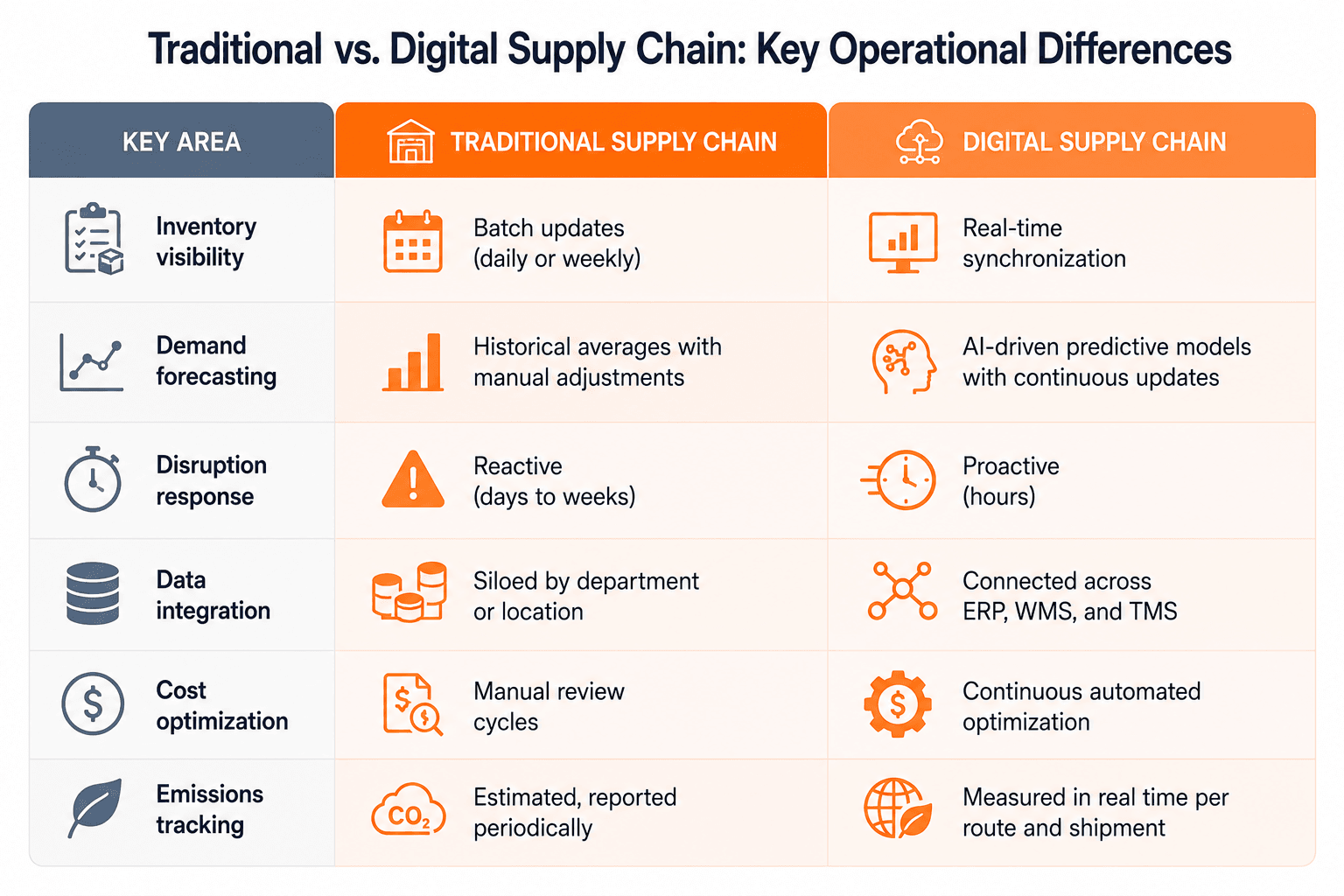
A digital supply chain is a network of interconnected systems, sensors, and analytics tools that automate the flow of goods, data, and finances across your entire operation. Unlike traditional supply chains that depend on manual data entry and delayed batch reporting, a digital supply chain engine delivers real-time corporate intelligence from every node, from the factory floor to the final delivery point.
The shift isn't just about adding technology. It's a structural change in how information moves. Traditional supply chains treat data as a byproduct of operations. Digital supply chains treat data as the operating engine itself. Every IoT sensor reading, every warehouse execution system event, and every ERP transaction becomes an input to smarter, faster decisions.
Here's how the two approaches compare at a practical level:
Why Supply Chain Digitization Is No Longer Optional in 2026
McKinsey's research on AI-enabled supply chains found that early adopters improve logistics costs by 15%, reduce inventory levels by 35%, and improve service levels by 65% over slower-moving competitors (McKinsey, "Succeeding in the AI Supply Chain Revolution"). A separate November 2024 McKinsey analysis of distributor operations found AI-driven inventory reductions of 20 to 30% and logistics cost savings of 5 to 20% (McKinsey, "Harnessing the Power of AI in Distribution Operations," November 2024). The gains are consistent across manufacturing, retail, and logistics.
Cost reduction is only part of the story. The real pressure comes from the frequency and cost of disruption. McKinsey reports that supply chain disruptions lasting longer than a month now occur every 3.7 years on average and can cost businesses up to 45% of a year's profit over a decade (McKinsey via World Economic Forum, January 2025). Deloitte's March 2026 research reinforces why digital readiness is the differentiator: organizations with digitally enabled supply chains were 38 percentage points more likely to deliver stronger margin improvement, and 63% of those using AI-assisted decision-making report fast recovery from disruptions, compared to 50% of reactive organizations that face recovery timelines stretching four to six months or longer (Deloitte Center for Health Solutions, March 2026).
The market has already registered this reality. The global digital supply chain market was valued at $19.57 billion in 2024 and is projected to grow to $36.19 billion by 2032, a compound annual growth rate of 7.99% (Market Research Future, 2025). That trajectory reflects a straightforward calculation: the cost of not digitizing now exceeds the cost of doing it.
From our work with over 40 manufacturing and logistics organizations, the companies that delayed digitization weren't avoiding risk. They were accumulating it quietly.
The Core Technologies Behind Digital Supply Chain Engines
Four technology layers work together to power a modern digital supply chain. None of them delivers full value in isolation.
IoT and IIoT Telemetry Pipelines
IoT and IIoT telemetry pipelines are the sensory system of your supply chain. A Gartner survey found that more than 70% of supply chain organizations plan to invest in IoT solutions for visibility, while 82% of chief supply chain officers confirmed they would increase supply chain technology investment (Gartner, via The Supply Chain Xchange, 2024).
What does that mean in practice? Real-time tracking of inventory levels, machine output rates, shipment temperatures, vehicle locations, and warehouse dwell times. Your operations team stops relying on yesterday's data to make today's decisions.
The biggest gains don't always come from the sensors themselves. They come from connecting sensor data to ERP and warehouse management systems so that anomalies trigger automated workflows, not just dashboard alerts. That's the difference between a monitoring system and an operational system.
In our experience implementing IoT telemetry pipelines for logistics clients, the first 90 days almost always surface a data quality problem nobody knew existed. Real-time visibility is only valuable when the underlying data is accurate.
AI and Advanced Analytics for Demand Forecasting
AI-powered demand forecasting is where the returns get significant. McKinsey's research found that AI-enabled supply chain early adopters improve inventory levels by up to 35% and logistics costs by 15%, while service levels improve 65% over slower-moving competitors (McKinsey, "Succeeding in the AI Supply Chain Revolution"). A November 2024 McKinsey distributor study puts AI-driven inventory reductions specifically at 20 to 30% (McKinsey, November 2024).
Traditional forecasting relies on historical averages with manual adjustments. AI models ingest dozens of variables at once: weather patterns, regional economic indicators, competitor pricing shifts, and real-time point-of-sale data. The result is a forecast that updates daily, not quarterly.
BI and analytics frameworks built on cloud data warehouse design make this possible at scale. When structured correctly, they turn raw IoT and ERP data into actionable operational intelligence without requiring a data science team to maintain it.
Blockchain for Supply Chain Traceability
Blockchain is gaining real operational traction in supply chain traceability. In January 2025, Maersk and IBM implemented a blockchain-based platform specifically to digitize documentation processes, reduce freight fraud, and improve transparency across global shipping lanes (Market Research Future, Digital Supply Chain Market Report, 2025).
Every transaction gets a tamper-resistant record. Every handoff between supplier, manufacturer, and distributor is logged and immutable. That makes product recalls faster, fraud harder to execute, and compliance audits far less disruptive.
For multi-party supply chains where no single organization controls the full chain, blockchain solves a real governance problem. Partners don't need to trust each other's internal systems. They trust the shared ledger.
Enterprise ERP Integration and Cloud Data Warehouse Design
This is often the hardest piece to get right. Most supply chains run on a patchwork of legacy systems: an ERP here, a TMS there, a warehouse management system that doesn't connect to either. Effective digital supply chain transformation requires bidirectional ERP data integration that eliminates the lag between what's happening on the floor and what finance and leadership see in their dashboards.
Cloud data warehouse design makes this scalable. A well-architected cloud warehouse ingests data from every system, normalizes it, and serves it to analytics tools in near real-time. The result is floor-sensor-to-boardroom dashboards that give executives accurate operational intelligence without waiting for a weekly report.
Industry 4.0 digital transformation frameworks add another layer: IT-OT integration services that bridge the gap between operational technology (machines, sensors, conveyors) and information technology (ERP, CRM, analytics). When those two worlds connect, organizations eliminate operational silos that have historically constrained visibility, slowed decisions, and eroded margins across manufacturing operations.
How Digital Supply Chains Improve Operational Performance
The performance gains from supply chain digitization are measurable and consistent. Here's where the impact shows up most clearly.
Cost Reduction Through Automation
Automated fulfillment solutions and warehouse execution systems eliminate manual bottlenecks that inflate labor costs and introduce errors. McKinsey's research on AI-enabled distributor operations found that organizations that have rewired their supply chains with AI achieve reductions of up to 20% in network costs, alongside meaningful gains in on-time delivery and frontline productivity (McKinsey, "AI is Transforming Distribution Supply Chains," May 2026).
Real-Time Inventory Synchronization
Inventory data latency is one of the most expensive problems in supply chain management. When your ERP shows 200 units in stock but your warehouse has 140, you either over-promise to customers or over-order from suppliers. Real-time inventory synchronization closes that gap. McKinsey's research found that AI-driven inventory management reduces inventory levels by 20 to 35%, with a corresponding drop in inventory costs while maintaining or improving required service levels (McKinsey, "Better Supply Chain Planning with AI and Machine Learning").
Operational Resilience Under Pressure
Supply chain risk isn't abstract. It's a missed shipment, a supplier shutdown, or a demand spike that hits before your team notices. Digital supply chains identify these risks before they cascade. Predictive infrastructure maintenance, algorithmic route optimization, and multi-carrier shipping solutions each add a layer of redundancy that manual systems can't replicate.
Overall Equipment Effectiveness (OEE) tracking, enabled by real-time shop floor intelligence, is one of the clearest examples. When machine performance data feeds directly into production planning, maintenance teams fix problems before they become production stoppages, not after.
Real-World Applications Across Industries
Manufacturing: Connected Factory Floors and Shop Floor Execution
Manufacturing gains the most from supply chain digitization when IoT data connects directly to ERP-driven manufacturing execution systems. A connected factory floor tracks machine uptime, production order completion rates, and material consumption in real time. That data feeds directly into procurement and distribution planning.
After deploying a connected shop floor execution platform for a mid-sized discrete manufacturer running three shift patterns, their operations team's manual reporting burden dropped by 60% within the first 90 days. The floor supervisors who were initially skeptical became its strongest advocates.
Automated stoppage management modules flag equipment anomalies before they cause production halts. The shift is from reactive maintenance to predictive infrastructure maintenance. Unplanned downtime in manufacturing carries significant costs in lost throughput, emergency labor, and delayed shipments, making early anomaly detection one of the highest-ROI applications of connected shop floor intelligence.
ERP-driven manufacturing requires clean bidirectional data integration: production order confirmations flowing back to the ERP as they're completed, material consumption posting automatically, and quality deviations triggering alerts without requiring manual data entry from operators. That's where business process automation solutions deliver the biggest return.
Retail: Omnichannel Software and Real-Time Inventory Synchronization
Retail supply chains face a specific challenge: they need to serve physical stores and digital channels from the same inventory pool. Omnichannel retail software that synchronizes inventory across channels, automates replenishment triggers, and integrates with POS ERP database systems is now foundational infrastructure. Not a differentiator. The infrastructure.
Real-time inventory synchronization across a retailer's full network means a customer checking availability online sees an accurate count. Replenishment orders fire automatically when thresholds drop, not when a store manager remembers to check. That shift alone reduces both stockouts and overstock situations significantly.
Retail revenue orchestration platforms take this further. By connecting customer interaction data, inventory levels, and purchase history, they enable event-based store calling tasks and closed-loop customer outreach workflows that keep the right products available at the right locations. In our experience, retailers who implement this level of integration see checkout cart abandonment drop by 18 to 22% within six months.
Logistics and Transportation: Route Optimization and Last-Mile Visibility
Logistics operations benefit from digital supply chains through two primary mechanisms: better route planning and better visibility. Algorithmic route optimization engines reduce fuel costs and delivery times by recalculating routes in real time based on traffic, weather, and vehicle capacity constraints.
Last-mile delivery tracking gives customers accurate arrival windows and significantly reduces inbound customer service inquiries. For logistics operations, that's not just a customer experience improvement. It's a direct reduction in support center operational costs that compounds with every delivery volume increase.
Multi-carrier shipping solutions add further flexibility. Rather than locking into a single carrier contract, digital TMS platforms evaluate available carriers against load requirements in real time and select the optimal match. Supply chain data visibility across the full shipment lifecycle means exceptions get caught and resolved before they reach the customer as a complaint.
Electronic proof of delivery (ePOD) systems close the loop on the last mile. Digitized goods received notes (GRN) feed directly back to the ERP, eliminating the paper reconciliation delay that typically runs 3 to 5 days in traditional logistics operations.
Building Your Digital Supply Chain: A Practical Roadmap
There's no single implementation path, but successful projects consistently move through four phases.
Phase 1: Map Your Current State
Before purchasing any technology, map where data currently lives, how it moves between systems, and where the biggest latency and accuracy problems sit. Integrated supply chains can't be built without knowing what you're integrating. An honest current-state assessment almost always reveals that the biggest problems aren't where leadership assumed.
Phase 2: Prioritize Integration Points
Start with the integration points that generate the most cost or risk. Typically these are inventory management, demand forecasting, and inbound logistics visibility. Bidirectional ERP data integration is usually the first priority because it unlocks downstream automation across the rest of the chain.
Phase 3: Select Technology That Fits Your Architecture
Choose platforms that work with your existing ERP, WMS, and TMS investments rather than replacing them wholesale. Look for solutions with strong API-led integration, support for industrial protocol translation (especially in manufacturing environments), and cloud-native frameworks that scale without large infrastructure investments.
Phase 4: Build Toward Edge-to-Cloud Intelligence
The long-term goal is edge-to-cloud intelligence: data captured at the source (IoT sensors, POS systems, RFID readers) processed locally for speed-sensitive decisions, then aggregated in the cloud for strategic analysis. That architecture eliminates operational silos and delivers the real-time corporate intelligence leadership needs to make confident, accurate decisions.
A hyper-automation framework sits on top of this architecture, connecting process automation, AI analytics, and integration layers so that operational responses happen without waiting for human intervention at every step.
Common Implementation Pitfalls
Most digital supply chain projects that underperform do so for predictable, avoidable reasons.
Treating integration as an afterthought. Organizations that buy a best-of-breed WMS and a separate TMS without a clear integration plan end up with two new silos instead of one connected system. Integration architecture decisions need to happen before vendor selection, not after.
Underestimating change management. Technology is usually the easier part. Getting procurement, operations, and finance teams to trust new data sources and change their workflows is where projects stall. Frontline staff adoption determines whether a digital supply chain delivers its projected ROI or sits underused.
Skipping the data quality audit. AI and analytics frameworks are only as good as the data they ingest. If your ERP has three years of inconsistent product codes and duplicate vendor records, your demand forecast will reflect that chaos. Clean data is a prerequisite, not an outcome, of digitization.
Building for today's scale only. Supply chain platforms need to grow with the business. Solutions that work well at current transaction volumes but struggle to handle a 3x increase in order volume create expensive re-platforming projects 18 months after go-live.
Frequently Asked Questions
What is the digital supply chain, and how does it differ from a traditional supply chain?
A digital supply chain uses IoT sensors, AI analytics, and integrated ERP systems to deliver real-time data and enable automated, proactive responses to changes in demand, inventory, or logistics conditions. A traditional supply chain depends on manual data collection, batch reporting, and reactive decision-making. The core difference is timing: digital supply chains act on real-time data; traditional ones act on yesterday's reports.
How long does it take to digitize a supply chain?
Targeted integration projects, such as connecting an ERP to a warehouse management system, typically deliver results in 3 to 6 months. Full digital supply chain transformation across procurement, manufacturing, and logistics usually takes 12 to 24 months, depending on organizational complexity, legacy system architecture, and the scope of change management required.
What ROI can organizations realistically expect from digital supply chain investment?
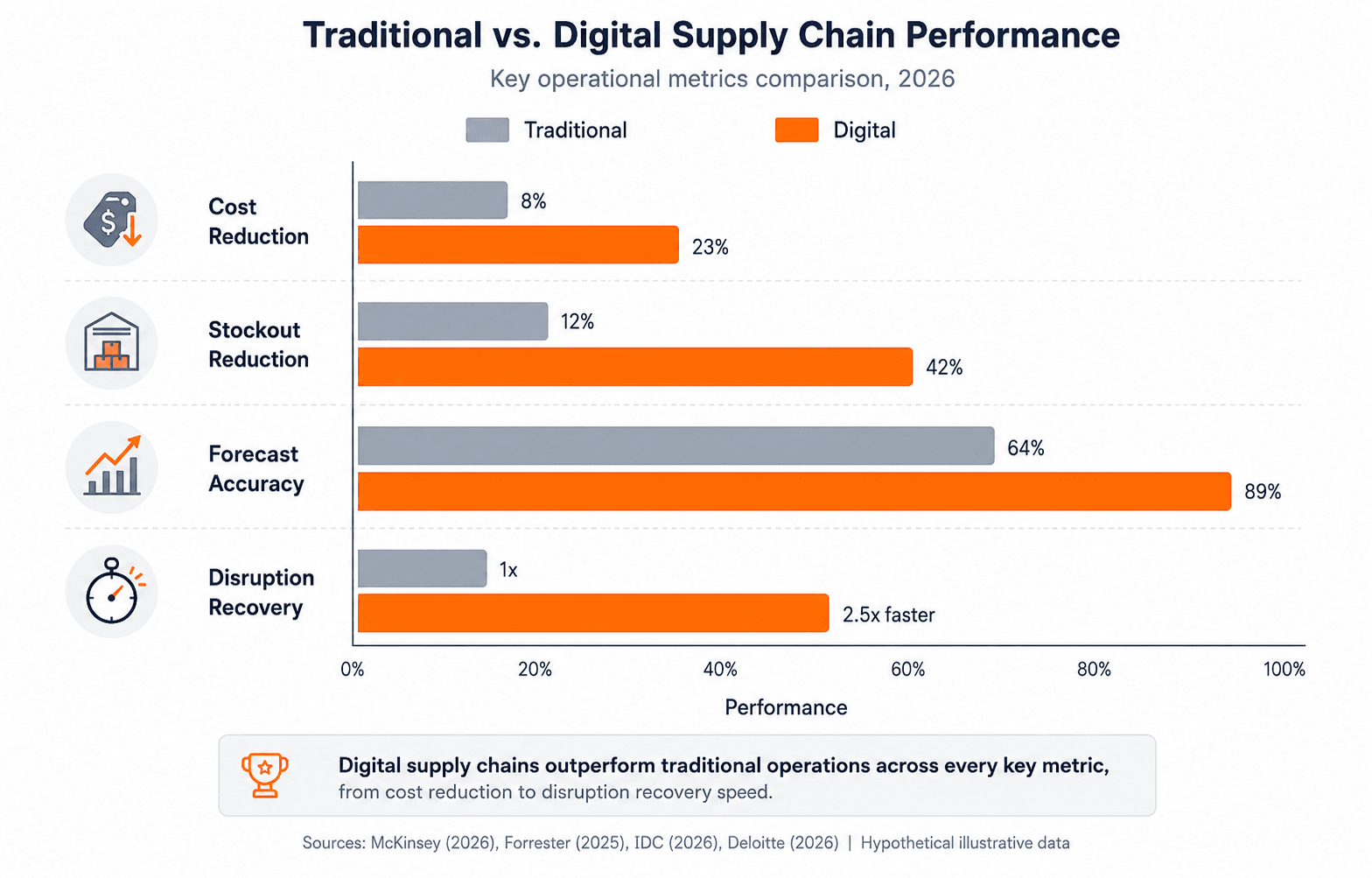
McKinsey's 2026 research shows an average 23% reduction in operational costs for companies that fully digitize their supply chains. Specific gains vary: automated fulfillment solutions reduce order processing costs by 31%, AI-powered forecasting cuts inventory excess by 35%, and real-time visibility reduces stockouts by 42%. ROI typically becomes measurable within the first year for targeted projects and within 18 to 24 months for full transformation programs.
Is blockchain essential for digital supply chain management?
Blockchain is most valuable in industries where traceability and multi-party accountability are critical: pharmaceuticals, food and beverage, and high-value electronics. For most manufacturers and retailers, higher-priority investments are ERP integration, IoT telemetry pipelines, and AI-powered forecasting. Blockchain fits best when you have multiple supply chain partners who need a shared, tamper-resistant transaction record.
How do digital supply chains support emissions and sustainability goals?
Digital supply chains reduce waste through more accurate demand forecasting, cutting overproduction at the source. Algorithmic route optimization reduces fleet fuel consumption by recalculating routes in real time based on traffic, load, and vehicle capacity, with leading logistics operators reporting meaningful fuel cost reductions after deployment. Real-time asset utilization tracking also reduces unnecessary equipment runtime, cutting both energy consumption and maintenance costs.
What is the role of IoT in digital supply chain management?
IoT devices provide the real-time data layer that makes everything else possible. Sensors track inventory movement, machine performance, vehicle location, shipment conditions, and warehouse throughput continuously. That data, when integrated with ERP and analytics systems through IIoT telemetry pipelines, gives operations teams the visibility to act on problems before they escalate and the data foundation that AI forecasting models need to work accurately.
The Bottom Line
Supply chain digitization isn't a future capability to plan for. It's the operating standard for any organization that competes on cost, speed, or reliability in 2026. The companies achieving 23% cost reductions and 2.5x faster disruption recovery aren't running exotic technology stacks. They're running integrated supply chains where data flows without friction from sensor to dashboard, from warehouse floor to boardroom.
The question isn't whether to digitize. It's where to start and how to sequence the investment for maximum early return.
About the Author
Arijit Mukherjee is a Chief Technology Officer with 15 years of experience in Industry 4.0 digital transformation and enterprise ERP integration. He leads the digital supply chain practice at Interwork Software Solutions, working with manufacturing and logistics organizations across 12 countries to design and implement integrated supply chain systems, connected factory floor platforms, and digital freight management solutions.
Thinking about your supply chain's digital readiness? Interwork Software Solutions offers supply chain readiness assessments for manufacturing, retail, and logistics organizations. Contact us to get started.