
Blog
Digital Twin Technology in Manufacturing: How IT Leaders Use Simulation to Optimize Production and Justify Capital Investment
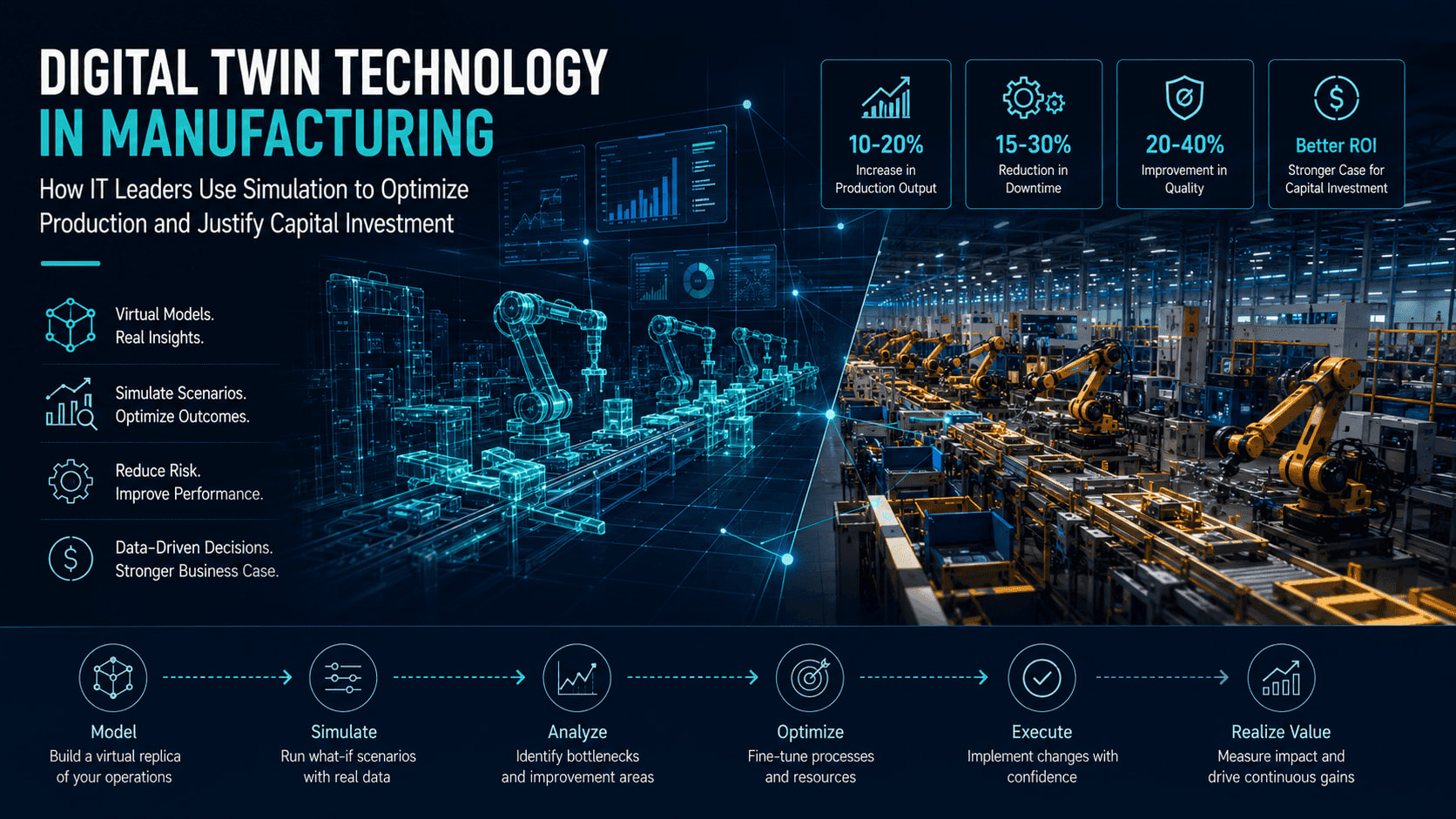
By Vishnu Panda, Chief Executive Officer, Interwork Software Solution Pvt. Ltd. | Updated October 2025
The digital twin manufacturing market grew from $3.6 billion in 2024 and is projected to reach $42.6 billion by 2034, a 28.1% compound annual growth rate (market.us, 2026). That growth is not driven by manufacturers chasing a technology trend. It is driven by two problems that IoT sensor monitoring alone cannot solve.
The first is capital investment risk. When a Plant Head or CTO proposes adding a new production line, reconfiguring an existing layout, or introducing a new process step, the traditional approach is to model it in a spreadsheet, present to the board, and hope the physical implementation behaves the way the model predicted. It rarely does exactly. Digital twin manufacturing lets manufacturers run that experiment virtually, with real production data feeding the simulation, before a single piece of equipment moves.
The second is the OEE gap that basic monitoring identifies but cannot close. Real-time sensor data tells a Plant Head that a machine stopped. A digital twin tells them why, how the stoppage relates to upstream process conditions several steps back in the production flow, and what parameter change would reduce the probability of recurrence. That is not monitoring. That is simulation-driven operational intelligence, and it is the next layer of Industry 4.0 digital transformation for manufacturers who have already invested in IoT and IIoT telemetry pipelines.
Key Takeaways
- The digital twin manufacturing market is growing from $3.6 billion in 2024 to $42.6 billion by 2034 at a 28.1% CAGR (market.us).
- McKinsey research documents digital twin programs cutting development time by up to 50%, reducing transportation and labor costs by up to 10%, and increasing revenue by as much as 10% for organizations building customer-facing digital twins (McKinsey).
- Asset-level digital twins deliver 200 to 500% ROI in the first year from downtime avoidance alone; process-level twins connected to MES data deliver 10 to 15% throughput increases worth $500,000 to $2 million annually for a mid-size plant (AppIT Software, 2026).
- NIST's Economics of Digital Twins research puts the total potential impact of digital twin adoption in U.S. manufacturing at $37.9 billion, against a documented $193.6 billion in combined maintenance costs and operational losses across the discrete manufacturing sector it examined (NIST).
- Digital twin manufacturing is most effective when sequenced by type: asset twins first for the fastest, most contained ROI, then process twins, then plant-level twins for capital investment simulation.
What Is the Difference Between Digital Twin Monitoring and IoT Sensor Monitoring in Manufacturing?
Digital twins and IoT sensor monitoring are related but not interchangeable. Understanding the distinction determines whether a manufacturer invests in the right architecture for its operational goals.
IoT sensor monitoring answers the question: what is happening right now? It captures machine states, production counts, temperature readings, vibration signatures, and energy consumption in real time, feeds that data through IoT and IIoT telemetry pipelines to ERP and analytics systems, and enables the floor-sensor-to-boardroom dashboards and automated alerting that form the operational visibility foundation of any Industry 4.0 digital transformation program.
Digital twins answer two additional questions that sensor monitoring alone cannot: what is causing this outcome, and what would happen if we changed this parameter? A digital twin is a computational model of a physical asset or process, built on physics-based simulation combined with real sensor data, that can replay historical events to identify root causes, simulate future scenarios to predict outcomes, and run "what-if" analyses that let engineers test production parameter changes, equipment modifications, or layout reconfigurations in the virtual environment before applying them to the connected factory floor.
That simulation capability is what separates digital twin manufacturing from sophisticated monitoring. A sensor network tells a Plant Head that Machine 7 stops at an above-average rate during the third production shift. A digital twin tells them that Machine 7's failure rate correlates with upstream temperature conditions in Process Step 4, that a 2-degree reduction in process temperature in Step 4 would reduce Machine 7 stoppages by an estimated 34%, and that implementing that parameter change would affect output quality in a specific, modeled way that can be reviewed before the change is made live.
The manufacturers who get the most from digital twin programs are the ones who understand that the twin's value is proportional to the quality of the data feeding it. A simulation model trained on manually entered, batch-processed ERP data cannot predict machine behavior with the same accuracy as one trained on continuous, validated, real-time sensor telemetry. The investment in a clean IIoT telemetry pipeline and accurate automated production confirmation is not just good data hygiene. It is the prerequisite for digital twin models reliable enough to use in capital investment decisions.
What Are the Three Types of Manufacturing Digital Twins and What ROI Does Each Deliver?
Manufacturing digital twin programs are most effective when sequenced by type, starting with the type that delivers the fastest ROI and using the data and organizational confidence that generates to build toward the higher-complexity implementations. The three types differ in scope, data requirements, and business impact.

Asset Twins model individual machines or pieces of equipment at the component level. They ingest real-time sensor data (temperature, vibration, pressure, current draw) and map it to physics-based failure models trained on historical component performance. Asset twins deliver the fastest ROI: 200 to 500% in the first year from downtime avoidance alone (AppIT Software). The asset twin is the right starting point for most enterprise manufacturing programs because the data requirements are contained, the ROI is measurable within months, and the organizational confidence built from a documented asset twin win creates the internal support needed to fund the more complex process and plant-level implementations.
Process Twins model entire production lines and the workflow sequences between machines. They map material flow between assets, identify bottleneck machines through utilization analysis, and enable "what-if" scenario testing: what happens to output if Machine 4 is reconfigured, if the production sequence between Steps 3 and 5 is reordered, or if a new machine is inserted at Step 7? Process twins connected to MES data deliver 10 to 15% throughput increases worth $500,000 to $2 million annually for mid-size plants (AppIT Software, 2026).
Plant-Level Twins model the full facility by integrating ERP demand forecasts with shop floor capacity models, adding energy consumption models for cost optimization, and enabling production planning simulation at the enterprise level. This is the twin type most directly tied to OEE optimization and operational yield optimization at the facility level, since it connects line-by-line performance data to enterprise demand planning rather than treating each line as an isolated capacity number. McKinsey documents digital twin programs at this scope cutting development time by up to 50% and reducing transportation and labor costs by up to 10% (McKinsey). The plant-level twin is also where digital twin manufacturing programs deliver their most significant contribution to capital investment decisions.
How Do Digital Twins Connect to ERP Systems for Production Planning?
A digital twin that runs in isolation from the ERP system is an engineering visualization tool, not an operational intelligence platform. The ERP integration between digital twin outputs and ERP production planning workflows is what converts simulation results into schedule changes, procurement decisions, and capacity planning adjustments that affect actual operations.
The integration architecture has two directions. The ERP feeds the twin: production orders, material batch assignments, labor allocations, maintenance schedules, and supply chain commitments from the ERP provide the demand and constraint context that gives simulation results operational relevance. A process twin running "what-if" scenarios on line reconfiguration needs to know what orders are scheduled against that line, what materials are committed to those orders, and what the delivery commitments are for the output. Without that ERP context, the simulation produces technically valid results that are not actionable in the actual production schedule.
The twin feeds the ERP: simulation outputs, optimized production sequences, bottleneck identification recommendations, maintenance scheduling recommendations from asset twins, and energy optimization parameters from plant-level models all need to reach the ERP and MES systems where operational decisions are made. This is not a one-time data export. It is a continuous feedback loop where updated simulation results trigger updated production plans, maintenance schedules, and procurement requests without requiring a human to manually translate twin outputs into ERP transactions.
The integration step that consistently requires the most careful design in digital twin programs is the feedback loop from twin simulation output to ERP production schedule updates. In early implementations, simulation results were presented to production planners as recommendations that they then manually entered into the ERP. The manual step introduced a 4 to 8 hour lag between when the twin generated an optimized schedule and when it reached the production floor, which eliminated most of the benefit of real-time simulation. Building the API-led connection from twin outputs to ERP production order updates directly is what makes simulation results operationally useful rather than academically interesting.
Interwork builds this ERP integration layer through API-led bidirectional connectors engineered for SAP and Oracle core database communication, using the same architecture that connects the Connected Shop Floor Execution Platform to enterprise ERP systems. The same near real-time synchronization framework that posts production order confirmations to the ERP receives simulation-driven scheduling recommendations and applies them to active production orders, closing the loop between virtual model and physical operation.
How Do Digital Twins Support Capital Investment Decisions in Manufacturing?
Capital investment decisions in manufacturing, new equipment, production line additions, facility expansions, and process technology upgrades, carry significant financial risk because the physical outcome often differs from the model used to justify the investment. Digital twin manufacturing reduces that risk by replacing static spreadsheet models with dynamic simulations trained on real operational data.
When a Plant Head proposes a multi-million dollar investment in a new press line to increase capacity, the traditional business case relies on theoretical throughput calculations, vendor-provided cycle time specifications, and capacity assumptions that do not account for the specific characteristics of the existing production environment. A plant-level digital twin runs the same capacity analysis using the actual throughput patterns, bottleneck frequencies, material flow dynamics, and maintenance patterns observed in the facility's real production data. The result is a capacity projection that reflects how the new line will actually perform in the existing environment, not how it would perform in an idealized scenario.
NIST's Economics of Digital Twins research documents combined maintenance costs and operational losses of $193.6 billion for the discrete manufacturing subset it examined, roughly $74.5 billion in direct maintenance activity and $119.1 billion in downtime, defect, and lost-sales losses, against a total potential digital twin adoption benefit of $37.9 billion (NIST). A significant share of that loss is not from equipment failures alone. It is from capital investments that underperform their business cases because the models used to justify them were not grounded in real operational data.
Digital twin-driven capital investment simulation also enables manufacturers to test multiple investment scenarios against the same ERP demand forecast. Should we add capacity on Line 3 or reconfigure Line 5? Should we invest in a new conveyor system or optimize the scheduling algorithm on the existing one? Each scenario runs as a simulation against real production data, with outputs that include projected OEE optimization, throughput, bottleneck movement, and energy consumption changes. The CFO gets a business case grounded in simulation evidence rather than spreadsheet assumptions.
Can an SMB Manufacturer Justify Digital Twin Investment Without Enterprise-Scale Capital?
Digital twin manufacturing is often framed as an enterprise-only capability, reserved for plants with dedicated data science teams and multi-million dollar IT budgets. That framing misreads how the asset twin entry point actually works, and it overlooks how much of the Industry 4.0 digital transformation curve an SMB plant can climb with a single, well-scoped asset twin.
An SMB manufacturer does not need a plant-level twin to get real value from digital twin technology. Starting with an asset twin on the two or three machines responsible for the largest share of unplanned downtime requires a contained sensor deployment, a focused failure signature library, and a connection to the existing ERP or CMMS maintenance workflow rather than a full plant-wide data architecture. Because asset twins deliver 200 to 500% ROI within the first year from downtime avoidance alone, the same economics that make asset twins the right enterprise starting point also make them a realistic first step for an SMB plant with one or two critical production lines.
Cloud-hosted digital twin platforms further reduce the infrastructure barrier, since an SMB manufacturer does not need to build a physical simulation environment or hire dedicated simulation engineers to run an asset twin program. Predictive maintenance gains from a single high-value machine, paired with edge-to-cloud intelligence that feeds sensor data into the model without on-premise servers, can fund the case for expanding into process-level simulation once the first asset twin has produced a documented result. That same edge-to-cloud intelligence pattern is what lets a single-plant SMB capture operational yield optimization gains without the multi-site data infrastructure enterprise programs assume. The sequencing logic that works for enterprise manufacturers, start narrow, prove ROI, expand, applies just as directly to a single-plant SMB operation.
What Data Architecture Does a Manufacturing Digital Twin Require?
Building a reliable manufacturing digital twin requires a data foundation that most enterprise plants are still assembling. The simulation model is only as accurate as the data feeding it, and the data requirements for digital twin accuracy are more demanding than those for basic monitoring or ERP reporting.
The IoT and IIoT telemetry pipelines are the real-time data foundation, and building them well is what separates plants that can support digital twin simulation from plants that only have dashboards. Asset twins need continuous high-frequency sensor telemetry: vibration data updated at 50 to 100 milliseconds for rotating equipment, temperature and pressure at 1 to 10 second intervals for process equipment, and position and cycle completion signals at millisecond resolution for discrete manufacturing equipment. This telemetry needs to be clean, continuous, and low-latency. A digital twin model trained on data with frequent gaps, calibration drift, or batch-processing delays produces simulations that diverge from physical reality over time.
The ERP integration layer provides the business context: production orders, material specifications, maintenance history, labor assignments, and supply chain commitments. Process twins and plant-level twins need this context to run simulations that are operationally relevant rather than purely technical.
Historical data depth determines model accuracy. An asset twin predicting bearing failure on a specific motor type needs historical failure data for that motor class: what sensor signatures preceded failures, at what operating conditions, under what production loads. The more historical failure data the model trains on, the higher the predictive accuracy for future predictive maintenance alerts.
Interwork's Unified Observability Platform for IT and OT Environments provides the operational monitoring layer that sits alongside digital twin programs, giving IT and plant operations teams real-time visibility into both the physical production environment and the health of the data pipelines feeding the twin models. When a sensor drops out, a connectivity interruption creates a data gap, or an ERP integration fails to post new production orders to the twin's demand model, the observability platform flags the issue before the twin's simulation accuracy degrades undetected.
What Does a Manufacturing Digital Twin Implementation Look Like in Practice?
Digital twin implementation for enterprise manufacturing follows a phased approach that builds capability and organizational confidence incrementally rather than attempting to deploy all three twin types simultaneously.
Phase 1: Asset twin on the highest-downtime equipment (60 to 90 days). Identify the 3 to 5 machines responsible for the highest share of unplanned downtime. Instrument them with the sensor types their failure modes require: vibration for rotating equipment, temperature and pressure for hydraulics, current monitoring for drives and motors. Establish the baseline failure signature library. Connect asset twin outputs to the ERP maintenance system so twin-generated maintenance recommendations automatically create work orders. Measure unplanned downtime frequency and duration against the pre-implementation baseline at 30-day intervals.
Phase 2: Process twin on the primary production line (90 to 150 days). Map material flow between the assets instrumented in Phase 1. Connect MES production order data to the process model. Identify bottleneck machines through utilization analysis and run "what-if" simulations on production sequence optimizations. Connect simulation-generated scheduling recommendations to ERP production planning through API-led integration. Measure throughput improvement against baseline.
Phase 3: Plant-level twin connected to ERP demand forecasting (180 to 360 days). Integrate ERP demand forecasts with the shop floor capacity model built from Phase 2. Add energy consumption models using meter reading data from the Connected Shop Floor Execution Platform. Enable capital investment scenario modeling. Measure total cost reduction and production plan accuracy against baseline.
This sequencing produces standalone ROI at each phase and generates the data foundation that makes each subsequent phase more accurate. Asset twin data improves process twin accuracy. Process twin utilization patterns improve plant-level capacity models. Plant-level models informed by real utilization data produce capital investment projections that are significantly more reliable than static spreadsheet analyses.
The most common cause of digital twin program abandonment at the enterprise scale is not technology failure. It is the absence of a baseline measurement framework established before implementation. Programs that did not document pre-implementation downtime frequency, OEE by line, production-to-plan accuracy, and maintenance cost by machine class cannot demonstrate what the digital twin improved. Without that evidence, the program cannot secure budget for Phase 2 from a CFO who wants documented ROI before funding the next phase. The baseline measurement plan is as important as the technology architecture.
Common Implementation Pitfalls in Enterprise Digital Twin Programs
Confusing monitoring with simulation. A dashboard showing real-time machine status is monitoring. A computational model that simulates what happens when a production parameter changes is a digital twin. Programs that deploy sensors and dashboards and call the outcome a digital twin do not deliver the scenario analysis and capital investment modeling capabilities that justify digital twin investment.
Underestimating data quality requirements. A digital twin simulation that runs on data with frequent gaps, uncalibrated sensors, or inconsistent product codes in the ERP produces results that diverge from physical reality. Data quality assessment before twin model construction, not after, is what determines whether the simulation is reliable enough to use in production decisions.
Skipping the ERP integration. Digital twins that output recommendations to a separate analytics portal, from which a human manually updates the ERP production schedule, add an intermediary step that defeats the automation benefit. The twin's production optimization recommendations need to flow to the ERP through an automated API integration layer to be operationally effective.
Starting with a plant-level model. The data requirements for a plant-level digital twin are extensive and the implementation timeline is long. Programs that start at the plant level and try to build down to asset-level accuracy almost always run over budget and timeline before delivering measurable ROI. Starting with an asset twin on a specific high-downtime machine produces measurable results in months and builds the organizational case for broader investment.
Frequently Asked Questions
What is a digital twin in manufacturing and how does it differ from IoT monitoring?
IoT monitoring captures real-time sensor data from factory floor equipment and delivers that data to dashboards and ERP systems, answering the question of what is happening now. A digital twin is a computational simulation model trained on that sensor data and historical production records, answering the questions of why an outcome is occurring and what would happen if a specific parameter changed. The simulation capability is what distinguishes digital twin manufacturing from monitoring systems and what enables scenario analysis, production optimization, and capital investment decision support.
What are the three types of manufacturing digital twins and which should a plant implement first?
Asset twins model individual machines or equipment at the component level, delivering 200 to 500% ROI in the first year from downtime avoidance. Process twins model entire production lines and workflow sequences, delivering 10 to 15% throughput improvements. Plant-level twins model the full facility connected to ERP demand forecasts, enabling capital investment scenario modeling. Most enterprise plants should start with asset twins on their highest-downtime equipment, as this delivers the fastest ROI and generates the data foundation that improves process and plant-level model accuracy.
How do digital twins connect to ERP systems in a manufacturing environment?
Digital twin programs require bidirectional ERP integration. The ERP feeds the twin: production orders, material assignments, maintenance schedules, and demand forecasts provide the operational context that makes simulation results actionable. The twin feeds the ERP: simulation-generated maintenance recommendations create work orders automatically, optimized production sequences update production order scheduling, and bottleneck identification recommendations feed into capacity planning. This requires an API-led architecture that handles near real-time data exchange rather than batch file transfers that introduce data latency and defeat simulation accuracy.
What data quality does a manufacturing digital twin require to produce reliable simulations?
Asset twins require continuous, high-frequency, calibrated sensor telemetry from the specific machines being modeled, combined with historical maintenance and failure records for the equipment class. Process twins require clean, consistent MES production data including cycle times, quality outcomes, and material consumption records across multiple shifts. Plant-level twins additionally require accurate ERP production order data, demand forecasts, and energy consumption records. Data gaps, sensor calibration drift, and inconsistent ERP master data all degrade simulation accuracy.
How do digital twins support capital investment decisions in manufacturing?
Plant-level digital twins connected to real ERP demand data and actual production utilization patterns can model the impact of proposed capital investments, new equipment additions, line reconfigurations, and facility expansions, before any physical change is made. The simulation uses actual throughput patterns, bottleneck frequencies, and material flow dynamics rather than theoretical specifications, producing capacity projections that reflect how the new asset will perform in the existing production environment rather than under idealized conditions.
Can a mid-size or SMB manufacturer justify digital twin investment without an enterprise budget?
Yes, by starting with an asset twin on the two or three machines responsible for the largest share of unplanned downtime rather than a plant-wide program. The sensor deployment and data requirements are contained, cloud-hosted platforms remove the need for on-premise simulation infrastructure, and the 200 to 500% first-year ROI documented for asset twins applies at single-plant scale just as it does at multi-site enterprise scale.
What is the typical implementation timeline for a manufacturing digital twin program?
Phase 1 asset twin on highest-downtime equipment typically delivers measurable results within 60 to 90 days of sensor deployment and model training. Phase 2 process twin on the primary production line typically requires 90 to 150 days from Phase 1 completion. Phase 3 plant-level twin connected to ERP demand forecasting typically requires 180 to 360 days from Phase 2 completion. The full three-phase program from initial sensor deployment to plant-level simulation capability typically spans 12 to 18 months at enterprise manufacturing scale.
Simulation Is What Monitoring Can't Do
Every sensor network tells manufacturers what is happening. Digital twin manufacturing tells them what to do about it and what would happen if they did something different. That simulation capability is what justifies the investment for Plant Heads evaluating whether a layout change will improve throughput before equipment moves, for CTOs modeling whether a new production line will perform as the capital investment business case projects, and for CIOs building the floor-sensor-to-boardroom dashboards that make simulation accuracy reliable at enterprise scale.
The digital twin manufacturing market reached $3.6 billion in 2024 on its way to $42.6 billion by 2034. The manufacturers investing in that market are not buying monitoring technology they already have. They are buying the ability to make production decisions and capital investment decisions with modeled confidence rather than operational uncertainty.
Interwork Software Solutions builds digital twin programs, IoT and IIoT telemetry pipelines and ERP-driven manufacturing integration architectures, and connected simulation frameworks for manufacturing and retail organizations across cement, automotive, pharmaceutical, white goods, and FMCG sectors.
Schedule a digital twin architecture assessment with the Interwork manufacturing engineering team
About the Author
Vishnu Panda is the Chief Executive Officer of Interwork Software Solutions, bringing more than 25 years of experience in manufacturing technology and industrial automation. He leads Interwork's practice across Manufacturing Execution Systems, SCADA integration, IIoT telemetry architectures, and ERP-connected shop floor programs for enterprise manufacturing clients across cement, pharmaceutical, automotive, and FMCG sectors. View all articles by Vishnu Panda