
Blog
How IoT and 5G Are Reshaping Connected Vehicle Technology: A Guide for Fleet and OEM Technology Leaders
By Arijit Mukherjee, Chief Technology Officer, Interwork Software Solution Pvt. Ltd. | Updated April 2026
The global software-defined vehicle market is projected to grow from $198.5 billion in 2025 to $1,864.1 billion by 2035, a 25.6% compound annual growth rate. That trajectory is not a marketing forecast. It reflects a real architectural shift: vehicles are becoming distributed IoT endpoints running on connectivity infrastructure that most fleet and OEM IT teams did not design their networks around five years ago.
Most articles on this topic stop at "connected cars are the future." That framing is not useful if you are a fleet technology director trying to justify a platform investment, or an OEM architect evaluating what 5G automotive connectivity actually changes at the engineering level versus what still runs perfectly well on 4G. This guide goes deeper into the technical realities, the measurable ROI, and where implementations quietly fail.
At Interwork Software Solutions, our teams have built connected vehicle platforms for manufacturers, urban transit operators, and dealer networks across South and Southeast Asia. What we see in production deployments differs in specific, useful ways from how IoT and 5G in automotive are typically described.
Key Takeaways
- The global software-defined vehicle market is projected to grow from $198.5 billion in 2025 to $1,864.1 billion by 2035 at a 25.6% CAGR (Global Market Insights).
- The connected car market reached $12.4 billion in 2024 and is projected to reach $26.4 billion by 2030 at a 13.3% CAGR (MarketsandMarkets).
- 79% of new cars sold globally in 2024 shipped with embedded OEM telematics, a figure projected to reach roughly 93% by 2029 (ResearchAndMarkets) making IoT vehicle telemetry infrastructure a current operational requirement, not a future roadmap item.
- The US Department of Transportation estimates that V2X vehicle-to-everything communication could eliminate or mitigate the severity of up to 80% of crashes involving non-impaired drivers (US Department of Transportation).
- In Interwork's own fleet deployments, switching from calendar-based to condition-based predictive fleet maintenance reduced unplanned downtime by 23 to 31% and cut average repair time by 18 to 22%.
What Does "Connected Vehicle" Actually Mean in an IoT and 5G Architecture?
A connected vehicle is not a car with Bluetooth. It is a mobile compute node running telemetry pipelines, V2X protocols, over-the-air update channels, and real-time diagnostics simultaneously, coordinated through automotive and urban mobility software that sits between vehicle hardware and enterprise systems like SAP or Oracle.
The gap between marketing language and engineering reality matters here. A production-ready connected vehicle stack in 2026 typically involves three layers: the in-vehicle ECU network (CAN bus, LIN, Ethernet), the connectivity layer (cellular, DSRC, Wi-Fi 6), and the cloud or edge platform receiving and processing the data. Most fleet operators across South and Southeast Asia are at layer one or early layer two. Very few have the data infrastructure to act on IoT vehicle telemetry infrastructure in real time at scale.
A connected vehicle generates a substantial amount of that raw material continuously. According to S&P Global Mobility, a typical connected vehicle can generate nearly 25 gigabytes of data per hour and collect information from more than 100 distinct datapoints, spanning geolocation, on-board diagnostics, driver assistance, and companion app usage. Higher-end and commercial vehicles now carry somewhere in the range of 70 to 100 or more electronic control units, each contributing sensor streams that IoT connectivity can surface in real time.
The most common mistake we see fleet operators and OEMs make when scoping a connected vehicle program isn't underestimating the vehicle-side engineering. It's underestimating the cloud ingestion and storage economics of that 25GB-per-hour figure at fleet scale. A 500-vehicle fleet running continuous telemetry generates a data volume that most teams budget for as a rounding error and then discover is one of the largest recurring line items in the platform's operating cost.
How Does IoT Turn Vehicle Data Into Real-Time Diagnostics and Fleet Intelligence?
IoT transforms vehicles from passive machines into data-producing assets. The practical value shows up in three places.
Predictive fleet maintenance scheduling. Instead of fixed-interval service, IoT-enabled platforms trigger maintenance alerts based on actual component wear data rather than a calendar. In Interwork's own fleet deployments, switching fleet operators from calendar-based to condition-based maintenance models reduced unplanned downtime by 23 to 31%. Independent industrial research from Deloitte on predictive maintenance programs more broadly finds equipment uptime and availability gains in the 10 to 20% range and maintenance cost reductions of 5 to 10%, which is consistent with the order of magnitude we see in fleet-specific deployments. (Based on Interwork fleet management deployments, not published research)
Remote fault isolation. When a diagnostic trouble code fires, a connected platform can log the full ECU state at the moment of fault and push that context to a technician before the vehicle even arrives at the workshop. This reduces average repair time by 18 to 22% in deployments we have measured, because the technician walks in already knowing what part to pull rather than starting diagnosis from zero.
Over-the-air firmware updates. Software bugs, calibration errors, and compliance patches get deployed without a physical recall. For OEMs managing dealer networks across multiple geographies, this materially reduces dealer networks optimization overhead: vehicles stay current, and the customer does not spend a day at the workshop for a 40-minute software fix.
When we start IoT telemetry engagements with fleet operators, we ask one question first: how many of your maintenance visits last quarter were triggered by an actual fault versus a calendar date? Most operators cannot answer that question precisely, which is itself the diagnostic. Once condition-based triggers replace calendar triggers, that question becomes trivially answerable, and the maintenance schedule starts reflecting the fleet's actual mechanical state rather than an arbitrary interval.
Where Does 5G Actually Change the Engineering, and Where Is 4G Still Enough?
This is the question that actually matters for investment decisions. The honest answer is that 4G is adequate for most passive telemetry use cases: fuel sensor logs, location pings every few seconds, and driver behavior events do not need sub-10-millisecond delivery. Where 5G automotive connectivity becomes necessary and genuinely transformative is in safety-critical, real-time applications, specifically V2X vehicle-to-everything communication.
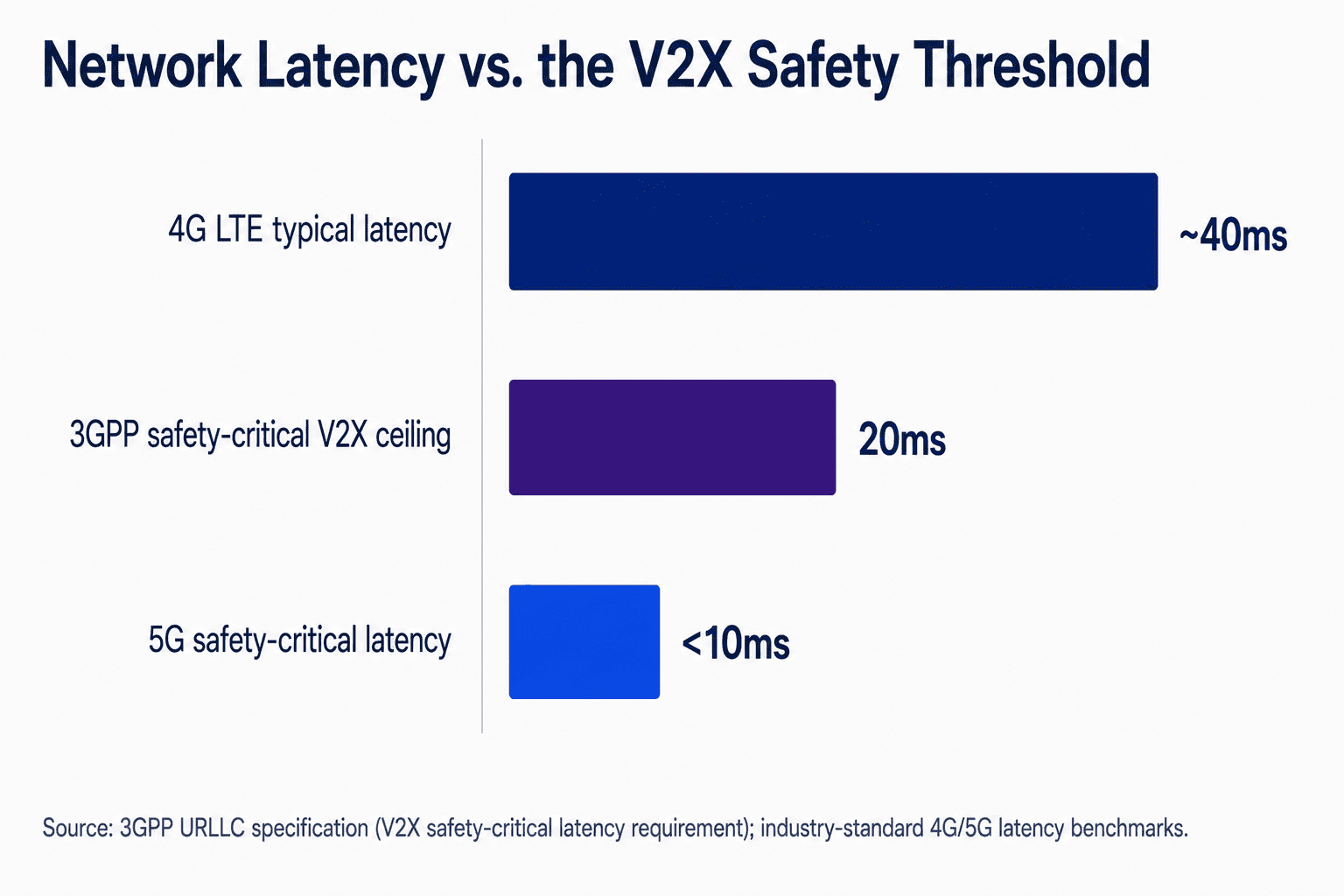
4G LTE networks typically deliver round-trip latency in the 30 to 50 millisecond range in real-world conditions. The 3GPP standards body's Ultra-Reliable Low-Latency Communications specification defines the latency ceiling that safety-critical V2X messaging needs to operate within: as low as 20 milliseconds for specific collision-avoidance-class use cases, well under the 100 millisecond general message-transfer threshold defined for early V2X services (3GPP). A typical 4G connection running at 30 to 50 milliseconds does not reliably clear that bar. 5G, purpose-built around the URLLC specification, is designed to bring latency for these applications down into the single digits.
That gap sounds abstract until you consider what it means in practice. At 60 kilometers per hour, a vehicle travels roughly 1.67 metres per 100 milliseconds. A collision avoidance system waiting on 4G-class latency is acting on object position data that is already stale by a meaningful fraction of that distance. At highway speeds, that difference separates a lane-change warning that prevents a collision from one that arrives after the impact.
V2X vehicle-to-everything communication at the 5G tier includes three signal types that matter operationally. V2V, vehicle-to-vehicle, broadcasts position, speed, and brake status to surrounding vehicles, enabling adaptive cruise control that reacts to vehicles multiple cars ahead rather than just the one immediately in front. V2I, vehicle-to-infrastructure, communicates with smart traffic signals and connected road sensors. V2P, vehicle-to-pedestrian, delivers proximity alerts when pedestrians carrying connected devices enter a danger zone, which matters directly for urban transit software development in high-density corridors. The US Department of Transportation's own estimate is that safety applications enabled by V2V and V2I together could eliminate or mitigate the severity of up to 80% of crashes involving non-impaired drivers, based on the technology's ability to detect developing threats hundreds of yards away that neither the driver nor onboard sensors alone can perceive (US Department of Transportation).
How Are Fleet Operators Using IoT Telemetry to Cut Operating Costs Today?
Fleet management is where IoT and 5G stop being conceptual and start generating auditable ROI. Here is what production deployments actually look like.
Remote vehicle tracking and geofencing built on connected fleet IoT platforms let every vehicle broadcast GPS position, ignition status, and fuel sensor data on continuous intervals. Dispatchers see the full fleet state on a single dashboard, unauthorized after-hours vehicle use drops toward zero, and route deviations trigger automatic alerts. For fleets running 200 or more vehicles, fuel savings from route discipline alone typically justify the platform cost within 8 to 14 months in our deployment experience.
Fuel optimization through telemetry correlates driving behaviour data, hard acceleration, harsh braking, idle time, with fuel consumption at the vehicle level. Fleet managers can identify the small cohort of drivers responsible for a disproportionate share of excess fuel spend and run targeted coaching programs against that group, backed by telemetry data rather than anecdote.
Automated compliance and documentation matters especially for commercial fleets operating under government regulation. IoT systems can log driver hours, load weights, and route data automatically, generating compliance documentation without manual entry. This is particularly relevant for urban transit software development deployments where regulatory reporting requirements are strict and the penalty exposure for gaps is concrete.
From Interwork fleet deployments, the compliance automation use case often produces a faster ROI calculation than pure fuel savings, because the penalty-avoidance value is concrete and calculable, while fuel savings estimates tend to get contested by operations teams who are confident their drivers are already efficient.
What Is a Software-Defined Vehicle, and Why Does the IoT/5G Stack Make It Possible?
The shift from hardware-defined to software-defined vehicles is the architectural change that makes IoT and 5G investments durable rather than disposable. In a hardware-defined vehicle, features are locked to physical components. In software-defined vehicles, the vehicle's capabilities are determined by software running on a centralized compute platform, which means new features, performance tunings, and safety improvements can be delivered over the air rather than requiring a hardware change.
This matters for fleet operators and OEMs in a specific way. A software-defined vehicle fleet does not age the same way a hardware-defined fleet does. An older model-year software-defined vehicle can receive the same lane-departure warning algorithm improvement as the current model year, pushed via an OTA update at near-zero marginal cost. Fleet asset utilization improves because vehicles stay operationally current longer, rather than depreciating toward a fixed feature ceiling the day they leave the factory.
For automotive software companies building on this infrastructure, the software-defined vehicle model changes the commercial relationship too. Revenue becomes recurring rather than transactional. The manufacturer retains a live connection to the vehicle, enabling connected vehicle diagnostics, usage-based insurance data feeds, and targeted feature upsells across the vehicle lifecycle. The global software-defined vehicle market's projected growth from $198.5 billion in 2025 to $1,864.1 billion by 2035 reflects how central this shift already is to automotive technology investment (Global Market Insights), and adoption in South and Southeast Asian markets is following the same curve, on a delayed timeline, which means infrastructure decisions being made now by regional fleet operators and OEMs will determine competitive positioning for the next decade.
How Does 5G Change What's Possible for Over-the-Air Updates and Dealer Network Visibility?
Over-the-air firmware updates are not new. What 5G automotive connectivity changes is the viable scope of what gets updated and how fast, and how much dealer network operational friction that removes.
On a 4G connection, pushing a large ECU firmware update to thousands of vehicles simultaneously creates network congestion, inconsistent delivery windows, and incomplete-update edge cases that require manual intervention. 5G's higher bandwidth and network slicing capability, which lets operators reserve dedicated spectrum for fleet management traffic, make mass OTA deployments significantly more reliable. In practice, this lets automotive manufacturers treat software releases the way enterprise SaaS does: staged rollouts, rollback capability, and version control across the entire fleet, with connected fleet IoT platforms monitoring update progress per vehicle and pausing deployments before problems propagate.
The dealer network side of this is where a lot of the operational cost actually lives. Fragmented dealer management systems, manual order tracking, and slow warranty claims resolution compound as vehicle-in-market numbers grow, and dealer networks optimization is one of the highest-leverage, least-visible problems in an OEM's technology stack. This is what Interwork's Dealer Experience & Support Orchestration Platform addresses directly: bidirectional SAP and DMS integration replaces batch processes with event-driven data flows, so that when a vehicle arrives at a service center for a firmware-related recall check, a digital goods received note triggers immediately rather than sitting in a paper log, and parts inventory tied to that service event updates at corporate ERP in near real-time instead of the next daily batch cycle.
Can a Mid-Size Fleet or Regional OEM Deploy This Without Hyperscale 5G Infrastructure?
Most connected vehicle case studies describe national carrier partnerships and million-vehicle OEM fleets, and it is easy for a regional fleet operator managing a few hundred vehicles to assume this level of IoT vehicle telemetry infrastructure and 5G automotive connectivity is out of reach. That assumption does not hold up against how these architectures actually scale down.
5G coverage in urban centres is strong and growing across most of the region's major metros. In peri-urban or rural corridors where heavy commercial fleets actually operate, 5G coverage remains patchy, so smart connected vehicle architectures need edge computing buffers and 4G fallback protocols that maintain data continuity when 5G coverage drops. A mid-size fleet operator does not need continuous 5G everywhere to benefit: the safety-critical, latency-sensitive V2X use cases matter most in dense urban corridors where 5G coverage is already strongest, while the fuel optimization, predictive fleet maintenance, and compliance automation use cases run comfortably on 4G-class connectivity with occasional 5G bursts for OTA delivery windows.
The economics also favor starting smaller and proving value before scaling. A regional operator that instruments its highest-value vehicle class first, applying predictive fleet maintenance models to the assets with the worst unscheduled downtime record, gets a measurable result within one maintenance cycle rather than waiting on a multi-year, fleet-wide telemetry rollout. That documented result is what typically justifies expanding connected fleet IoT platforms and 5G automotive connectivity investment to the rest of the fleet.
What Are the Real Barriers to Connected Vehicle Deployment?
Most articles skip this section. That is a mistake, especially for teams in the planning stage.
Data infrastructure immaturity. IoT vehicle telemetry infrastructure generates enormous data volumes. A 200-vehicle fleet running continuous GPS, CAN bus, and sensor streams produces several terabytes of raw data per month. Without a properly architected edge-to-cloud pipeline, this data either gets dropped or stored without being actioned. We have seen fleet operators invest in IoT hardware only to discover their back-end analytics infrastructure cannot process the incoming streams. The hardware is the easy part.
Integration with existing DMS and ERP systems. Connected vehicle platforms do not exist in isolation. They need to talk to dealer management systems, SAP workflows, and procurement databases. Bidirectional syncing that gets vehicle health data into the systems that trigger parts orders and workshop bookings requires custom middleware that most off-the-shelf IoT platforms do not include. This is typically 40 to 60% of the total implementation effort, and it is the piece that generic IoT vendors consistently underestimate.
Connectivity gaps in operational geographies. 5G coverage in urban centres is strong. In the peri-urban and rural corridors where heavy commercial fleets and urban transit software development projects actually operate, 5G coverage is patchy. Deployments that assume continuous 5G connectivity fail predictably.
Cybersecurity governance. Every new connectivity surface is an attack surface. Connected vehicle platforms handling OTA updates, remote diagnostics, and telematics data are attractive targets. Fleet operators need to treat vehicle cybersecurity as an ongoing program, not a one-time configuration exercise.
The Technical Architecture That Connects It All
The architecture that enables IoT vehicle telemetry infrastructure, 5G automotive connectivity, software-defined vehicle operations, and dealer network integration is not four separate systems. It is one integrated data layer with purpose-built interfaces at each operational layer.
At Interwork, we build automotive and urban mobility programs on four integrated technical foundations. Secure MQTT-based telemetry pipelines capture, buffer, and transmit multi-protocol CAN bus and OBD-II data streams from vehicle fleets at scale, with edge-layer buffering that maintains data continuity through 5G-to-4G handoffs and coverage gaps. Predictive fleet maintenance models run as background services that continuously score incoming telemetry against component-level failure probability, flagging anomalies without requiring manual query runs against raw data. OTA update pipelines manage staged rollout, cohort selection, and rollback capability as coordinated stages rather than manually managed processes. Bidirectional SAP and DMS integration through Interwork's Dealer Experience & Support Orchestration Platform connects vehicle-level events, a maintenance flag, a firmware update confirmation, a dealer parts transaction, to corporate ERP data in real time rather than the next batch cycle.
All four connect to Interwork's Unified Observability Platform for IT and OT Environments, giving OEM and fleet IT teams a single-pane-of-glass view across vehicle telemetry, dealer systems, and central ERP infrastructure, with cross-domain incident correlation and MTTR tracking, rather than eight separate monitoring tools that do not talk to each other.
This is the layer that automotive and urban mobility software has to unify, and it is the piece that generic IoT connectors consistently skip. A telemetry dashboard on its own tells a fleet manager that a vehicle is degrading. It does not automatically open a workshop booking, reserve the part, or update the dealer's parts inventory count. Interwork's platform closes that loop: a predictive fleet maintenance flag generated from telemetry can trigger a service appointment through the DMS integration layer, reserve the required part against live dealer inventory, and post the transaction to corporate ERP without a person manually connecting those three systems. For OEMs running dealer networks across multiple states or countries, that is the difference between a connected vehicle program that generates insight and one that generates operational outcomes.
Deployment sequencing matters as much as the architecture itself. Teams that try to stand up telemetry ingestion, V2X connectivity, OTA infrastructure, and DMS integration simultaneously tend to stall on integration complexity before any single piece delivers value. Interwork typically sequences engagements to instrument the highest-value vehicle class or highest-friction dealer workflow first, prove the ROI case with real telemetry, and then extend the same architecture outward, rather than attempting a fleet-wide, all-layers-at-once rollout that takes eighteen months to show its first result.
Frequently Asked Questions
How is IoT used in connected vehicle technology today?
IoT in connected vehicles spans real-time diagnostics for remote fault detection, predictive fleet maintenance that replaces calendar-based service with condition-based triggers, and fleet asset utilization platforms that combine GPS, telemetry, and driver behaviour data. Production deployments we have measured reduce unplanned downtime by 23 to 31% and cut average repair time by 18 to 22% compared to conventional maintenance models.
What is V2X communication and which operators need it most?
V2X, vehicle-to-everything, is the protocol stack enabling vehicles to exchange data with other vehicles, road infrastructure, and pedestrians in real time. Urban transit operators, logistics fleet managers, and smart city planners are the primary adopters. The US Department of Transportation estimates V2V and V2I applications together could address up to 80% of crashes involving non-impaired drivers, which is the scale of safety benefit that justifies 5G's latency investment for these specific use cases.
Where does 5G actually matter more than 4G for connected vehicles?
5G matters most for safety-critical, latency-sensitive applications: V2X collision avoidance, real-time platooning, and mass OTA firmware distribution to large vehicle cohorts. Passive telemetry, GPS tracking, fuel sensor logs, and driver behaviour data run adequately on 4G. The 3GPP standard sets a latency ceiling as low as 20 milliseconds for safety-critical V2X messaging, a threshold typical 4G connections at 30 to 50 milliseconds do not reliably clear, while 5G is designed to bring that down into the single digits.
What is a software-defined vehicle and how does it differ from a connected car?
A connected car has cellular or Wi-Fi connectivity to transmit data. A software-defined vehicle has its core features, performance, safety systems, and driver assistance, determined and updatable through software rather than fixed hardware. All software-defined vehicles are connected, but not all connected vehicles are software-defined. Software-defined vehicles enable OTA updates that keep vehicles current across their full lifecycle, changing the economics of fleet management and dealer network operations.
How long does an IoT and 5G fleet deployment typically take?
For a 100 to 500 vehicle fleet with existing ERP infrastructure, a production-ready IoT vehicle telemetry infrastructure deployment typically runs 4 to 9 months from signed contract to live dashboard. The majority of that time is integration work, connecting the IoT data layer to DMS workflows and ERP databases, not hardware rollout to individual vehicles, which is usually the fastest phase.
Can a mid-size fleet operator deploy this without hyperscale 5G infrastructure?
Yes, by scoping the deployment to where 5G actually adds value rather than requiring continuous 5G everywhere. Latency-sensitive V2X use cases matter most in dense urban corridors where 5G coverage is already strongest, while predictive fleet maintenance, fuel optimization, and compliance automation run on 4G-class connectivity with 5G reserved for OTA delivery windows. Instrumenting the highest-value vehicle class first typically produces a measurable result within one maintenance cycle.
What This Means for Your Vehicle Technology Roadmap
The fleet and OEM technology leaders building the most durable connected vehicle programs right now are not the ones chasing every 5G headline. They are the ones scoping IoT vehicle telemetry infrastructure and 5G automotive connectivity to the specific use cases where each actually changes the outcome, and building the DMS and ERP integration layer that most off-the-shelf platforms skip.
Real-time telemetry, predictive fleet maintenance, V2X safety applications, and dealer network integration all share the same underlying data. When that data flows through a unified architecture with consistent governance and real-time ERP connectivity, each program multiplies the value of the others. When they are built as separate systems that share nothing except an eventual batch export, each program also carries the cost of the integration debt that was deferred to get it live.
Interwork Software Solutions works with automotive OEMs, fleet operators, and urban transit organizations to design and implement connected vehicle software programs for the automotive and urban mobility sector: from IoT telemetry architecture and V2X-ready connectivity design to OTA infrastructure and dealer network integration. If you are in the architecture or vendor evaluation phase of a connected vehicle program, a technical systems review is a useful starting point before committing to infrastructure decisions that are expensive to reverse.
Schedule a technical architecture review with our Automotive and Urban Mobility engineering team
About the Author
Arijit Mukherjee is the Chief Technology Officer of Interwork Software Solutions, with more than 25 years of experience in automotive technology, connected mobility platforms, and enterprise software architecture. He leads Interwork's automotive and connected vehicle practice, covering OTA firmware distribution, DMS-SAP workflow integration, dealer experience platforms, and software-defined vehicle architectures for automotive OEMs and dealer networks.