Blog
Industry 4.0 for Manufacturing: 5 Enterprise Advantages That Actually Move the P&L
By Vishnu Panda, Chief Executive Officer, Interwork Software Solution Pvt. Ltd. | Updated October 2025
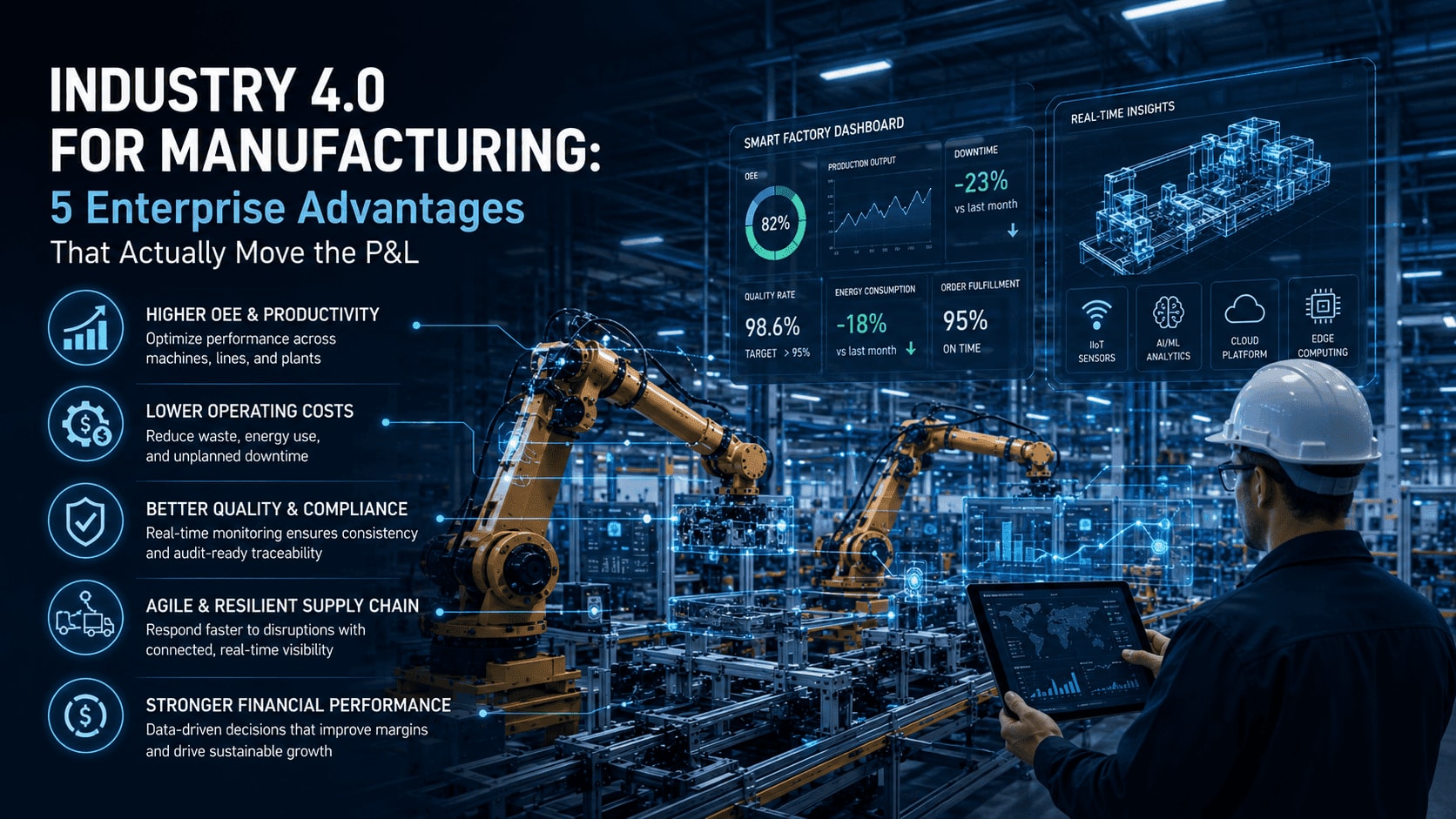
Plant heads and CIOs do not need convincing that Industry 4.0 matters. What they need is a straight answer to a harder question. Which specific gains show up on the P&L, and what does the integration actually look like inside a cement kiln, an automotive line, or a pharmaceutical batch record? That capital is not chasing buzzwords. It is chasing measurable operational yield, and the five advantages below explain exactly where that yield comes from.
Key Takeaways
- The global Industry 4.0 market is on pace to grow at a compound annual rate of roughly 18% between 2026 and 2035, with manufacturing already claiming more than a third of that revenue (Precedence Research, 2026).
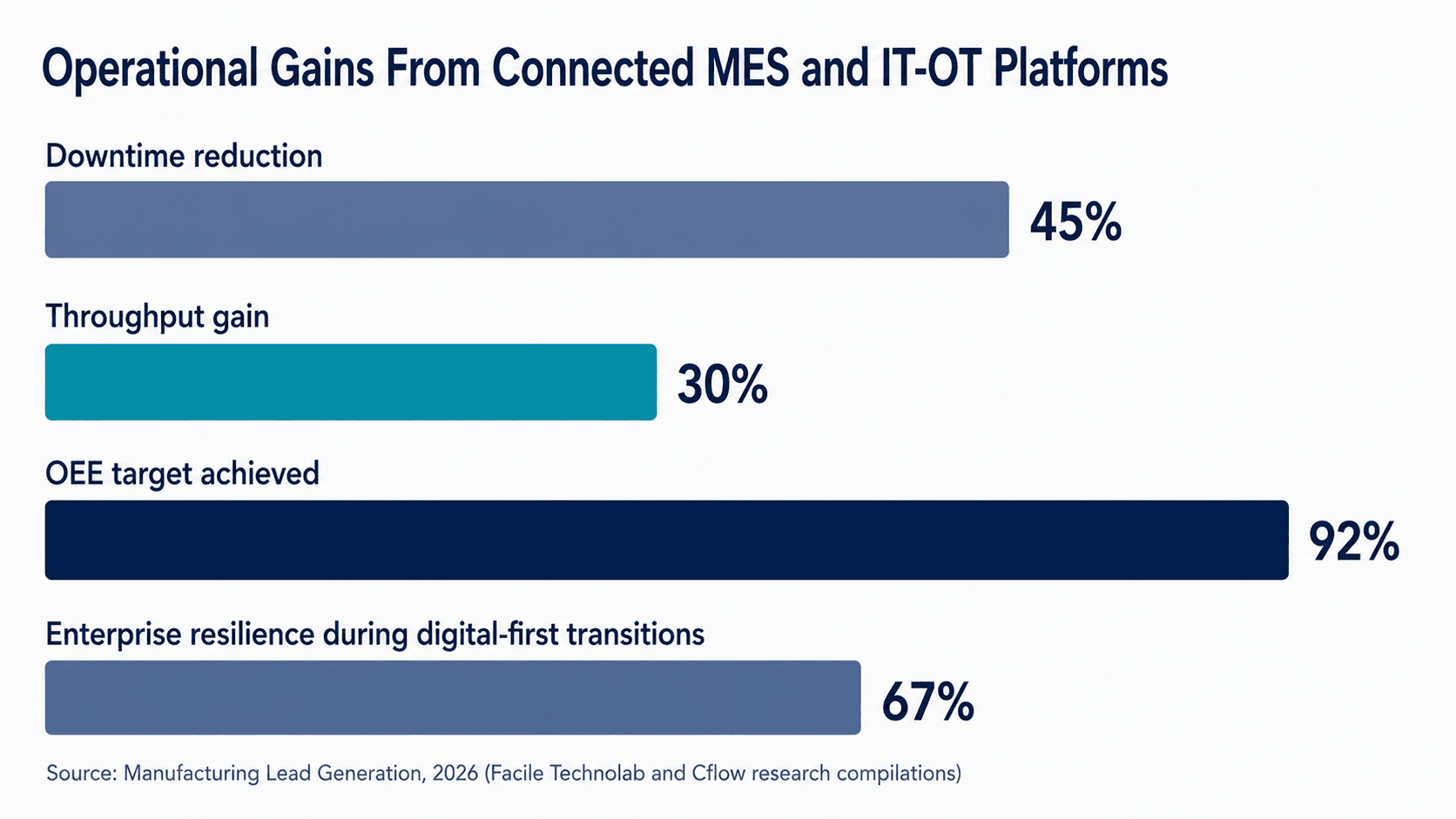
- Manufacturers running connected MES and cloud architectures report downtime reductions of up to 45%, throughput gains near 30%, and OEE targets around 92% (Manufacturing Lead Generation, 2026).
- Interwork's Connected Shop Floor Execution Platform replaces manual stoppage logs and multi-shift ERP delays with same-shift, API-led synchronization to SAP and Oracle.
- The Unified Observability Platform correlates SCADA and PLC telemetry with ERP API performance on one dashboard, cutting the time engineers spend chasing root cause across IT and OT domains.
- None of this requires ripping out your ERP. The gains come from integration architecture, not replacement.
What Does Industry 4.0 Actually Change on an Enterprise Shop Floor?
Industry 4.0 changes the latency between an event on the floor and a decision in the enterprise system. Sensors, PLCs, and SCADA layers have existed for decades. What is new is the pipeline that carries that telemetry into ERP, MES, and observability platforms in near real time. A stoppage, a quality deviation, or a meter reading becomes visible to the people who need to act on it within the same shift, not the next reporting cycle. That pipeline is what our Digital & IoT Services practice builds: edge-to-cloud architecture that bridges physical assets with corporate IT.
For plants running on spreadsheet logs and end-of-shift data entry, that latency gap is the real cost center. It is not that the machines are inefficient. It is that nobody downstream knows what the machines are doing until the damage is already booked. Interwork's Connected Shop Floor Execution Platform exists specifically to close that gap. It is an enterprise-grade Manufacturing Execution System with API-led, bidirectional connectors into SAP and Oracle, so runtime telemetry reaches the ledger the same shift it happens, not the next one.
Most Industry 4.0 write-ups describe five benefits in the abstract: efficiency, quality, cost, supply chain agility, innovation. Fair enough, but enterprise manufacturers do not buy abstractions. They buy the specific mechanism that closes the gap between what happens on the floor and what the ERP system believes happened three shifts ago. This piece walks through that mechanism, module by module, the way we build it at Interwork Software Solutions.
How Does a Connected Shop Floor Improve OEE and Cut Downtime?
OEE improves when downtime capture stops depending on an operator's memory at the end of a twelve-hour shift. Facilities running connected MES and cloud architectures report downtime reductions of up to 45%, throughput gains near 30%, and OEE targets around 92% (Manufacturing Lead Generation, 2026). Those numbers hold up for a specific reason. Automated stoppage capture removes the two biggest sources of OEE data error: forgotten micro-stoppages and mismatched reason codes.
Our Automated Stoppage Management Module identifies and records line stoppages directly from machine data. It maps every occurrence down to the specific resource sub-section, not just the production line as a whole. The module supports event-splitting, so a single incident with multiple contributing causes gets recorded accurately instead of collapsed into one generic code. A built-in maker-checker workflow pairs operator input with supervisor validation before anything posts to the ERP. That validation step is what keeps the resulting OEE numbers trustworthy enough for a plant head to act on, rather than double-check.
In our work with cement and automotive plants, the recurring pattern is not one catastrophic outage. It is dozens of five-minute stoppages a shift that nobody logs consistently, because logging them by hand is tedious and low priority in the moment. Automating the capture, not the fix, is usually where the first real OEE gain shows up.
How Do Manufacturers Get Real-Time Quality Control and Compliance Without Adding Headcount?
Real-time quality control comes from tying production confirmation directly to the same system that tracks material specifications, not from adding inspection staff. Our Production Order Confirmation Module lets technical teams book daily production volumes directly against enterprise Process Orders. It captures custom parameters for material variables such as moisture, density, and temperature at the point of production, rather than reconstructing them later from paper logs.
The module supports flexible booking windows, including same-day entries and N-1 retroactive dates. It also includes logic to split and manage mixed-material runs without losing ledger accuracy. Every confirmed order carries its captured parameters and passes through the same maker-checker validation used in stoppage tracking, so deviations surface while the batch is still in progress, not during a month-end reconciliation. That traceability chain also happens to be what pharmaceutical and automotive compliance audits ask for first.
Where Do the Real Cost and Resource Optimization Gains Come From?
The cost gains come from two places: eliminating unplanned maintenance triggered by undetected wear, and closing the metering gaps that quietly inflate utility and material spend. McKinsey's research on digitally mature manufacturers found throughput increases of 10 to 30% and labor productivity improvements of 15 to 30% at scale. Predictive maintenance and tighter resource tracking drive most of that gain, not headcount changes.
Our Meter Reading Management Module handles the resource side directly. It captures electrical, fuel, and utility meter data continuously across every active assembly section, with automated validation rules that flag out-of-bounds readings before they hit the corporate ledger. On the maintenance side, the Unified Observability Platform for IT and OT Environments layers predictive analytics on top of PLC and SCADA telemetry. It analyzes historical trend lines to flag early signs of equipment wear before they become breakdowns, and tracks Mean Time Between Failures alongside Mean Time to Repair, so maintenance managers can benchmark asset performance across facilities instead of guessing at it plant by plant.
How Does IT-OT Convergence Build a More Resilient, Agile Operation?
IT-OT convergence works when engineers can see a server-side anomaly and a machine-level fault on the same screen, correlated by time and impact. Without it, teams chase two separate monitoring systems that were never designed to talk to each other. That correlation is the entire premise of ISA-95, the enterprise-control system integration standard that defines how manufacturing operations management should interface with business systems (ISA, 2025 revision). It is also the architectural backbone we build the Unified Observability Platform around.
The platform ingests PLC and field sensor health data, SCADA telemetry, and production-line asset tracking on the OT side. On the IT side, it tracks server, network, database, and API performance, normalizing both into a single-pane-of-glass dashboard. Intelligent alerting applies threshold logic and trend analysis to isolate root cause across domains, instead of firing a flood of disconnected alerts, and routes notifications through multi-channel trees based on priority. For plant heads and directors of operations, the practical outcome is a documented target: cutting operational downtime by 30 to 40% by closing the blind spot between SCADA networks and cloud infrastructure.
What Competitive Edge Comes From Connecting the Shop Floor to the ERP Ledger?
The competitive edge is decision speed. When production totals, stoppage data, and meter readings reach SAP or Oracle the same shift instead of days later, executive reviews work off current numbers instead of stale ones. That compresses the time between a floor-level problem and a corporate-level response. Our Platform and Product Engineering practice builds the connective tissue underneath this: SAP Basis integration hooks, Oracle database integration, and real-time transactional ledger synchronization, engineered specifically so manufacturing telemetry does not get stuck behind legacy batch jobs.
This matters more for brownfield plants than greenfield ones. Most enterprise manufacturers are not starting from a blank slate. They are running ERP instances that are ten or fifteen years old, alongside newer MES and IoT layers that were bolted on separately. Rather than a full ERP replacement, we typically apply a Strangler Fig migration pattern. Specific workflows, like production confirmation or stoppage logging, move onto modern microservices incrementally, while the legacy core keeps running underneath. It is a slower-looking approach on a slide, but it is the one that does not stop the plant.
How Should Plant Heads and CIOs Sequence an Industry 4.0 Investment?
Sequencing matters more than scope. The plants that get stuck are the ones trying to modernize the entire stack in one program. The ones that show results in the first two quarters typically start differently. They pick a single, well-bounded module, most often automated stoppage tracking or production order confirmation, and prove the ERP integration pattern works at production volume. Only then do they extend the same architecture to metering, observability, and freight. Cloud-based deployment is what makes that staged approach practical: it already captures the largest share of Industry 4.0 spend and is growing faster than on-premises or hybrid models because it lets manufacturers add modules without heavy upfront infrastructure (GM Insights, 2025).
Interwork's modular, microservices-based architecture is built for that sequencing. Each module of the Connected Shop Floor Execution Platform ships with plant-specific configuration options. A cement line with continuous process flows and an automotive line with discrete batch runs can both adopt the platform without forcing either one into the other's data model. Once that foundation is in place, extending into the Unified Observability Platform for cross-domain monitoring becomes an integration exercise, not a second ground-up project. The same is true for manufacturers with distribution networks extending into our Freight-Centric TMS.
Frequently Asked Questions
Does adopting Industry 4.0 require replacing our existing ERP system?
No. Most enterprise manufacturers keep their SAP or Oracle core and add API-led connectors that synchronize shop-floor data into it. We typically apply a Strangler Fig migration pattern, moving specific workflows onto modern microservices incrementally while the legacy ERP continues running underneath, rather than a disruptive rip-and-replace.
How long does a Connected Shop Floor Execution Platform rollout take?
Timelines depend on plant complexity, but most enterprises start with one module, commonly automated stoppage management, and validate the ERP integration at production volume first. They then extend to production order confirmation and meter reading management over subsequent phases, rather than a single big-bang deployment.
What is the difference between IT-OT convergence and a traditional plant IT setup?
A traditional setup monitors corporate IT and factory-floor OT on separate, disconnected systems, so an engineer investigating a production issue has to manually cross-reference two consoles. IT-OT convergence, built around standards like ISA-95, correlates both domains on one observability platform, so root cause across server and machine-level faults becomes visible on a single dashboard.
How is Overall Equipment Effectiveness affected by connected shop floor platforms?
OEE accuracy improves because stoppage and downtime data get captured automatically from machine signals, rather than reconstructed from memory at shift end. Manufacturers running connected MES and cloud architectures report OEE targets around 92%, compared to inconsistent, manually reported figures on legacy tracking.
Does predictive maintenance require a separate platform from shop floor execution?
Predictive maintenance data typically comes from the same PLC, SCADA, and sensor telemetry that feeds shop floor execution. It is analyzed through the Unified Observability Platform, which tracks Mean Time Between Failures and Mean Time to Repair and flags early wear patterns before they cause downtime.
Which manufacturing sectors see the fastest Industry 4.0 returns?
Cement, automotive, pharmaceutical, and FMCG plants with high-volume, continuous or batch production tend to see the fastest returns. Automated stoppage capture and production order confirmation address the highest-frequency data gaps in those environments. Pharmaceutical and automotive manufacturers also gain compliance traceability as a direct byproduct of the same integration.
Where This Fits Into Your Broader Manufacturing Stack
None of these five advantages exist in isolation on an enterprise floor. Automated stoppage tracking feeds the OEE numbers that justify the observability investment. The observability platform's predictive maintenance data reduces the same unplanned downtime that stoppage management is built to catch. And the ERP integration underneath all of it, whether through the Connected Shop Floor Execution Platform or our broader Platform and Product Engineering practice, is what makes the data trustworthy enough for a CIO to build a dashboard on.
If your plant is still reconciling shop floor totals against ERP numbers manually at month end, that is usually the clearest signal. The integration layer, not the machinery, is where the next investment should go. We work with Plant Heads, CTOs, and CIOs across our Manufacturing & Retail practice, covering cement, automotive, pharmaceutical, white goods, FMCG, and energy manufacturing, to scope exactly where that layer should start.
About the Author
Vishnu Panda is the Chief Executive Officer of Interwork Software Solutions, bringing more than 25 years of experience in manufacturing technology and industrial automation. He leads Interwork's practice across Manufacturing Execution Systems, SCADA integration, IIoT telemetry architectures, and ERP-connected shop floor programs for enterprise manufacturing clients across cement, pharmaceutical, automotive, and FMCG sectors.