Blog
The Real Industry 4.0 Implementation Challenges Manufacturing IT Leaders Face in 2026
By Vishnu Panda, Chief Executive Officer, Interwork Software Solution Pvt. Ltd. | Updated July 2026
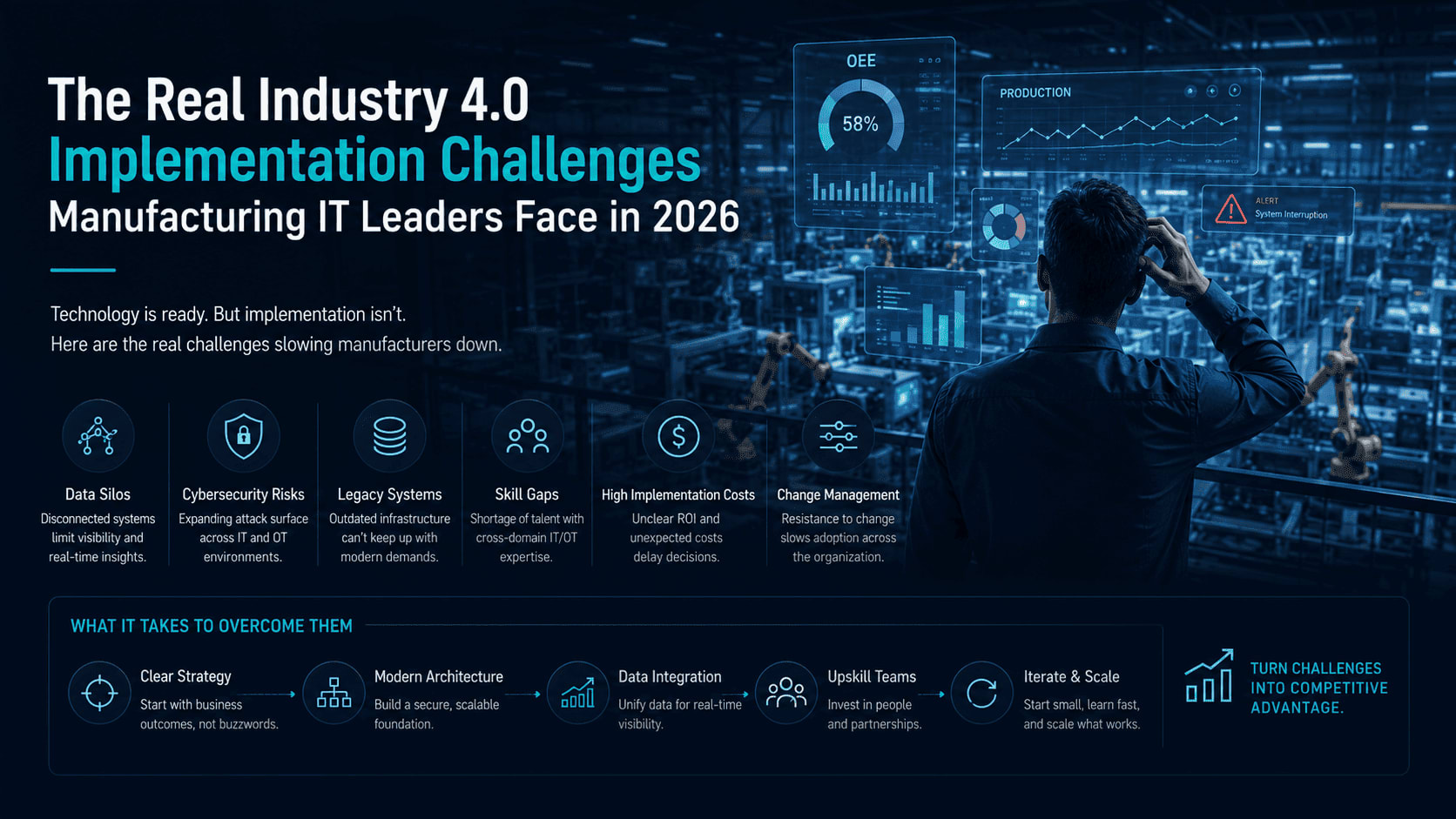
The standard list of Industry 4.0 implementation challenges, cost, skill gaps, cybersecurity, data management, technological complexity, appears in every article on the topic. It is not wrong. But it is not specific enough to help a CTO, Plant Head, or Process Automation Engineer who has already cleared the business case, received budget approval, and is now facing the concrete obstacles that show up when implementation actually begins.
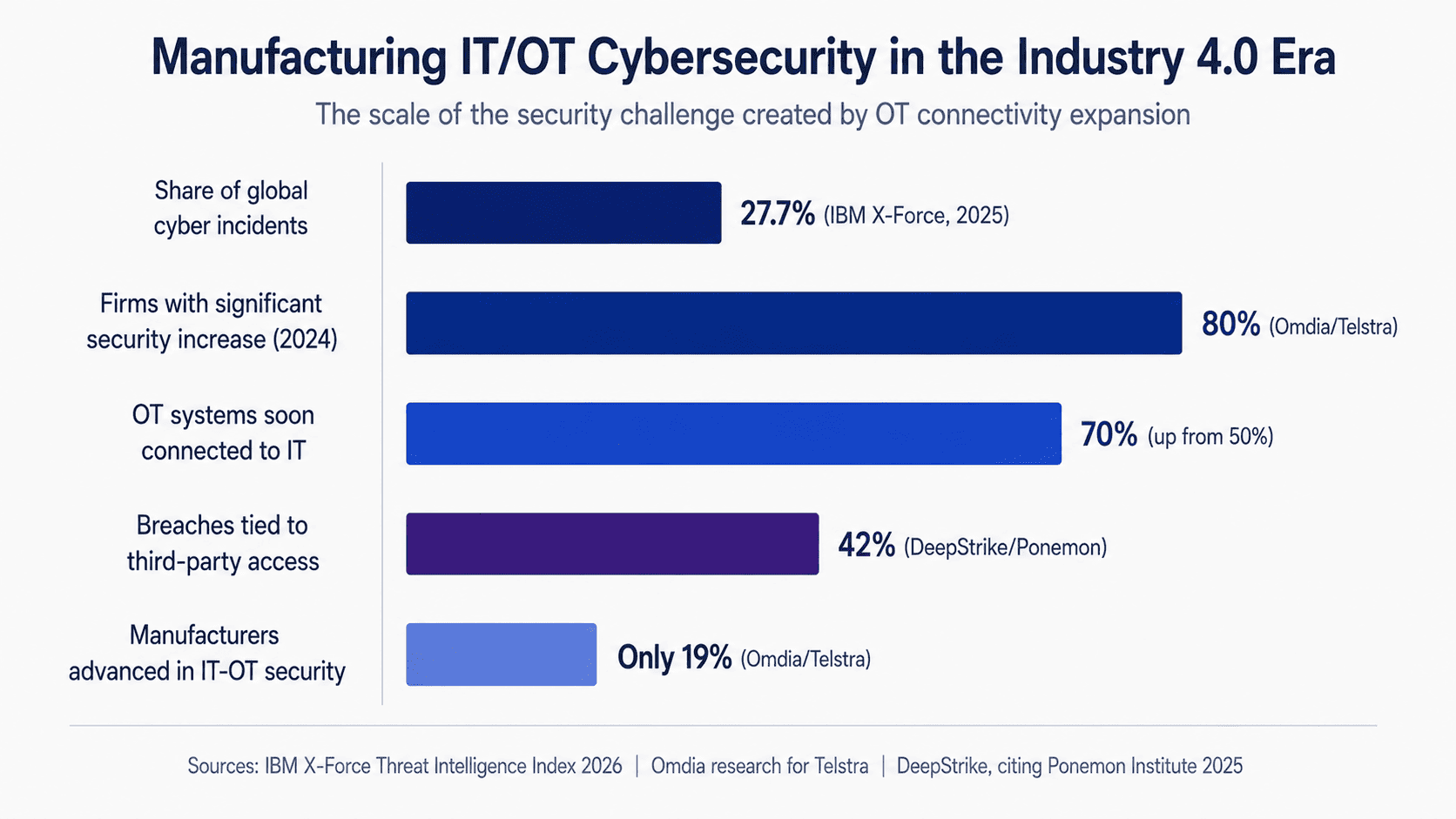
Manufacturing is now the most cyberattacked industry in the world for the fifth consecutive year, accounting for 27.7% of all cyber incidents tracked by IBM X-Force in 2025 (manufacturingleadgeneration.com, citing IBM X-Force Threat Intelligence Index 2026). 80% of manufacturing firms reported a significant increase in security incidents in 2024, and only 19% are considered advanced in securing their IT-OT systems (Omdia research for Telstra, cited at Telecoms.com). These are not general cybersecurity statistics. They are the specific consequence of Industry 4.0 programs connecting OT networks that were never designed for connectivity to IT networks that face daily attack pressure.
This guide covers the five implementation challenges that manufacturing IT leaders consistently encounter after program approval, with the architectural specificity that turns generic manufacturing cybersecurity advice into actionable engineering decisions rather than aspirational checklists.
Key Takeaways
- Manufacturing is the most cyberattacked industry globally for the fifth consecutive year, accounting for 27.7% of all cyber incidents in 2025; OT-impacting data breaches cost an average of $4.56 million per incident (manufacturingleadgeneration.com, citing IBM X-Force and Elisity research).
- 80% of manufacturing firms reported a significant increase in security incidents in 2024; only 19% are considered advanced in securing their IT-OT systems, exposing a critical gap as Industry 4.0 connectivity expands (Telecoms.com, citing Omdia research for Telstra).
- 70% of OT systems in manufacturing will soon be connected to corporate IT networks, up from 50%, creating a rapidly expanding attack surface that requires deliberate segmentation architecture rather than ad hoc connectivity (Cyber Magazine).
- 42% of manufacturers experienced a breach tied to third-party vendor or remote access, making vendor access governance a critical component of Industry 4.0 OT cybersecurity programs (DeepStrike, citing Ponemon Institute 2025 survey benchmarks).
- Lack of interoperability between proprietary platforms and compatibility issues with legacy equipment are a systemic barrier that keeps many manufacturers, particularly SMEs, from fully capturing Industry 4.0 digital transformation benefits (Mexico Business News, 2025).
Challenge 1: The IT/OT Convergence Security Problem, Why Industry 4.0 Makes Manufacturing More Attackable
The fundamental security challenge of Industry 4.0 is structural. Manufacturing OT networks were designed for operational reliability, not cybersecurity. SCADA systems, PLCs, and DCS platforms from the 1990s and 2000s were built to be isolated, reliable, and long-lived. They were never designed to be connected to corporate IT networks, supplier portals, cloud analytics platforms, or remote access systems. Industry 4.0 requires connecting all of these. Each new connection creates an attack surface that did not previously exist.
Manufacturing's position as the most cyberattacked industry is not a coincidence. It reflects the combination of three factors that attackers find uniquely attractive: valuable intellectual property and production data, legacy OT systems with documented vulnerabilities that cannot be easily patched, and near-zero tolerance for downtime that creates strong incentive to pay ransoms rather than endure extended recovery. OT-impacting data breaches cost manufacturers an average of $4.56 million per incident, well above the cross-industry average, and ransomware groups posted 1,060 manufacturing victims to leak sites in 2025, a 58% year-over-year increase (manufacturingleadgeneration.com, citing GuidePoint Security GRIT Report 2026).
The specific security architecture challenge that Industry 4.0 creates for manufacturing IT leaders is not "we need better cybersecurity." It is "how do we enable the IT/OT connectivity that Industry 4.0 requires without dissolving the OT network isolation that protects process control systems from IT network threats?" That is an architectural problem, not a product purchase.
The answer is deliberate network segmentation design: a three-zone architecture where OT control systems remain in a protected OT zone, a DMZ contains the data historians and integration servers that move data between OT and IT, and the IT zone contains ERP, analytics, and corporate infrastructure. Data flows from OT to DMZ to IT. ERP and cloud systems never write directly to OT control systems. Every vendor and remote access connection terminates at the DMZ or IT zone with time-limited, monitored credentials rather than persistent VPN access. 42% of manufacturer breaches are tied to third-party vendor access, making this governance layer as important as the network architecture itself.
IEC 62443 cybersecurity standards for industrial control systems define the security architecture requirements for connected OT environments. Compliance with IEC 62443, alongside the EU's NIS2 Directive and Cyber Resilience Act requirements taking effect in 2025 and 2026, is not optional for manufacturers selling into regulated markets. These regulatory requirements define the security architecture that Industry 4.0 connectivity must be built on, not retrofitted into after deployment.
The security mistake that most Industry 4.0 programs make is treating OT security as a phase that follows connectivity deployment. Connecting an OT network to IT infrastructure and then designing the security architecture is the wrong order. The security architecture, segmentation zones, data flow directionality, vendor access governance, identity and access controls, must be designed before any OT-to-IT connection is made. The cost of retrofitting security architecture into a connected OT network is significantly higher than building it in from the start, and the exposure window during retrofit is exactly the period when the connected network is most vulnerable.
Challenge 2: Brownfield Equipment Integration, Connecting Machines That Were Never Designed to Talk
Most manufacturing plants contain equipment from multiple generations and vendors. A typical production environment has PLCs installed in 2002 running Modbus RTU, SCADA systems from 2010 running OPC-DA, newer conveyor systems from 2019 using MQTT, and brand-new collaborative robots using REST APIs and 5G connectivity. Industry 4.0 requires all of these to share data. None of them speak the same protocol.
Brownfield equipment integration is the most technically underestimated obstacle in Industry 4.0 programs. Lack of interoperability between proprietary platforms and compatibility issues with legacy equipment represent a systemic barrier that keeps many organizations, especially SMEs, from fully capitalizing on the promised benefits of Industry 4.0 digital transformation (Mexico Business News). The word "systemic" is key. This is not a problem that one vendor's gateway product solves. It is a design problem that requires a deliberate integration architecture.
The architectural approaches available to manufacturing IT leaders for brownfield equipment fall along a spectrum. At one end, full equipment replacement, removing legacy machines and installing new IoT-native equipment that speaks modern protocols. This is the most complete solution and the most expensive by far, requiring capital investment, production downtime for installation, and operator retraining. For most manufacturers, full replacement is a long-horizon goal, not a near-term implementation option.
In the middle, smart retrofitting, adding IoT gateway hardware to legacy machines that captures electrical, vibration, and thermal signals from the machine without requiring the machine's control system to participate. A vibration sensor mounted on a 2002-vintage CNC spindle does not need the CNC's control system to cooperate. The gateway reads the physical signals, converts them to MQTT or OPC-UA, and passes them to the integration platform. The machine's firmware is never touched. This approach works for condition monitoring and basic predictive maintenance use cases on equipment that cannot be modified.
At the integration layer, OPC-UA aggregation servers provide the standardization mechanism that bridges multiple incompatible protocols. An OPC-UA aggregation server exposes a unified OPC-UA interface that downstream systems (MES, cloud analytics, ERP integration platforms) connect to, while handling Modbus, OPC-DA, and proprietary protocol translation on the OT side. This is the approach that IEC 62264-compliant smart manufacturing architectures typically use for brownfield equipment integration, because it provides protocol independence at the analytics and ERP integration layer without requiring changes to legacy machine firmware.
The selection between these approaches, replacement, smart retrofitting, or OPC-UA aggregation, depends on asset age, maintenance criticality, downtime tolerance, and the specific data types required for the Industry 4.0 use case being implemented. Process Automation Engineers who document this analysis for each major asset class before integration architecture design begins avoid the expensive mid-implementation discovery of equipment that cannot be integrated with the originally planned approach.
Challenge 3: Multi-Vendor Data Interoperability, When Siemens, Rockwell, and Honeywell Won't Share Data Natively
Manufacturing enterprises running equipment from multiple major automation vendors face a data interoperability challenge that goes beyond protocol translation. Each major vendor, Siemens, Rockwell Automation, Honeywell, ABB, Schneider Electric, has its own proprietary data format, its own asset model structure, and its own approach to representing equipment states and process variables. Even when all equipment is successfully connected to a common OPC-UA layer, the data they expose uses different tag naming conventions, different unit standards, and different hierarchical structures.
A Siemens S7 PLC exposes equipment status using Siemens-specific function block data structures. A Rockwell Allen-Bradley PLC exposes the same conceptual information using a completely different tag naming convention and data type representation. A unified analytics platform that consumes data from both needs a data normalization layer that maps both proprietary representations to a common semantic model before analytics can be applied consistently across assets from both vendors.
This data normalization problem is what persists data silos at the analytics layer even after physical network connectivity is established. The integration connects the data streams. The normalization work interprets them in a common language. Without normalization, a predictive maintenance model trained on Siemens asset data produces results that are not directly applicable to Rockwell asset data, requiring separate model development and maintenance for each vendor's equipment, which multiplies the analytics development cost without multiplying the capability.
In multi-vendor brownfield integration programs, the data normalization work consistently takes twice as long as the connectivity work and gets half as much budget in the initial project scope. The team connects 80% of the machines to the integration platform on schedule, then discovers that the data coming from each vendor's equipment requires vendor-specific transformation rules before it can feed a shared analytics layer. The normalization backlog then creates a bottleneck that delays the analytics and ERP integration milestones regardless of how well the connectivity work was executed. Starting the normalization design in parallel with connectivity design, not sequentially after it, is the architectural practice that prevents this bottleneck.
The ISA-95/IEC 62264 asset model provides the semantic reference that normalization mapping should target. It defines a vendor-neutral hierarchy for representing manufacturing assets, locations, equipment classes, and process segments. Mapping each vendor's proprietary data representation to the ISA-95 semantic model produces a normalized data layer that analytics applications can consume consistently regardless of which vendor's equipment the data originated from, and it is the same normalized foundation that underpins reliable edge-to-cloud intelligence across a multi-vendor plant.
Challenge 4: Operator Adoption, Why Technology Success on the Floor Is Not the Same as Technology Adoption
The technical implementation of an Industry 4.0 system can go exactly as planned, and adoption on the production floor can still fail. This happens because the technology change and the human workflow change are two separate programs that require separate management.
When a Manufacturing Execution System automates production data capture that was previously done by the shift supervisor entering production counts manually at end of shift, the shift supervisor's role does not disappear. It changes: from data entry to data verification, exception management, and escalation. If that role change is not explicitly designed, communicated, and supported before the system goes live, the shift supervisor experiences the new system as a burden, an additional thing to do rather than a replacement for something they used to do. The result is minimal system engagement, high error rates in the data that requires human input (reason codes, quality outcomes, operator acknowledgments), and lower system data quality than the manual process it replaced.
Operators who have managed production floors for 10 to 20 years carry deep institutional knowledge about why specific machines behave specific ways under specific conditions. That knowledge does not appear in training manuals or system documentation. Industry 4.0 systems that present automated insights without mechanisms for operators to contribute contextual knowledge, "Machine 5 vibration spikes on Tuesdays because that's when Supplier A's material lot arrives and their material behaves differently," lose the benefit of that institutional knowledge rather than encoding it into the analytics layer where it could improve model accuracy.
The operator adoption challenge is distinct from the skills gap challenge that generic lists describe. Skills gaps require training. Operator adoption requires process redesign. Training teaches operators to use the new system. Process redesign defines what operators are expected to do differently because of it, and removes the manual process steps that the new system replaces. Both are necessary. Only skills training is typically scoped.
Challenge 5: ROI Continuity, Keeping the Business Case Alive Across Budget Cycles
Industry 4.0 programs are multi-year investments with compounding returns. The first phase delivers measurable ROI from automated stoppage management and production confirmation accuracy. The second phase delivers higher OEE from predictive maintenance. The third phase delivers supply chain cost reduction from real-time inventory synchronization. Each phase builds on the data foundation the previous phase established.
The business case challenge is that manufacturing organizations typically evaluate technology investments on annual budget cycles. A program that delivers strong ROI on Phase 1 in Year 1 and delivers its highest-value outcomes in Years 2 and 3 is vulnerable to budget reallocation after Year 1 if Phase 2 and 3 returns have not been documented as part of the original investment case.
CTOs and CIOs who successfully maintain Industry 4.0 program budgets across leadership transitions and budget cycles treat ROI documentation as a continuous program function rather than a project deliverable at program close. This means establishing baseline measurements before each phase begins, documenting the ROI each phase delivers against that baseline as it is realized, and presenting that documentation alongside the Phase N+1 budget request so the next phase is funded based on demonstrated prior-phase returns rather than on projected future returns.
The measurement framework matters as much as the ROI amount. Finance leadership that sees "Phase 1 reduced unplanned stoppage events by 34% and recovered 22 production hours per month at an average contribution margin of X per production hour" finds that case substantially more credible than "Phase 1 improved OEE by 4.2 points." The first connects to a financial line item. The second requires the finance leader to perform a calculation that may not use the same assumptions the IT team used.
Can an SMB Manufacturer Sequence These Five Challenges Without an Enterprise Security Team?
Every one of these five challenges reads as an enterprise-scale problem, and for a mid-size or SMB manufacturer with a lean IT function, that framing can make Industry 4.0 implementation feel out of reach. The sequencing changes, but the challenges themselves do not disappear at smaller scale, and neither does the exposure. Manufacturing's cyberattack rate does not discriminate by company size, and 42% of breaches tied to third-party vendor access hit smaller manufacturers with thin IT security staffing just as often as large enterprises.
The practical path for an SMB manufacturer is to compress the same five challenges into a narrower, sequenced program rather than attempt all five simultaneously. Start the IT/OT segmentation architecture on the single production line or facility with the highest exposure, using a managed IT-OT integration security engagement rather than building an internal security operations function from scratch. Address brownfield equipment integration through smart retrofitting on the two or three highest-value legacy machines instead of a plant-wide protocol translation project. Treat operator adoption and ROI documentation as lightweight, built-in program habits from day one rather than formal change-management functions, since a smaller organization can move faster on both once leadership commits to designing them in.
Cloud-hosted IoT and IIoT telemetry pipelines and edge-to-cloud intelligence platforms reduce the on-premise infrastructure an SMB needs to stand up, which narrows the cost gap between SMB and enterprise Industry 4.0 implementation considerably. The architectural principles, segmentation before connectivity, normalization before analytics, process redesign before technology rollout, apply at any plant size. What changes for an SMB is the scope of the first phase, not the sequence of the five challenges.
How Interwork Addresses These Five Challenges in Practice
Interwork Software Solutions works with manufacturing enterprises on all five challenge dimensions, with specific capabilities at each layer.
IT/OT security architecture: Interwork's Unified Observability Platform for IT and OT Environments provides the monitoring infrastructure across the three-zone security architecture: OT zone health, DMZ integration performance, and IT network connectivity are all visible in a unified operational dashboard. Security event correlation between OT anomalies and IT network events gives security teams cross-domain visibility without requiring OT monitoring to run on IT infrastructure.
Brownfield equipment integration: The IT-OT integration security services Interwork provides include industrial protocol translation (Modbus, OPC-UA, OPC-DA, MQTT, Profibus, PROFINET) through edge gateway architecture that protects OT network isolation while enabling data extraction. Legacy equipment without native connectivity is addressed through smart retrofitting approaches where appropriate and OPC-UA aggregation for multi-vendor environments.
Data normalization: The IoT and IIoT telemetry pipelines Interwork builds apply ISA-95 asset model mapping as a standardization layer between raw vendor-specific data and the normalized data model that ERP integration, MES, and analytics applications consume. Industrial protocol translation at the edge gateway layer, converting Modbus, OPC-DA, and proprietary vendor protocols into a common OPC-UA representation, is what eliminates the vendor-specific model divergence that creates separate analytics silos for each equipment vendor.
Operator adoption: The Connected Shop Floor Execution Platform is designed with floor-level operator interfaces that match production workflow patterns, not IT application conventions. The maker-checker validation workflow gives operators agency in the data they are confirming rather than placing them as passive data entry points. Workflow redesign support during implementation defines what changes for operators and removes the manual steps the system replaces.
ROI continuity: Interwork's engagement model includes establishing measurement baselines before each program phase, tracking phase-level ROI against those baselines, and producing the financial documentation that Phase N+1 budget requests require. This same phased approach is what makes legacy system integration budgets defensible, since each phase's ROI evidence justifies the next round of brownfield investment rather than asking finance to fund the whole program on a single upfront projection.
Frequently Asked Questions
Why is manufacturing the most cyberattacked industry, and what does that mean for Industry 4.0 programs?
Manufacturing accounts for 27.7% of all cyber incidents globally, more than any other sector for the fifth consecutive year. This is a direct consequence of the combination of legacy OT systems with known vulnerabilities, valuable intellectual property, near-zero tolerance for production downtime (which creates ransom-payment incentive), and the rapid expansion of IT/OT connectivity that Industry 4.0 requires. For Industry 4.0 programs, this means the OT security architecture must be designed before connectivity is established, not retrofitted after implementation.
What is the brownfield equipment integration challenge and how do manufacturers address it?
Brownfield equipment integration is the challenge of connecting legacy production equipment, PLCs, SCADA systems, and industrial machines installed before IoT connectivity was expected, to modern Industry 4.0 data infrastructure. Approaches range from smart retrofitting (adding IoT gateway hardware to capture physical signals without modifying machine firmware) to OPC-UA aggregation servers (providing a unified OPC-UA interface that translates between multiple proprietary protocols). The correct approach depends on asset age, modification feasibility, and the specific data types required for the Industry 4.0 use case.
What is the IT/OT convergence security architecture that IEC 62443 requires?
IEC 62443 defines a security architecture for industrial control systems based on zones and conduits. The three-zone architecture relevant to Industry 4.0 programs maintains an OT zone containing SCADA and PLCs, a DMZ containing historians and integration servers that broker data between OT and IT, and an IT zone containing ERP, analytics, and corporate infrastructure. Data flows from OT to DMZ to IT. IT systems and cloud platforms never write directly to OT control systems. Vendor and remote access connections terminate at the DMZ or IT zone, not at OT control systems directly.
Why do operator adoption programs fail even when Industry 4.0 technology implementations succeed?
Technical implementation and workflow adoption are separate programs. When a new system automates data capture that operators previously did manually, operator adoption fails when the process redesign work has not defined what operators should do differently because of the new system and what manual steps the system replaces. Without that process redesign, operators experience the new system as additional work rather than a replacement for existing work, leading to minimal engagement, high error rates in operator-input data, and lower system data quality than the manual process the system was intended to improve.
How do CTOs maintain Industry 4.0 program budgets across budget cycles and leadership transitions?
The most effective approach is treating ROI documentation as a continuous program function rather than a final project deliverable. This means establishing baseline measurements before each phase begins, documenting phase-level ROI against those baselines as it is realized, and presenting that documentation alongside Phase N+1 budget requests. The documentation format that finance leadership finds most credible connects system performance metrics to financial line items rather than presenting technology performance metrics that require additional calculation to reach financial impact.
What does data normalization mean in multi-vendor manufacturing environments and why does it matter?
Multi-vendor manufacturing environments contain equipment from Siemens, Rockwell, Honeywell, ABB, and other vendors, each using proprietary data formats, tag naming conventions, and asset hierarchy structures. Physical network connectivity enables data extraction from each vendor's equipment, but without normalization, each vendor's data speaks a different language that analytics applications must learn separately. Data normalization maps each vendor's proprietary data representation to a common semantic model, typically based on ISA-95/IEC 62264 asset hierarchy standards, enabling shared analytics applications to operate consistently across all vendors' equipment without separate model development for each.
Can an SMB manufacturer implement Industry 4.0 without an enterprise-scale IT security team?
Yes, by compressing the same five challenges into a narrower, sequenced program rather than attempting all five simultaneously. Starting IT/OT segmentation on the single facility with highest exposure, using a managed IT-OT integration security engagement, addressing brownfield equipment through smart retrofitting on the highest-value legacy machines, and treating operator adoption and ROI documentation as built-in program habits from day one all reduce the scope without changing the underlying sequence. Cloud-hosted telemetry and edge-to-cloud intelligence platforms further reduce the on-premise infrastructure investment required.
Implementation Success Requires Precision on the Specific Challenges
The generic list of Industry 4.0 challenges, cost, skills, cybersecurity, data management, technological complexity, describes the problem space accurately but at too low a resolution to drive implementation decisions. A CTO deciding how to secure IT/OT connectivity needs to know that 70% of OT systems will soon be connected to corporate IT networks and that only 19% of manufacturers are advanced in securing them. A Plant Head planning brownfield equipment integration needs to understand the difference between smart retrofitting and OPC-UA aggregation and when each applies. A Process Automation Engineer managing operator adoption needs a process redesign program, not a training program.
The precision that turns Industry 4.0 implementation challenges from obstacles into solvable engineering problems comes from understanding which specific variant of each challenge applies to the specific manufacturing environment, at the specific technology layer, with the specific equipment mix the organization operates. Manufacturers that get this precision right end up with legacy system integration architecture that behaves the way the original business case promised, rather than a collection of connected devices that never quite closes the loop back to the ERP.
Interwork Software Solutions designs and implements Industry 4.0 digital transformation programs for manufacturing and retail enterprises across cement, automotive, pharmaceutical, white goods, and FMCG sectors, with specific capabilities in IT-OT security architecture, brownfield equipment integration, multi-vendor data normalization, and connected shop floor execution platform deployment.
Schedule an Industry 4.0 implementation readiness assessment with the Interwork engineering team
About the Author
Vishnu Panda is the Chief Executive Officer of Interwork Software Solutions, bringing more than 25 years of experience in manufacturing cybersecurity technology and industrial automation. He leads Interwork's practice across Manufacturing Execution Systems, SCADA integration, IIoT telemetry architectures, and ERP-connected shop floor programs for enterprise manufacturing clients across cement, pharmaceutical, automotive, and FMCG sectors.