
Blog
MES-ERP Integration in Manufacturing: Why the Execution Layer Is the Missing Link Between What ERP Plans and What the Factory Delivers
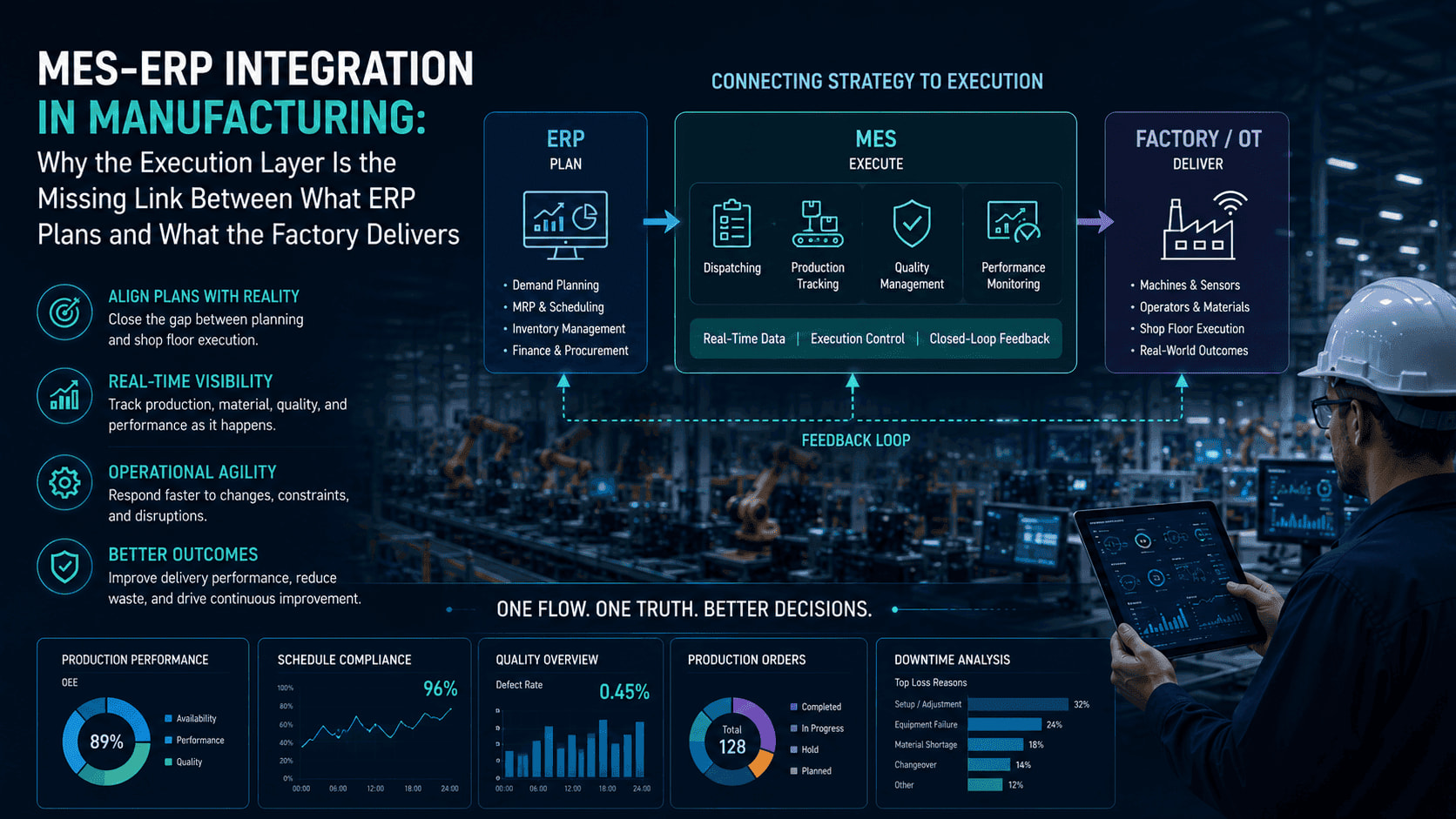
By Vishnu Panda, Chief Executive Officer, Interwork Software Solution Pvt. Ltd. | Updated December 2025
Every manufacturing enterprise running SAP, Oracle, or any core ERP faces a version of the same problem. The ERP creates a production order for 800 units of Product A, scheduled for completion by Thursday 6 PM against a firm customer commitment. The production planner signs off. The order gets released. And then the plan and the floor separate.
The floor runs into a machine issue on Tuesday. A quality deviation on the morning shift holds 120 units. A material shortage delays the restart by four hours. None of these events reach the ERP in real time, because there is nothing between the ERP's planning layer and the physical floor that captures, validates, and feeds back what is actually happening. The ERP still shows the order on track at 5 PM Thursday, while operations leadership is managing a crisis it has known about since Tuesday morning.
This is the gap that a Manufacturing Execution System (MES) closes, and it is why MES ERP integration has become one of the fastest-moving categories in industrial software. The global manufacturing execution systems market was valued at $16.57 billion in 2025 and is projected to reach $56.65 billion by 2034, growing at a 14.9% compound annual rate as Industry 4.0 digital transformation programs push manufacturers toward real-time production visibility (Fortune Business Insights). Manufacturers that run integrated ERP and MES coordinate operations with customer service, logistics, and delivery at more than double the rate of those that do not, and they standardize production planning and execution far more consistently (MIE Solutions, citing Aberdeen Group research). A manufacturing execution system is the architecture that turns that ambition into a working data loop.
Key Takeaways
- The global manufacturing execution systems market was valued at $16.57 billion in 2025 and is projected to grow to $56.65 billion by 2034, a 14.9% CAGR driven by Industry 4.0 digital transformation and demand for real-time production visibility (Fortune Business Insights, 2026).
- Manufacturers with integrated ERP and MES coordinate operations with customer service, logistics, and delivery at 57%, versus 26% for manufacturers running disconnected systems, and 53% standardize production planning and execution versus 27% (MIE Solutions, citing Aberdeen Group research).
- On a line generating €200 of added value per operating hour across 4,500 hours a year, one OEE point of improvement is worth roughly €9,000 annually, and TEEPTRAK customers average a 29 OEE-point improvement within 12 months, worth roughly €261,000 per line per year (TeepTrak).
- MES-ERP integration works only when the data loop closes bidirectionally and in near real time; the execution layer defined by ISA-95/IEC 62264 exists specifically to sit between ERP planning (Level 4) and shop floor automation (Levels 1-2) (ISA-95 standard).
- Custom MES development, matched to the specific production reality of a plant rather than a generalized workflow template, is what makes connected shop floor execution platform deployments produce OEE optimization results that generic MES configurations typically cannot.
Why Can't ERP Talk Directly to the Shop Floor?
The question every Plant Head and CTO eventually asks when evaluating MES investment is the right one: if the ERP already has production planning modules, why does another system layer exist? Why can't the ERP tell the floor what to produce and receive the results directly?
The answer sits in the granularity and timing mismatch between what ERP is built to handle and what the factory floor generates.
ERP production orders operate at the level of: produce 800 units of Product A, using Bill of Materials version 3.1, starting Monday and completing Thursday. That is the correct planning-layer abstraction. ERP manages the business transaction: the customer commitment, the cost allocation, the material reservation, the capacity slot in the production schedule.
The factory floor generates a completely different category of data in real time. Machine 5 started at 07:14. Setup took 23 minutes instead of the standard 18 minutes. The first batch of 50 units passed quality at 08:40. Material lot MLT-2241 consumed 47.3 kg against the 46.0 kg standard. A short stoppage occurred at 09:55, duration 4 minutes, reason code "tool change." Output rate dropped to 87% of target speed at 11:30.
ERP cannot receive this data stream directly. It has no data model for machine-level events, no workflow for operator-level quality decisions, and no mechanism for second-by-second WIP tracking. Feeding raw shop floor event data into the ERP's production order record would corrupt the financial ledger it is designed to maintain.
This is exactly the gap that a manufacturing execution system is defined to close under the ISA-95/IEC 62264 standard. ISA-95 execution layer defines Level 3 Manufacturing Operations Management as the functional boundary between the ERP's enterprise business functions (Level 4) and the automation and control layer of PLCs and SCADA systems (Levels 1 and 2) (ISA). MES takes production orders from the ERP, translates them into granular work instructions for operators and machines, tracks everything that happens during execution, enforces quality checkpoints before work proceeds, and feeds the confirmed, validated production results back to the ERP in the format the financial ledger can use.
When we ask manufacturing enterprises without MES how production order progress reaches the ERP, the answer is almost always "the shift supervisor enters it at end of shift." That manual entry is the organizational mechanism compensating for the absence of a proper execution layer. It is also why ERP production data is 8 to 18 hours old, why actual-versus-standard cost variances are impossible to explain at the batch level, and why a Thursday 5 PM production crisis has been developing since Tuesday morning without anyone in the ERP knowing.
What Does the MES Execute That the ERP Plans?
MES handles execution functions that ERP production planning modules cannot perform at the granularity manufacturing operations require.
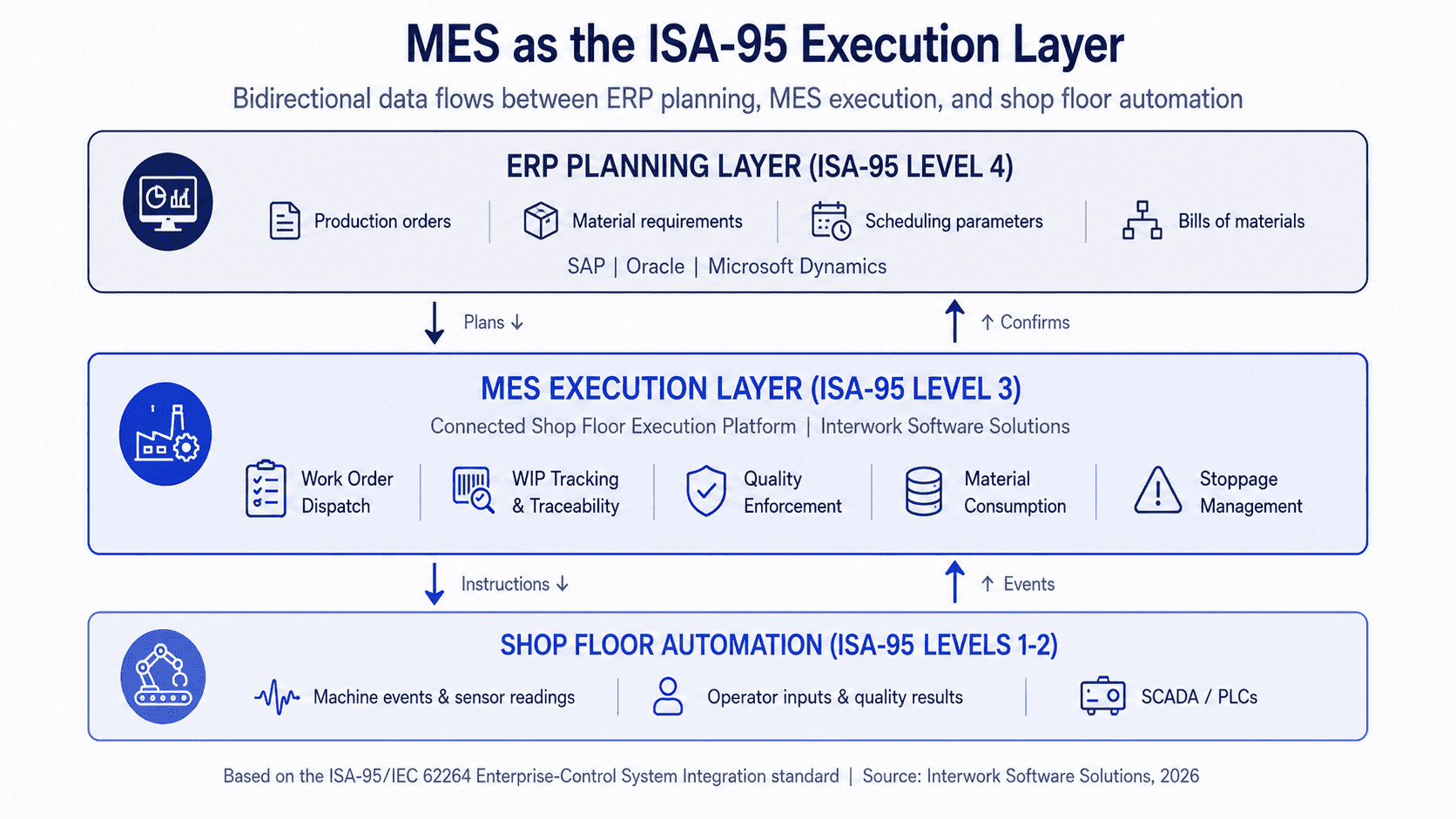
Work order dispatch and granular scheduling. ERP creates a production order: 800 units, Thursday. MES breaks it into executable work assignments: Line 3, Shift 1, 250 units. Line 3, Shift 2, 280 units. Line 5, Shift 1, 270 units. It issues work instructions to operators at each workstation, assigns tool sets, triggers material pick lists from the warehouse, and sequences the work against actual machine availability rather than the infinite-capacity plan the ERP used.
Real-time WIP tracking and traceability. MES tracks every component and work-in-progress item through the production flow by lot, batch, or serial number. A Plant Head can see at any moment exactly where every open production order sits, what percentage is complete, which operators have worked on it, which material lots were consumed, and which quality inspections it has passed or failed. This WIP visibility is what makes the Thursday crisis visible on Tuesday rather than on Thursday.
Quality enforcement at production checkpoints. MES does not just record quality outcomes; it enforces them. Quality checkpoints are defined in the MES routing, and the system will not allow production to advance to the next process step until the required inspection is completed and the outcome recorded. If 12 units fail inspection at Step 4, MES holds those 12 units and routes them for disposition before they move forward, while the 788 conforming units continue.
Material consumption recording. MES records actual material consumption at the batch or work order level: which material lots were consumed, in what quantities, at what timestamps. That actual consumption record posts to the ERP material ledger through API-led integration, enabling actual-versus-standard cost variance analysis at the batch level. For manufacturers running 21 CFR Part 11 or GxP-regulated processes, this material genealogy is also the batch record foundation.
Stoppage and downtime management. MES captures production stoppages at the moment they occur, with reason codes and duration, rather than waiting for end-of-shift operator estimates. Combined with shift production totals and quality data, this stoppage record generates the OEE components (availability, performance, quality) that make OEE optimization a real-time discipline rather than an end-of-week estimate.
How Does the MES-ERP Data Loop Close the Planning-Execution Gap?
The value of MES ERP integration is realized only when the data loop closes in both directions and operates in near real time rather than as a daily batch process.
From ERP to MES: production orders, material reservation confirmations, Bill of Materials versions, routing definitions, and demand-driven scheduling parameters. MES needs this context to execute correctly. It cannot dispatch work against a production order that is not released in the ERP, and it cannot record material consumption against lots that are not confirmed as available in ERP inventory.
From MES to ERP: production order progress updates, confirmed completions, actual material consumption by lot, quality inspection outcomes, OEE component data, downtime event logs, and operator time recordings. Each of these data flows updates a specific ERP record: production order status, material document, quality notification, cost center posting, and capacity utilization record. This is what production order tracking looks like when the loop is fully closed rather than partially wired.
TeepTrak's own operating model illustrates why the financial stakes of closing that loop are larger than most Plant Heads expect. For an illustrative factory generating €30 million of annual production value, a 5% improvement in cost variance accuracy from better MES-ERP production data would deliver roughly €1.5 million in financial improvement from information quality alone (TeepTrak). That figure represents the difference between production cost accounting based on standard costs and actual costs that reflect what the floor truly consumed and produced. Finance teams that previously estimated actuals from standard rates get accurate numbers from MES-confirmed production records instead.
The financial improvement compounds through the rest of the ERP's planning function. Accurate actual costs make procurement cost modelling more reliable. Accurate actual material consumption makes inventory planning more precise. Accurate actual production output makes capacity planning more credible. MES does not just improve production execution visibility; it improves the quality of the data that every downstream ERP planning function depends on.
The first month after MES-ERP integration goes live is always the same: finance identifies cost variances they had no idea existed. The variance wasn't created by MES; MES just made it visible. In one cement manufacturing program, the first accurate batch-level material consumption report revealed that a specific raw material was being consumed at 6.4% above the standard recipe quantity on a particular kiln line. That overage had been present for two years, absorbed into the overall production cost variance, and never isolated. The MES material tracking produced the data that identified it in the first month.
What Makes Interwork's Connected Shop Floor Execution Platform Different From Generic MES?
Generic MES platforms are broad. They cover many industries with generalized execution workflows that require significant configuration to reflect the specific production reality of any individual manufacturer. Interwork's Connected Shop Floor Execution Platform is built as a custom MES development approach: the platform is engineered to match the actual workflows of the specific manufacturing environment, rather than requiring the manufacturing environment to adapt to a default workflow model.
This distinction matters in practice because production execution requirements are highly specific to industry, product complexity, and regulatory context. What a cement manufacturer needs from MES (kiln control integration, material consumption by batch, energy meter readings tied to production lots) differs from what an automotive parts manufacturer needs (sequence-dependent setup management, torque tool integration, operator certification at safety-critical operations), which differs again from what a pharmaceutical manufacturer needs (21 CFR Part 11 compliance, batch record generation, process parameter recording with audit trail).
The platform's Automated Stoppage Management module captures machine stoppages automatically from machine data rather than from operator memory, with dynamic event splitting for multi-reason failures and a maker-checker validation workflow that enforces data governance without adding administrative friction. This is the module that closes the gap between when a stoppage occurs and when it is logged, which is the gap that makes manual OEE calculation unreliable.
The platform's Production Order Confirmation module enables continuous production tracking against active ERP Process Orders, with one-click, API-driven synchronization to the core financial ledger. Flexible same-day and N-1 retroactive booking handles the operational scenarios where real-time posting is not always practical, while still eliminating the overnight batch delay that typically separates floor events from ERP records.
The platform's Meter Reading Management module handles utility and energy consumption data: cross-section ingestion of electrical and fuel meter readings, plus automated validation rules that flag out-of-bounds readings before they enter the database. This is the module that enables energy cost allocation at the production order level, connecting actual consumption to specific batches rather than averaging energy costs across the production period.
All three modules connect to SAP, Oracle, and other ERP systems through bidirectional, API-led integration engineered for core database communication, with near real-time synchronization that eliminates the shift-end batch posting that creates ERP data latency.
Can SMB Manufacturers Adopt MES-ERP Integration Without a Multi-Site Rollout Budget?
Most MES case studies describe multi-plant enterprise rollouts, and it is easy for an SMB Plant Head or factory owner to conclude that MES ERP integration is out of reach until the business scales further. That reading misses how a custom MES development program is actually scoped today.
The manufacturers who get the fastest, cleanest return are not the ones who deploy every MES module across every line on day one. They are the ones who scope by problem: a single production line with the worst cost variance, a single shift with the heaviest manual booking backlog, or a single quality hold process that keeps escalating to the plant head personally. A phased connected shop floor execution platform rollout, starting with the Automated Stoppage Management module or the Production Order Confirmation module alone, lets an SMB manufacturer prove the OEE optimization and data quality gains on one line before committing capital to a plant-wide program.
Cloud-hosted deployment options reduce the infrastructure investment further, since the manufacturer does not need to stand up on-premise servers to run a modern manufacturing execution system. Bidirectional ERP integration is scoped to the ERP the SMB already runs, whether that is a full SAP or Oracle deployment or a mid-market ERP, so the integration effort scales with the size of the operation rather than assuming enterprise complexity by default. For an SMB running a single plant with two or three production lines, this incremental path to ERP-driven manufacturing integration is frequently the difference between MES staying a five-year aspiration and becoming a working system within a single budget cycle.
What Measurable Results Does MES-ERP Integration Deliver?
The return-on-investment data from MES programs points to two consistent levers: OEE optimization and data-driven cost accuracy.
On a production line generating €200 of added value per operating hour, running 4,500 hours per year, a single OEE point of improvement is worth approximately €9,000 in recovered output value annually. TEEPTRAK customers report averaging a 29 OEE-point improvement within 12 months, worth roughly €261,000 per line per year at that same value basis (TeepTrak). The exact multiplier will vary with a plant's own hourly value of production, but the direction is consistent: OEE gains compound quickly once accurate, real-time production data replaces manual estimation.
Manufacturers with integrated ERP and MES also report structurally different operational coordination than manufacturers running the two systems separately. 57% of manufacturers with integrated systems coordinate operations with customer service, logistics, and delivery, compared with 26% of manufacturers without integration, and 53% standardize production planning and execution compared with 27% (MIE Solutions, citing Aberdeen Group research). That gap is the practical evidence for why MES ERP integration, not MES alone, is the unit of value that matters.
We are not publishing a single blended ROI percentage or a universal payback period here, because credible per-plant figures depend on baseline OEE, labor cost structure, and the specific processes a program targets, and no independently verifiable industry source currently confirms a single figure that applies across sectors. What we can confirm from verified sources is the market trajectory, the operational coordination gap between integrated and non-integrated manufacturers, and the OEE-point economics above. Any plant-specific ROI projection should be built from a pre-implementation baseline, not from a generic industry average.
What Does a Successful MES-ERP Integration Program Look Like?
Four decisions determine whether a program delivers its projected outcomes.
Scope by problem, not by module list. The most effective MES programs start by identifying the two or three specific production execution problems costing the most: ERP cost variance unexplainability, shift-end manual booking backlog, quality hold documentation delay, material consumption reconciliation errors. Building the MES scope around those specific problems produces measurable results faster than deploying every available module simultaneously and hoping usage drives improvement.
Design bidirectional ERP integration before building MES workflows. MES workflows that generate data that is not connected back to the ERP in real time do not close the planning-execution loop. They create a third system silo alongside the ERP and the shop floor. The API-led bidirectional integration architecture that connects MES confirmations to ERP production order records should be designed before MES workflow design begins, not added afterward as an integration project.
Establish the maker-checker data governance model from day one. Automated MES data capture is valuable only when data quality is sufficient for ERP financial reporting and quality compliance. A governance framework that defines which fields require operator input, which require supervisor validation before ERP posting, and what the correction and audit trail process looks like for post-submission edits is foundational infrastructure, not an optional add-on.
Measure OEE components before and after deployment. The MES business case requires a pre-implementation baseline: current OEE by line and shift, current actual-versus-standard cost variance, current manual booking time per shift, current production record error rate. Without that baseline, a program cannot demonstrate what it improved, and it cannot secure budget for the next phase of a connected shop floor execution platform rollout.
Common MES-ERP Integration Pitfalls
Building MES around the existing ERP's data model rather than the floor's operational reality. ERP production order structures do not always map neatly to how production actually runs. When MES forces floor data into ERP categories that do not reflect physical process steps, the resulting data quality problems undermine the trust floor teams place in the system. MES workflow design needs input from shift supervisors and operators, not just ERP project managers.
Treating MES implementation as an IT project. The technology is implemented by IT teams, but the data MES captures has to be designed with Plant Heads and process engineers. Reason code taxonomies that do not reflect how the floor actually categorizes stoppages produce logs that operations management does not trust and will not use for root cause analysis.
Deploying MES without real-time ERP integration. MES that generates excellent floor execution data but posts it to ERP in a nightly batch file creates a faster version of the same latency problem MES was supposed to solve. Near real-time API integration from MES to ERP is the architecture that makes same-shift visibility possible.
Skipping the OEE baseline measurement. Programs that deploy MES and report OEE improvement percentages without a documented pre-implementation baseline cannot validate the business case or use the results to justify a multi-site rollout budget.
Frequently Asked Questions
What is the difference between MES and ERP in manufacturing?
ERP manages enterprise-wide business processes: financial planning, inventory management, procurement, production order creation, and supply chain coordination. MES manages real-time production execution: it takes production orders from the ERP, dispatches them as granular work assignments to specific machines and operators, tracks work-in-progress in real time, enforces quality checkpoints, records actual material consumption, and feeds confirmed production data back to the ERP. The ISA-95 execution layer and IEC 62264 standard defines MES layer (Level 3) between ERP planning (Level 4) and shop floor automation (Levels 1-2).
Why can't ERP handle production execution directly without a separate MES?
ERP production planning operates at the level of production orders, BOM-based material requirements, and capacity bucket scheduling. The shop floor generates second-by-second machine event data, operator-level quality decisions, and real-time WIP states that ERP cannot receive or process without corrupting the financial ledger it maintains. A manufacturing execution system handles the execution-layer granularity and feeds structured, validated production results back to the ERP at the level ERP is designed to consume.
How does MES connect to ERP systems in a manufacturing environment?
MES ERP integration uses API-led bidirectional connectors. From the ERP, MES receives production orders, material availability confirmations, BOM versions, and routing definitions. From MES, the ERP receives production order progress updates, confirmed completions, actual material consumption by lot, quality inspection outcomes, OEE component data, and downtime event logs. Near real-time API integration posts these data flows within the same shift rather than in overnight batch files.
What is the maker-checker workflow in MES data governance?
The maker-checker workflow is a dual-approval validation mechanism in which an operator (Maker) enters production data and a supervisor (Checker) reviews and approves it before it posts to the core ERP system. This governance layer enforces data accuracy at the point of capture rather than requiring correction after the fact, which matters when MES production data feeds directly into financial reporting, quality compliance records, and ERP cost accounting. The maker-checker model is built into Interwork's Connected Shop Floor Execution Platform as a foundational governance control, not an optional configuration.
How does MES handle quality enforcement differently from manual quality processes?
MES enforces quality checkpoints as hard gates in the production routing: the system will not allow production order tracking to advance to the next process step until a required quality inspection is completed and the result recorded. Manual quality processes rely on operators remembering to complete inspections and supervisors checking that records were filed. MES quality enforcement is automatic and auditable, with every quality event time-stamped, linked to the production lot and operator, and structured for direct ERP quality management and regulatory compliance documentation.
Can a mid-size or SMB manufacturer justify MES-ERP integration without an enterprise budget?
Yes, through a phased, problem-scoped deployment rather than a plant-wide rollout. Starting with a single module, such as Automated Stoppage Management or Production Order Confirmation, on the production line with the worst cost variance or manual booking backlog lets an SMB manufacturer prove OEE optimization and data quality gains before committing capital to a multi-line program, and cloud-hosted deployment options reduce the infrastructure investment further.
ERP Plans. MES Executes. Both Have to Talk.
The gap between what the ERP plans and what the smart factory systems deliver is not a planning problem. It is a data architecture problem. ERP has the demand data, the material requirements, the financial structure, and the customer commitments. The floor has the machines, the operators, the material, and the actual production events. Without an execution layer connecting them in real time, those two realities stay separate, and the organization manages the gap with shift-end manual entries, weekly reconciliation meetings, and cost variances nobody can fully explain.
MES closes that gap. It translates plans into executable work assignments. It tracks execution in real time. It enforces quality before defects propagate. It records actual material consumption at the batch level. And it feeds all of that back to the ERP so the financial ledger reflects what actually happened on the floor, not what was planned to happen.
Interwork Software Solutions builds custom MES development programs, ERP-driven manufacturing integration architectures, and Connected Shop Floor Execution Platforms for manufacturing and retail organizations across cement, automotive, pharmaceutical, white goods, and FMCG sectors, from single-plant SMB operations to multi-site enterprise networks and smart factory systems.
Schedule a connected shop floor assessment with the Interwork manufacturing engineering team
About the Author
Vishnu Panda is the Chief Executive Officer of Interwork Software Solutions, bringing more than 25 years of experience in manufacturing technology and industrial automation. He leads Interwork's practice across Manufacturing Execution Systems, SCADA integration, IIoT telemetry architectures, and ERP-connected shop floor programs for enterprise manufacturing clients across cement, pharmaceutical, automotive, and FMCG sectors.