
Blog
SCADA-ERP Integration in Manufacturing: Connecting Process Control to Enterprise Intelligence Without Compromising OT Performance

By Vishnu Panda, Chief Executive Officer, Interwork Software Solution Pvt. Ltd. | Updated July 2026
Most process manufacturers already run SCADA well on connected factory floors. Temperature curves hold, pressure profiles track to setpoint, and alarm history accumulates in the historian exactly as designed. The gap is not on the plant floor. It sits between that process control layer and the ERP systems that run costing, procurement, maintenance, and quality, where the data SCADA already has never quite makes it across. Closing that gap is what SCADA-ERP integration in manufacturing is really about.
Key Takeaways
- The global SCADA market was valued at $12.90 billion in 2025 and is projected to reach $26.59 billion by 2034 at a CAGR of 8.5 percent, a scale increase that reflects how much process data manufacturers are now generating and trying to connect to enterprise systems (Fortune Business Insights, 2025)
- SCADA-ERP integration must respect three distinct data flow types, process historian data, alarm and event data, and production performance data, each requiring a different integration pattern rather than one generic API connection
- Interwork's SCADA network integration services and IT-OT integration architecture read from the SCADA historian in a DMZ layer, never from the SCADA server itself, using industrial protocol translation across OPC-UA, Modbus, and proprietary historian interfaces so ERP integration load never competes with the control loop for CPU or memory
- The Connected Shop Floor Execution Platform's maker-checker validation and same-shift ERP posting give SMB manufacturers a lower-cost entry point into SCADA-ERP integration before they build out full historian and alarm automation
- Regulated process manufacturers integrating SCADA batch data into ERP records need integration architecture that satisfies 21 CFR Part 11 audit trail requirements and ISA/IEC 62443 network segmentation from the design phase, not as a retrofit
What Is SCADA-ERP Integration, and Why Is It Architecturally Different From Standard IT Integration?
SCADA-ERP integration connects the supervisory process control layer to enterprise business systems so that process data reaches cost accounting, maintenance, and quality workflows without manual transcription. It is not a harder version of a standard system integration. Treating it like one is the most common reason these programs fail.
The question that immediately reveals the maturity of a SCADA-ERP integration proposal is "where does the data extraction happen?" An extraction that runs directly on the SCADA server competes with the control process for CPU and memory. An extraction that runs on the historian, isolated from the control loop, protects process performance. That architectural decision, made early in design, determines whether the operations team blames "the new ERP connection" for quality problems six months after go-live.
Standard IT integration connects applications that share a data model, run on the same network, and tolerate variable response times without safety consequences. An ERP connecting to a CRM system fits that description. SCADA does not. The SCADA control layer drives physical equipment, opening valves, adjusting setpoints, starting motors, in cycles often measured in milliseconds. Any integration that adds latency to that loop is a production safety question, not a data quality one.
The second difference is the OT/IT network boundary. Manufacturing enterprises maintain deliberate segmentation between the operational technology network, where SCADA, PLCs, and field devices live, and the information technology network, where ERP and corporate infrastructure run. NIST's Guide to Operational Technology Security treats this segmentation as a baseline control, not an optional hardening step, because an IT breach that reaches SCADA control systems can affect physical equipment. Integration has to cross that boundary without dissolving it, which is a fundamentally different design problem than connecting two IT applications.
What Are the Three Data Flows That Matter Most in SCADA-ERP Integration?
Manufacturing operations generate three distinct categories of SCADA data, and each needs a different integration pattern into the ERP.
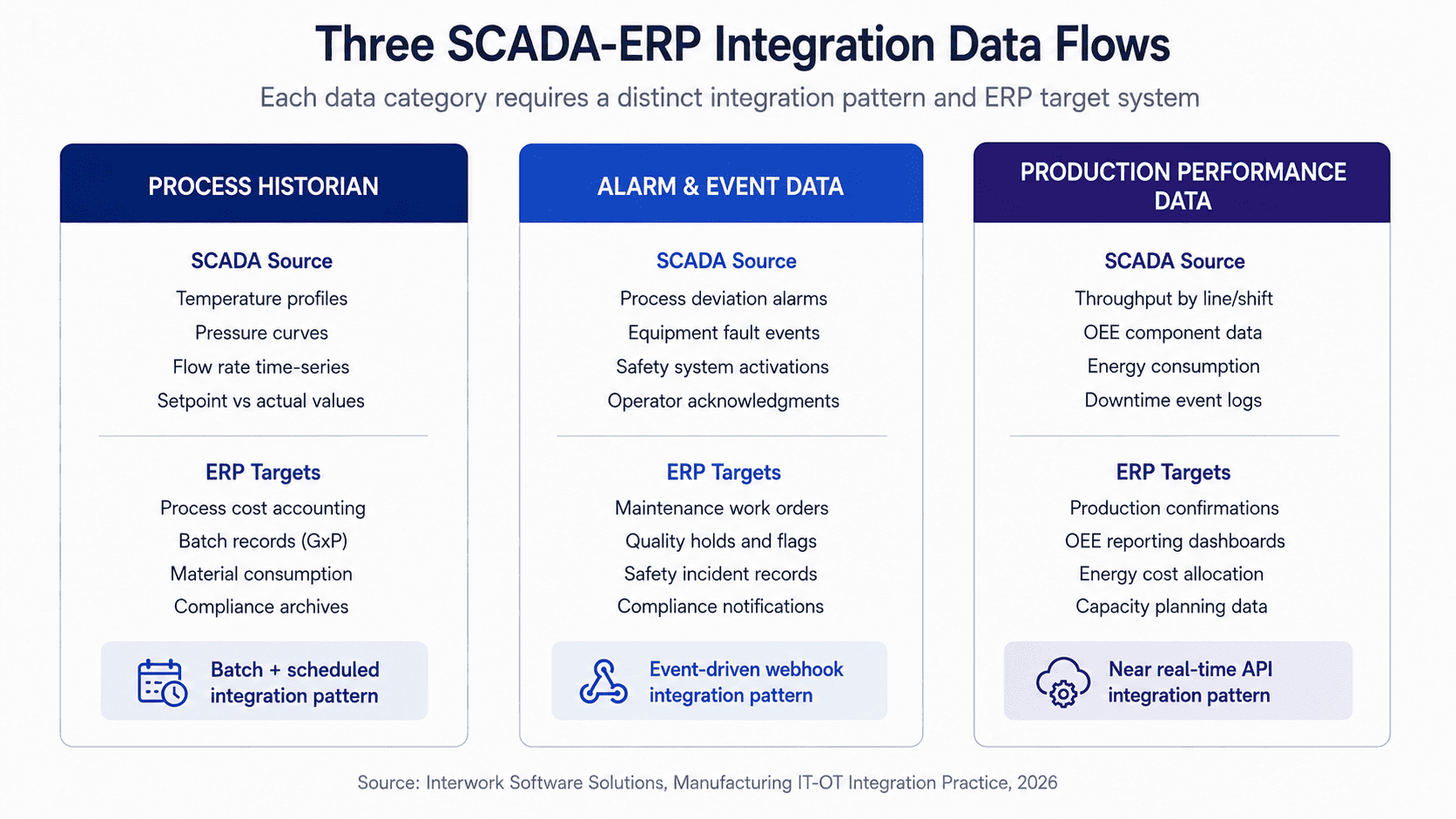
Process historian data is the time-series record: temperature profiles across a run, pressure curves through a reaction sequence, and setpoint versus actual comparisons across a batch. It feeds ERP cost accounting, regulatory batch records, and material consumption reconciliation. It does not need sub-second delivery. Batch data can transfer at batch completion, and shift summaries can transfer on a scheduled interval, so the pattern is scheduled batch transfer with transformation into structured cost and production records.
Alarm and event data is where the operational cost of the integration gap is highest. When a pressure relief valve activates or a motor fault occurs, that event typically triggers a manual chain: an operator calls maintenance, who opens a work order in the ERP hours later. Event-driven integration between SCADA alarm management and ERP maintenance and quality systems removes that manual step, so a severity-threshold alarm creates a work order, checks spare parts, and routes a notification automatically.
Production performance data sits between the two in frequency. Throughput by line, OEE components, and energy consumption need to be current enough for operational dashboards without flooding the ERP with sub-second volumes. Near real-time API posting every 15 to 30 minutes, plus a shift-end confirmation record, gives manufacturing leadership the floor-sensor-to-boardroom visibility needed for OEE optimization without overloading the transactional ledger.
How Does the OT/IT Network Boundary Shape SCADA-ERP Integration Architecture?
The OT/IT network boundary is the constraint that shapes every SCADA-ERP integration decision. Ignoring it creates a security vulnerability. Designing for it correctly enables integration without dissolving the segmentation that protects control systems from IT network threats.
Mature OT security postures run a three-zone architecture. The OT zone holds SCADA servers, PLCs, HMIs, and field devices. The DMZ, a controlled intermediate zone, holds the historians, integration servers, and protocol gateways that move data between OT and IT. The IT zone holds ERP, MES, and corporate infrastructure. Data flows from OT to the DMZ, and from the DMZ to IT. It does not flow directly from IT into the OT control systems.
Interwork's IT-OT integration architecture uses the DMZ historian as the data broker. SCADA writes continuously to the historian. Integration software in the DMZ reads that data, transforms it for ERP consumption, and passes it into the IT zone through a monitored path. ERP never writes directly to SCADA. It can pass a setpoint recommendation or production schedule to a DMZ staging area, which an operator then applies through the HMI after review. That human control point is not a technical limitation. It is a safety governance requirement, and it is the design principle ISA/IEC 62443 is built around for industrial control system network segmentation.
Hybrid architectures, where real-time control stays on-premises and historical data and analytics move to cloud infrastructure, are the dominant pattern for manufacturers modernizing their SCADA estate today. That split is edge-to-cloud intelligence in practice, and it matters for SMB and enterprise plants alike: it lets a plant keep its existing control hardware untouched while still getting cloud-scale analytics on the historian side, which is exactly the boundary Interwork's Unified Observability Platform for IT and OT Environments is built to sit across.
How Do SCADA Alarm States and Process Deviations Trigger ERP Workflows Automatically?
SCADA alarm management and ERP maintenance workflows are two systems that should talk directly but in most plants still require a person to translate between them. The alarm fires. The operator acknowledges it. A maintenance coordinator opens the CMMS or ERP and creates a work order, often a day or more after the original event. The quality team hears about it in the next morning meeting.
Business process automation that connects SCADA alarm management to ERP workflows closes that gap. The integration layer monitors the SCADA alarm log through the DMZ historian or an OPC-UA server, classifies incoming alarms against a defined event taxonomy, equipment fault, process deviation, safety event, operator override, and routes each type to the correct ERP workflow trigger.
An equipment fault alarm on a critical motor creates a maintenance work order automatically, checks spare parts availability in the ERP inventory module, generates a procurement request if stock is below the minimum, and routes full context to the maintenance supervisor's mobile notification. A process deviation alarm affecting a batch places it on quality hold in the ERP batch management system, logs the process condition at the time of deviation, and routes the record for quality review. The quality decision still belongs to a person. The data gathering and record creation do not.
The most significant shift SCADA-ERP alarm integration produces is not the reduction in manual work order time. It is what happens to alarm rationalization. Once maintenance teams see SCADA alarm history correlated against ERP maintenance cost records, they usually find a category of alarms that fire often, trigger costly response workflows, and are never actually caused by equipment failure. They are caused by process parameter drift that operators correct manually without logging it. Seeing that pattern in one integrated system is what drives the investigation that fixes the underlying cause, and it turns an alarm rationalization project that used to take months of manual correlation into a straightforward exercise.
This is what Interwork's Unified Observability Platform for IT and OT Environments provides in SCADA-integrated operations: cross-domain incident correlation that maps a SCADA alarm directly to its business impact in the ERP, rather than requiring a human translator at every system boundary. A single view surfaces the alarm, its historical frequency, the affected production order, batch status, spare parts position, and the maintenance team on shift.
What Compliance Requirements Govern SCADA-ERP Data in Regulated Process Manufacturing?
In pharmaceutical, food and beverage, and chemical manufacturing, SCADA-ERP integration carries regulatory weight that adds specific requirements to the architecture.
21 CFR Part 11 requires that electronic records and signatures meet defined criteria for data integrity, audit trails, and access control. When SCADA process data flows into an ERP batch record, the integration path has to preserve data provenance: the value in the ERP record must be demonstrably identical to what SCADA recorded at the point of measurement. Any transformation applied along the way needs to be documented and validated, and the audit trail has to show who accessed the data, when it moved, and what changed.
That does not make the integration impossible. It makes the design requirements explicit. Data provenance tracking from historian tag to ERP batch field, timestamp preservation through every step, and role-based access controls aligned between the SCADA operator model and the ERP batch record are all implementable, provided they are designed in from the start rather than retrofitted after go-live.
GxP requirements for pharmaceutical, veterinary, and food manufacturing require that production records reflect actual process conditions and that deviations are documented and evaluated before batch release. SCADA-ERP integration that auto-populates batch records from actual historian data, flags deviations against the batch record, and routes the affected batch for quality review supports GxP compliance more reliably than manual transcription, which is where human error usually enters the record.
How Does Interwork Architect SCADA-ERP Integration for Manufacturing Enterprises?
Interwork's approach to SCADA-ERP integration in manufacturing rests on four technical capabilities, each addressing a different layer of the problem, and each grounded in the same Industry 4.0 digital transformation principles Interwork applies across its manufacturing practice.
SCADA network integration services handle the OT-side connection: OPC-UA, OPC-DA, Modbus, and proprietary historian interfaces extract process data, alarm events, and production metrics through the DMZ without touching the control layer. This is industrial protocol translation in practice, and it is the edge-to-cloud intelligence layer that lets protocol-specific connectors normalize heterogeneous SCADA formats into structured records the pipeline can transform and route across connected factory floors of any size.
IT-OT integration services provide the DMZ architecture itself: the secure data broker that sits between OT and IT, buffers data during connectivity interruptions, applies validation rules before data reaches the ERP, and maintains the audit trail regulated manufacturers need. This is also where the event taxonomy lives, the logic that classifies incoming SCADA alarms and routes them to the right ERP workflow.
API-led ERP integration connects the structured SCADA-derived data to ERP production confirmation records, quality workflows, maintenance work orders, and cost accounting modules through bidirectional connectors built for SAP and Oracle core database communication, the same ERP Development and Core Integration discipline Interwork applies across its manufacturing practice. Near real-time synchronization handles production performance data, event-driven webhooks handle alarm routing, and scheduled batch transfer handles historian data for cost accounting and batch records.
The Connected Shop Floor Execution Platform provides the MES layer that sits between SCADA and ERP in more complex process environments, and it is the backbone of Interwork's smart factory systems approach. Rather than connecting SCADA directly to the ERP, which creates tight coupling that breaks whenever either system changes, the platform's Automated Stoppage Management Module and Production Order Confirmation Module give SCADA a stable data model to populate and the ERP a stable structure to read from for production confirmation, quality management, and cost allocation. Changes to SCADA hardware or ERP configuration get absorbed by that layer instead of forcing an integration rebuild.
Can SMB Process Manufacturers Adopt SCADA-ERP Integration Without an Enterprise Budget?
Full historian integration, alarm-to-ERP automation, and DMZ-broker architecture are enterprise-grade builds, but an SMB plant does not have to build all three at once to get value. The practical entry point is the data flow with the lowest integration complexity and the fastest payback: production performance data.
A mid-sized plant running a single SCADA system and a standard ERP module can start with the Connected Shop Floor Execution Platform's Production Order Confirmation Module, which posts completed production volumes to the ERP on a same-shift basis with N-1 booking flexibility for corrections, without requiring a full DMZ historian buildout first. The Meter Reading Management Module adds validated utility and energy consumption tracking on the same lightweight integration path. Both give plant heads floor-sensor-to-boardroom visibility on OEE and cost allocation immediately, using the API-led connectors that already exist for SAP and Oracle rather than a bespoke integration project.
Alarm-to-ERP automation and full compliance-grade historian integration, the pieces that carry the highest engineering cost, are the natural second phase for OEE optimization once the plant has proven the ERP-side workflows on production data. This phased sequence is why the same Manufacturing & Retail practice that designs enterprise SCADA-ERP architectures for multi-plant cement and pharmaceutical operations can size the same architecture down to a single-line SMB deployment without changing the underlying design principles, only the scope of what gets built first.
What Are the Most Common SCADA-ERP Integration Pitfalls?
Connecting ERP directly to the SCADA server is the most common mistake. Any integration running on the SCADA server consumes CPU and memory the control process needs, and it typically bypasses OT network segmentation in the process. Extract from the historian, never from the server itself.
Using one integration pattern for all three data types is the second. Real-time API calls suit production performance aggregates but are wrong for historian time-series data, which should transfer in batches. Event-driven webhooks suit alarm routing but are wrong for scheduled batch record compilation. Forcing one pattern across all three produces a system that is too slow for alarms, too fast for historian data, or both.
Building the alarm-to-ERP integration before completing alarm rationalization is the third. If the SCADA alarm system generates hundreds of nuisance alarms per shift that operators acknowledge without action, connecting that output to ERP maintenance workflows floods the maintenance team with automated work orders for events that need no maintenance. Rationalization should precede or run alongside the integration, not follow it.
Ignoring compliance requirements during design is the fourth. Discovering during a validation review that the integration path does not preserve data provenance or audit trail integrity forces expensive rework after the build is finished. Requirements for the applicable regulatory framework need to shape architecture decisions from day one, not get bolted on afterward.
Underestimating change management for SCADA operators is the fifth. Once a SCADA alarm automatically creates an ERP work order, an operator's acknowledgment becomes a more consequential action. Operators need to understand how their actions propagate into ERP systems, and their input should shape which alarm categories trigger automatic workflows versus which stay SCADA-only.
Frequently Asked Questions
What is SCADA-ERP integration, and why is it architecturally different from standard IT integration?
SCADA-ERP integration connects supervisory process control systems with enterprise business systems so process data reaches cost accounting, quality management, and maintenance scheduling without manual transcription. It differs from standard IT integration because SCADA runs on a network segmented from IT for safety reasons, carries real-time control performance requirements that cannot absorb integration load, and generates data types, time-series process variables and alarm events, that ERP systems do not natively consume.
How do you integrate SCADA with ERP without compromising process control performance?
Extract data from the SCADA historian, never from the SCADA server itself. The historian receives data continuously from the control process and stores it independently. Integration software reads from the historian inside the DMZ, transforms the data for ERP consumption, and passes it into the IT network through a controlled path. The control loop never touches the ERP connection, so integration load never consumes resources the control algorithms need.
What three types of SCADA data need to flow to ERP systems?
Process historian data, temperature profiles, pressure curves, and flow rates, flows to ERP cost accounting and batch records using scheduled batch transfer. Alarm and event data, equipment faults and process deviations, flows to ERP maintenance and quality workflows using event-driven webhooks. Production performance data, throughput, OEE components, and energy consumption, flows to ERP production confirmations and dashboards using near real-time API integration.
What compliance requirements apply to SCADA-ERP integration in pharmaceutical manufacturing?
21 CFR Part 11 requires data integrity, audit trails, and access controls for electronic records. The integration path must preserve data provenance so ERP values are demonstrably identical to SCADA-recorded values, keep timestamps intact through every step, and align access controls between systems. GxP requirements additionally require that process deviations are captured in batch records and routed for quality review before batch release.
How does SCADA alarm data trigger ERP maintenance and quality workflows automatically?
An event-driven integration layer monitors the SCADA alarm log through a DMZ historian or OPC-UA server, classifies alarms by event taxonomy, and routes each type to the matching ERP workflow. Equipment fault alarms create maintenance work orders, check spare parts inventory, and notify supervisors automatically. Process deviation alarms place affected batches on quality hold and route the batch record for review, removing the manual translation step between alarm acknowledgment and ERP record creation.
Can a smaller manufacturing plant get SCADA-ERP integration benefits without a full enterprise rollout?
Yes. A plant can start with production performance data flowing through the Connected Shop Floor Execution Platform's Production Order Confirmation Module, which requires far less integration engineering than full historian and alarm automation. That gives an SMB plant same-shift ERP visibility on production and OEE immediately, with alarm-to-ERP automation and compliance-grade historian integration added as a second phase once the initial workflows are proven.
The Integration That Completes the Smart Factory Picture
SCADA is already doing its job. The process control layer holds setpoints, the historian accumulates process history, and the alarm log captures every deviation. What is missing in most plants is not better process control. It is a path for that data to reach the ERP without a person retyping it, and a way to eliminate operational silos between the two systems without touching the control loop. This is the last mile of Industry 4.0 digital transformation for most process manufacturers, and it is what turns a well-run SCADA estate into genuine smart factory systems rather than a collection of disconnected control rooms.
SCADA-ERP integration closes that path, driving ERP cost accounting from actual process performance instead of standard costs, triggering maintenance and quality workflows from real alarm events instead of phone calls, and giving production planning teams current capacity and performance data instead of theoretical standards. Manufacturers that eliminate operational silos this way get a single, trustworthy record of what happened on the floor, not two competing versions of it.
The architecture has to respect the control layer, preserve OT/IT segmentation, satisfy compliance requirements where they apply, and treat the three data flow types differently. Getting those decisions right, whether for a single-line SMB plant or a multi-site enterprise operation, is what separates an integration that holds up for years from one that causes quality problems six months after go-live.
Interwork Software Solutions designs and implements SCADA-ERP integration architectures, IT-OT integration services, and unified observability platforms for manufacturing enterprises across cement, pharmaceutical, chemical, food and beverage, and FMCG sectors, at both single-plant and multi-site scale.
About the Author
Vishnu Panda is the Chief Executive Officer of Interwork Software Solutions, bringing more than 25 years of experience in manufacturing technology and industrial automation. He leads Interwork's practice across Manufacturing Execution Systems, SCADA integration, IIoT telemetry architectures, and ERP-connected shop floor programs for enterprise manufacturing clients across cement, pharmaceutical, automotive, and FMCG sectors.