
Cement major, multi-plant · Manufacturing
Same-shift ERP sync across multiple cement plants
A national cement manufacturer replaced shift-end paper forms with MES-driven confirmations. The CFO close now runs on numbers that match the line.
Read

Case Study ·
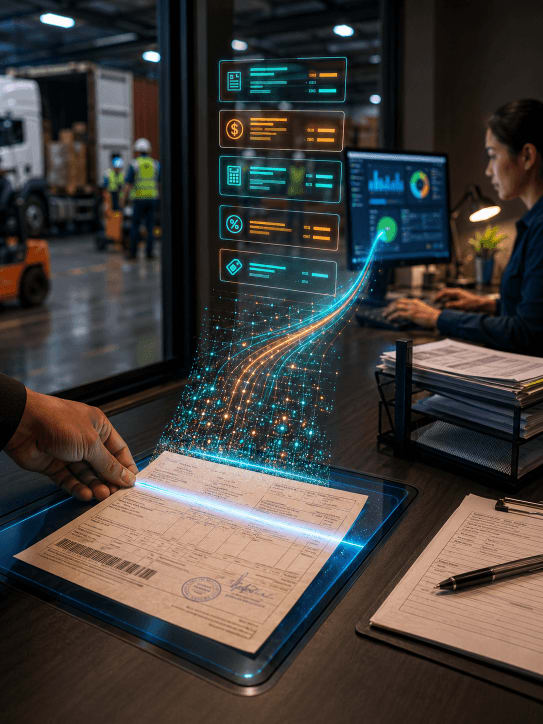
· 94% of freight bills auto-posted to MIRO, no clerk touch · Approval SLA cut 50%, exception queue only · INR 35-50M in working capital freed from the provision buffer · Reconciliation backlog cleared within 90 days of go-live
This OEM processes 600 to 800 inbound freight bills a week across 12 manufacturing plants, with every bill needing to be matched, tax-computed, approved, and posted to the ERP before it can be paid. If your finance and logistics teams are still reconciling freight bills by hand at anything close to that volume, this will feel familiar.
Every freight bill arrived as a PDF. A clerk matched it to a Goods Received Note, ran it through a tax computation spreadsheet to work out GSTIN, commodity code, and carrier lane, and placed it in an approval queue before it could post to MIRO. The full cycle took three days on average, and at any given moment, INR 35 to 50 million in freight liability sat unposted, a gap large enough that finance kept a permanent provision buffer just to cover it.
The approval queue treated every bill the same. All 100% of bills passed through it, including the roughly 90% that required no human judgment at all, clean matches simply waiting behind the genuinely complex ones. On top of that, disputes lived in email threads with no audit trail attached to the freight order and no SLA governing resolution time, which meant a disputed bill could sit for as long as whoever owned that inbox let it.
The OEM brought in Interwork to deploy a freight-centric TMS for manufacturing enterprises, built specifically to automate the inbound freight financial cycle from the gate to the ledger.
GRN capture moved to the source. The platform runs automated calculation of goods received notes, capturing GRN directly from the gate pass or weighbridge at each plant the moment a shipment is received, rather than waiting for a clerk to key it in from a PDF.
Tax computed automatically, at the point of capture. Programmatic freight tax computation runs against GSTIN, commodity code, and carrier lane the instant the GRN lands, replacing the manual spreadsheet step entirely. This is programmatic freight tax computation applied at scale, not a one-off script.
Clean bills post themselves. This is automated freight bill verification software at work: bills that match cleanly auto-post to MIRO in the ERP with no clerk involvement. Only bills that don't match route to an exception queue, running at five to eight percent of volume in steady state, a fraction of what used to pass through manual review. Automated freight bill verification software only earns its keep if the exception rate stays this low.
Disputes got structure and a clock. Disputes moved out of email and into structured tickets attached directly to the freight order. Every ticket carries an SLA counter starting at submission, a named owner, and a defined resolution path, so nothing sits unaccounted for in someone's inbox.
Head office got a live view. A real-time dashboard shows query volume, dispute type distribution, and carrier-level SLA performance across all 12 plants, giving the OEM's head office visibility it never had before.
| Metric | Before | After | Change |
|---|---|---|---|
| Freight bills auto-posted to MIRO | 0% (manual PDF matching) | 94% | — |
| Approval queue coverage | 100% of bills | Exception queue only (5-8%) | -50% SLA |
| Freight liability provision buffer | INR 35-50M held | Eliminated | +INR 35-50M working capital |
| Reconciliation backlog | Ongoing | Cleared within 90 days of go-live | — |
| Dispute tracking | Email threads, no SLA | Structured tickets, SLA-timed, named owner | — |
The finance team eliminated the freight liability provision buffer entirely, and the broader goal driving the rollout, to stop transport revenue leakage across the network, was met with room to spare. For the first time, the OEM's head office had real-time visibility into carrier performance and dispute resolution SLA across all 12 plants, not a monthly reconstruction of it. Every finance leader chasing ways to stop transport revenue leakage eventually lands on the same conclusion: the leakage isn't fraud, it's friction.
Talk to our team about automating your freight bill cycle →
"We were carrying a provision buffer every month just to cover freight liability we hadn't posted yet. That buffer is gone now. When 94% of bills post themselves the moment the GRN lands, there's nothing left to provision for."
Head of Logistics Finance, Manufacturing OEM
What happens to the bills that don't match cleanly? They route to an exception queue instead of the full approval process. In this deployment, that queue held five to eight percent of total volume, down from the 100% of bills that used to pass through manual review.
How is tax computed without manual review? The engine calculates tax at source using GSTIN, commodity code, and carrier lane the moment the GRN is captured, rather than a clerk running it through a spreadsheet after the fact.
What replaced the email dispute threads? Structured tickets attached directly to the freight order, each with an SLA counter running from submission, a named owner, and a resolution path, all visible on the head office dashboard.
If freight liability is sitting in a provision buffer instead of your working capital, let's map out what a freight-centric TMS for manufacturing, built on automated calculation of goods received notes from day one, could look like across your plants.
Set up an architectural review with our transport software specialists →
Related resources
A national cement manufacturer replaced shift-end paper forms with MES-driven confirmations. The CFO close now runs on numbers that match the line.
A multi-plant OEM eliminated the freight reconciliation backlog. Working capital trapped in unreconciled freight liability returned to operations within 90 days.

A leading automotive OEM cut dealer support load by routing PO, LR and funds queries through the portal. Counter staff stopped calling the OEM to ask where their consignment was.