
Interwork

Connected Shop Floor Execution Platform

Unify Plant-Floor Telemetry with Your Enterprise ERP to Optimize OEE, Automate Production Booking, and Enforce Rigid Operational Governance.

Contact Us

Siloed machinery networks, unmapped micro-stoppages, and delayed data entry drain manufacturing margins and corrupt corporate ledger reliability. Our Connected Shop Floor Execution Platform is an enterprise-grade, high-availability Manufacturing Execution System (MES) designed explicitly to bridge the gap between physical production layers and core enterprise software ecosystems. We partner with CIOs, CTOs, Plant Heads, and Directors of Manufacturing to replace fragile spreadsheet logs with automated, near real-time edge data integration pipelines. By capturing structured runtime telemetry, instituting strict validation workflows, and enabling single-click ledger synchronization, this platform eliminates visibility dead zones, drives operational yield, and builds a resilient foundation for your Industry 4.0 smart manufacturing roadmaps.

Eliminating the Blind Spots and Data Latencies of Plant Operations

Industrial operations lose critical efficiency when frontline execution metrics remain isolated from executive decision systems. We dismantle the persistent architectural and process bottlenecks that restrict real-time control.

Delayed ERP Ledger Reflectivity

Eliminating the typical multi-shift delay in updating central databases with production totals and asset stoppage logs.

Manual and Fragmented Downtime Capture

Replacing retrospective, error-prone manual logs with automated tracking to catch short, recurring micro-stoppages.

Unstructured Asset Tracking

Introducing complete system transparency across complex industrial lines to track metrics down to individual resource sub-sections.

Unreliable Data and Siloed Metering

Ending dependency on unverified hand-written parameters and loose readings that skew OEE tracking and inventory reporting.

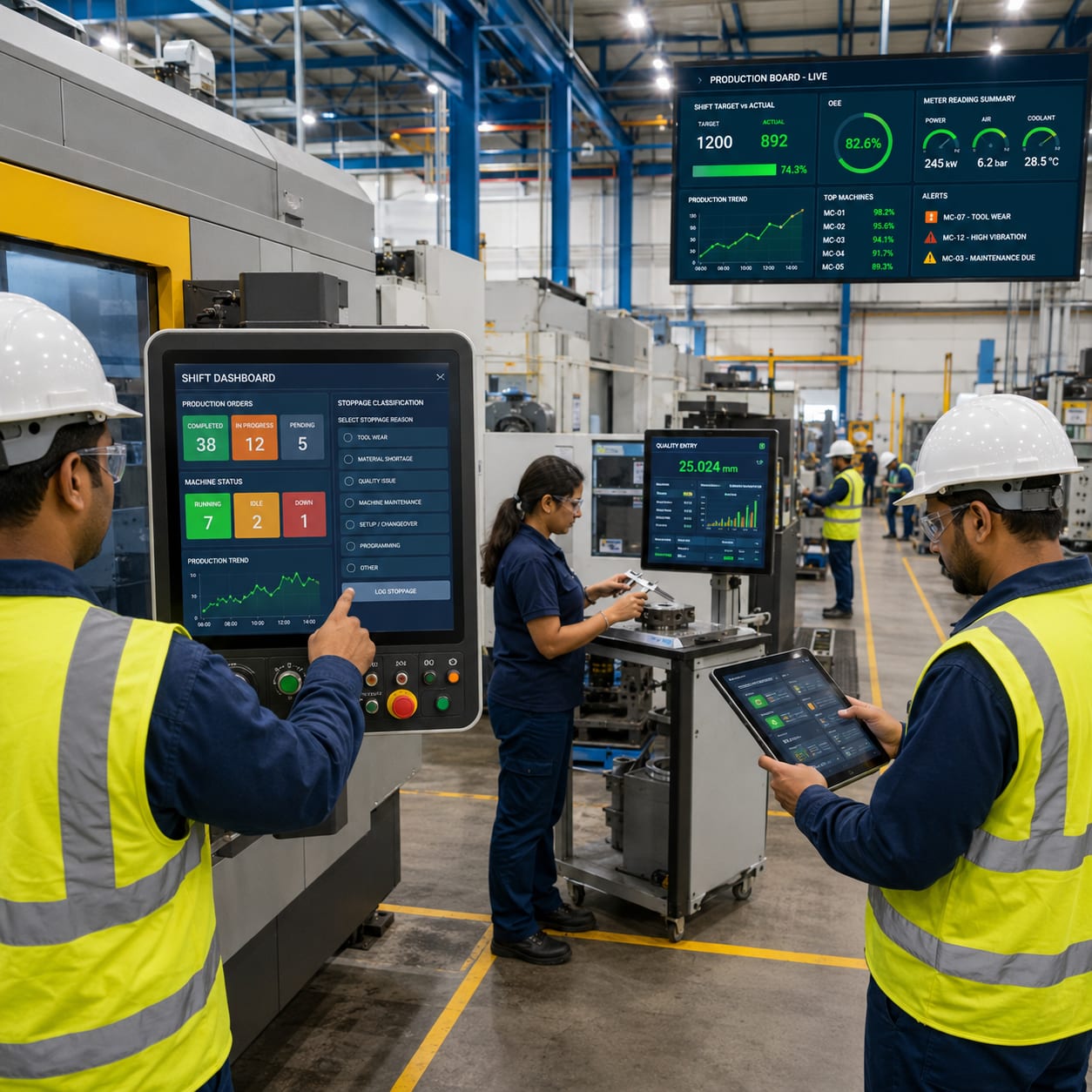
Shop floor operator working with MES dashboard, capturing stoppage and production data

Multi-plant cement manufacturer. Same-shift ERP data across every line.

Same-Shift
ERP posting cadence
Multi Plant
Single platform rollout
Zero
End-of-month reconciliation
OEE Gains
Measurable per plant
Multi-plant cement manufacturing facility with MES deployment tracking production and maintenance

When the Shop Floor and ERP Speak Different Languages

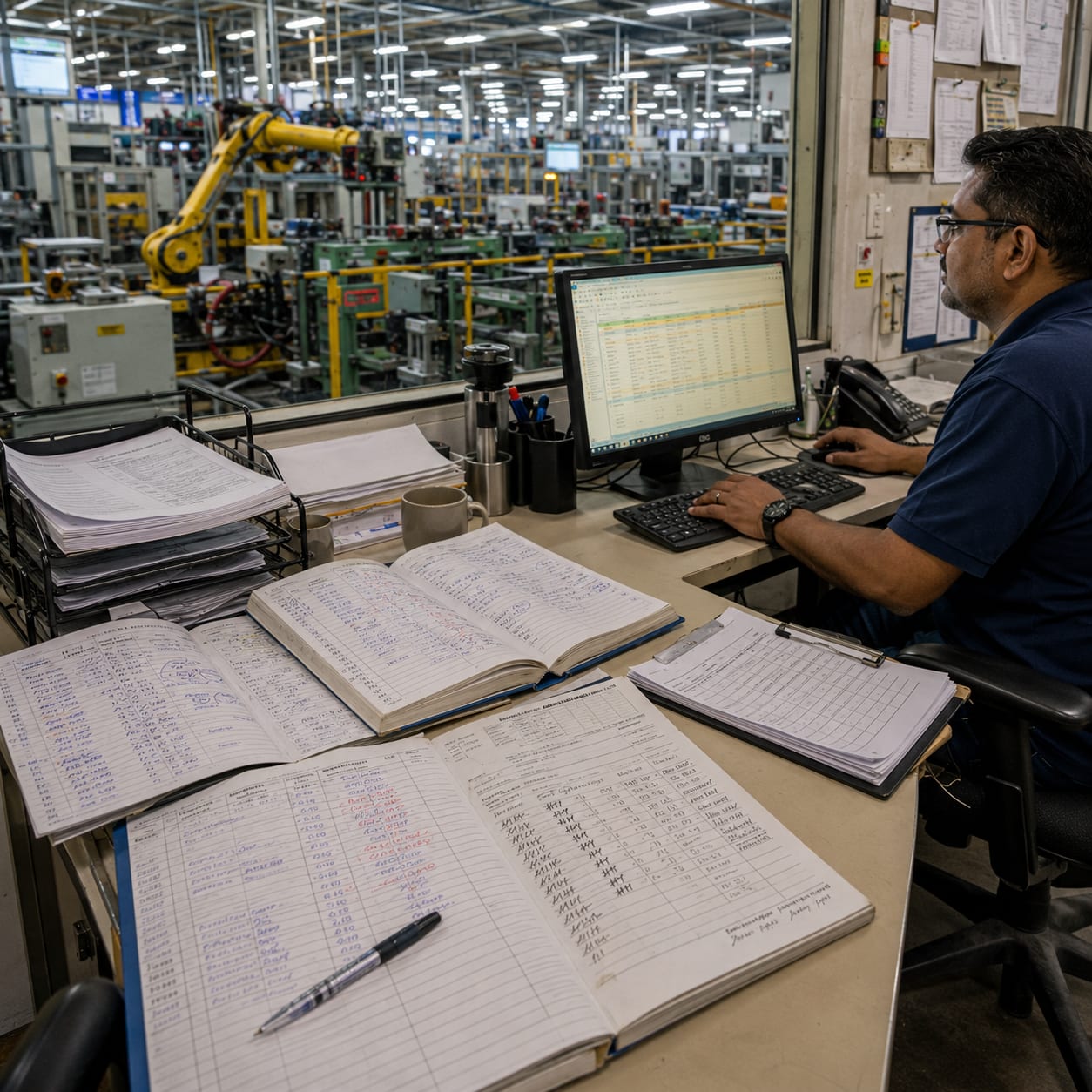
Shop floor cascade illustrated, the disconnect between machine state and ERP entries

The problem is the operational cascade. A stoppage happens at 14:00. The ERP entry is made at end-of-shift or the next morning. Root cause analysis runs two days late. Maintenance planning is reactive, not preventive. By the time the report lands on the Plant Head desk, the OEE points that were lost cannot be recovered, only counted.

Walk down the symptoms in any plant running shop floor data manually: stoppages recorded on paper, PO entries created hours or days after the shift, meter readings captured in silos that never make it back to the cost centre, no structured linkage between a downtime event and the root cause that triggered it. The reports look fine. The underlying state of the plant is invisible.

  • Manual stoppage recording with delayed ERP entry
  • PO confirmations posted after the fact
  • Meter readings captured in spreadsheets, not the ERP
  • No structured linkage between stoppages and root causes

High-Availability Core Operational Execution Modules

Built on a modular, scalable microservices architecture, our platform organizes real-time shop floor operations into three specialized functional modules:

Automated Stoppage Management Module

This module removes human bias and manual friction from factory downtime auditing.

The system identifies, calculates, and records line stoppages automatically, tracking operations down to specific resource sub-sections. It maps individual downtime occurrences directly to your standardized reason codes, supports event-splitting for complex multi-tiered incidents, and protects data integrity with a built-in verification workflow.

Capabilities List

  • Automated identification and runtime tracking of machine stoppages directly from machine data.
  • Multi-tier asset operational mapping: Plant, Production Line, Resources.
  • Dynamic downtime event splitting to isolate multi-reason failures during single stoppages.
  • Integrated maker-checker validation workflow: Operator data input (Maker) matched with supervisor approval (Checker).
  • Near real-time, same-shift data push to central ERP databases via high-performance APIs.

Production Order Confirmation Module

Achieve complete alignment between physical manufacturing output and corporate scheduling matrices.

This module enables technical teams to monitor and book daily production volumes directly against enterprise Process Orders (POs). Designed to accommodate complex operational scenarios, it allows flexible booking timelines and tracks specialized material variables without sacrificing ledger accuracy.

Capabilities List

  • Continuous daily production tracking and logging against active ERP Process Orders (POs).
  • Flexible production booking options supporting same-day logs and N-1 retroactive date entries.
  • Custom parameter data capture tracking essential material metrics (e.g., moisture, density, and temperature levels).
  • Advanced logic to split, manage, and book mixed-material manufacturing output runs.
  • One-click, API-driven synchronization to pass completed production volumes to core financial books.

Meter Reading Management Module

Eliminate isolated tracking habits across utility, fuel, and electrical consumption lines.

This module captures, digitizes, and logs meter data across every active assembly section. It features an editable operational interface backed by strict security controls, allowing your team to reconcile discrepancies while keeping edge metrics synchronized with corporate data centers.

Granular Capabilities List

  • Continuous, cross-section ingestion of industrial electrical, fuel, and utility meter readings.
  • Flexible, permission-controlled user screens to adjust log inaccuracies while maintaining audit trails.
  • Automated data validation rules to capture out-of-bounds sensory anomalies before database logging.
  • Direct database synchronization to match factory edge consumption with main enterprise records.
Control room view of integrated shop floor operations managed through the MES platform

Every line. Every stoppage. Every shift. One connected view.

Streamlining Factory Data Workflows

Before Platform Implementation
  • Downtime Ingestion

    Manual, retrospective tracking prone to incomplete duration capture.

  • Downtime Diagnosis

    No structured linkage between unexpected stops and root causes.

  • Order Confirmation

    Delayed recording of production totals against enterprise Process Orders.

  • Meter Operations

    Telemetry logs captured in silos without real-time validation checks.

  • Enterprise Syncing

    Lagging batch synchronization creating discrepancies in corporate reports.

After Platform Implementation
  • Downtime Ingestion

    Automated stoppage tracking with precise timestamps and duration calculation.

  • Downtime Diagnosis

    Standardized mapping of runtime anomalies to predefined reason codes.

  • Order Confirmation

    Transparent PO-based production monitoring with flexible N-1 booking entries.

  • Meter Operations

    Digitized, validated consumption logging with precise administrative edit controls.

  • Enterprise Syncing

    Near real-time API-led data synchronization with core ERP architectures.

Architected for High-Volume, High-Availability Operations

API-Led ERP Integration

Bidirectional connectors engineered for seamless core database communication (ERP/Oracle suites).

Microservices Architecture

Containerized, modular platform design structured to mirror physical plant layouts.

Enterprise-Grade Scalability

Optimized backend data pipelines built to handle massive sensory logs without performance issues.

Plant-Specific Configurations

Easily adaptable data schemas and rules engines tailored to your specific manufacturing processes.

Delivering Real-Time Control and Measurable Operational Yield

Complete Plant Visibility

Consolidated runtime and downtime dashboards across all lines, sub-sections, and facilities.

Accelerated Executive Reviews

Same-shift ledger updates shorten the window between shop-floor events and management analysis.

Rigid Operational Governance

Standardized classification rules and dual-level validation loops ensure dependable data.

Maximized OEE Performance

Fast root-cause data helps engineers spot repeating failure patterns and prevent unplanned downtime.

Technical questions, answered directly.

For deeper integration questions, our team can join a working session with your ERP CCoE and plant IT leads.

The platform integrates with ERP PM for maintenance notifications, ERP PP for production order confirmation, and ERP CO for cost centre postings. All integration happens via standard BAPIs and IDocs. Custom RFC connections can be built where standard interfaces do not cover plant-specific requirements. We have deployed this against both ECC 6.0 and S/4HANA environments.
The operator records a stoppage or confirms a production entry via the shop floor interface. The entry is flagged as pending. The shift supervisor reviews it on a separate validation screen, corrects if needed, and approves it. Only approved entries are pushed to ERP via the integration layer. Rejected entries are returned with a reason code for correction.
Yes. Each plant maintains its own reason code library, which maps to the corresponding ERP functional location and equipment master. Reason codes can be structured hierarchically: primary reason, secondary reason, root cause. Configuration is done through an admin console without requiring a code deployment.
A single-plant go-live typically takes 12 to 16 weeks, covering discovery, configuration, UAT, and parallel run. For multi-plant rollouts, the first plant serves as the reference deployment. Subsequent plants can be onboarded faster once the integration pattern is established, typically 6 to 8 weeks each.
Yes. The shop floor application is built with an offline-first architecture. Data is captured locally and synced to the central system when connectivity is restored. The ERP push happens from the central layer, not from the shop floor device, so intermittent connectivity does not interrupt the integration.
Existing ERP master data, including functional locations, equipment, production orders, and cost centres, is imported into the MES before go-live. The MES does not overwrite ERP data. It posts incremental transactions as entries are confirmed. Historical data in ERP remains untouched.

Secure Clear Visibility, Optimize OEE, and Automate Your Shop Floor

Schedule a technical system review with our industrial software team. Let's evaluate your plant-floor infrastructure and design a secure, low-latency edge-to-cloud MES roadmap that unlocks precise, real-time control over your manufacturing operations.

Contact Us