
Interwork

Freight-Centric TMS for Manufacturing Enterprises

Connect Shipping Workflows with Your Core ERP Landscape to Automate Freight Billing, Optimize Carrier Routing, and Stop Transport Cost Leakage.

Contact Us

Fragmented freight tracking, manual tax verification, and slow payment loops frequently disrupt supply chains and drain manufacturing margins. Our Freight-Centric TMS for Manufacturing Enterprises is an enterprise-grade solution engineered to manage both inbound raw material delivery and outbound finished product distribution. We partner with CIOs, CTOs, Chief Supply Chain Officers (CSCOs), and Directors of Logistics to replace manual freight calculations and messy billing habits with an automated, API-driven system. By integrating directly with your core enterprise resource planning (ERP) layers, this platform automates freight bill generation, optimizes carrier contracts, and handles financial tax auditing to reduce administrative errors, lower transport costs, and accelerate cash velocity.

Eliminating System Gaps and Financial Discrepancies in Industrial Logistics

Heavy manufacturing enterprises struggle with complex logistics footprints that create data silos between the factory loading dock and corporate accounting departments. We resolve the persistent operational bottlenecks that limit network transparency and slow down payment cycles:

Manual Freight Bill Auditing

Eliminating tedious manual invoice reviews by auto-generating freight bills directly from verified warehouse receipt notifications.

Slow Financial Data Syncing

Replacing slow, batch-processed financial workflows with near real-time ledger entries to accelerate accounting verification processes.

Unoptimized Routing and Empty Miles

Fixing poor transit scheduling to ensure vehicles run at full capacity and use the most fuel-efficient routes.

Complex Tax Calculation Errors

Preventing tax and compliance mistakes across multi-region logistics networks by automating localized tax calculations.

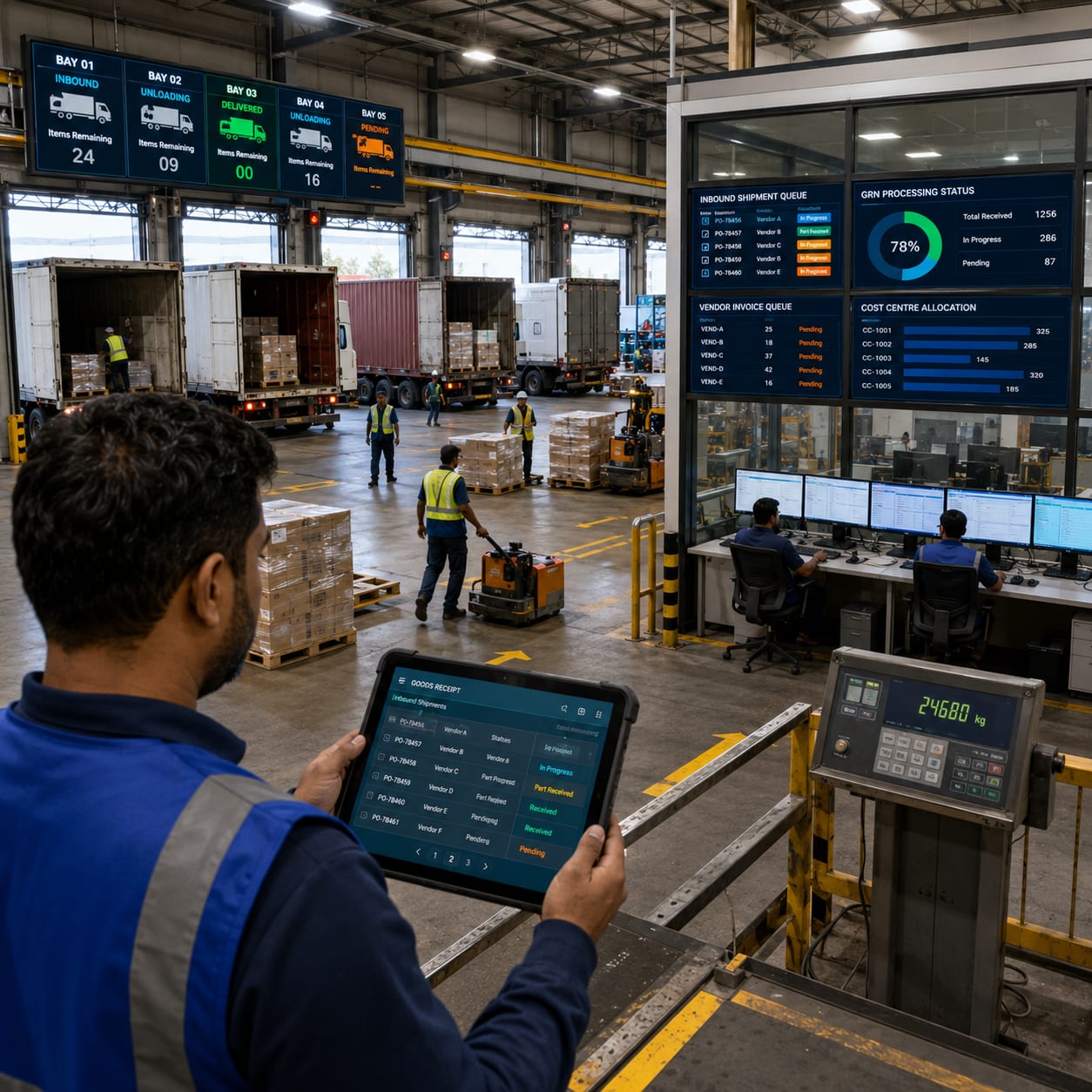
Inbound freight operations with trucks and warehouse activity

Enterprise-Grade Inbound and Outbound Freight Management Modules

Built on a secure, cloud-native microservices framework, our platform optimizes the entire industrial logistics lifecycle across three core modules:

Inbound Logistical Financial Engine

This module automates transport financial tasks by capturing transactional data right from your warehouse entry points.

The platform ingests Goods Received Notes (GRN) automatically, instantly creates matching freight bills, computes complex localized tax calculations, and updates central accounting ledgers. If shipment amounts do not match order rules, the system creates Commercial Credit Notes (CCN) to prevent payment errors.

Capabilities List

  • Automated ingestion of Goods Received Notes (GRN) from central ERP systems.
  • Instant freight bill generation mapped to active physical receipt confirmations.
  • Automated multi-tier localized tax calculations (e.g., IGST, SGST, CGST) on all generated freight bills.
  • Bidirectional ERP integration for rapid accounting ledger update confirmations.
  • Automated Commercial Credit Note (CCN) generation to resolve transit volume or rate disputes.
  • Multi-stage approval workflows for transportation and accounting managers.

Outbound Dispatch & Multi-Tier Optimization Module

Maximize shipping asset utilization and speed up outbound distribution workflows.

This module connects directly with your main business platforms to ingest sales orders, coordinate multi-modal carrier routing, and deploy advanced route planning code. By centralizing active vendor pricing rules and performance histories, the platform helps logistics managers pick the best carrier for every shipping lane.

Capabilities List

  • Automated outbound order integration and matching across core ERP and WMS databases.
  • Centralized carrier management to trace shipping rates, contracts, and vendor performance history.
  • Algorithmic route optimization designed to minimize travel times, fuel consumption, and transit expenses.
  • Dynamic multi-modal shipment load-building and truck capacity optimization.
  • Real-time vehicle tracking webhooks providing continuous delivery visibility to end-users.

Automated Settlement & Integration Layer

Streamline backend administration and payment clearing paths.

This module generates soft-copy invoices against approved freight records, uploads signed billing documents into corporate document repositories, and provides real-time payment status tracking. Equipped with single sign-on (SSO) security controls, the platform connects easily with existing enterprise applications without creating new integration liabilities.

Capabilities List

  • Automated customer invoice generation backed by pre-validated freight metrics.
  • Direct delivery of signed financial documents into central enterprise storage systems.
  • Real-time payment tracking dashboards providing transparency into open freight accounts.
  • API-driven connectors designed to integrate smoothly with existing ERP, WMS, and CRM networks.
  • Single Sign-On (SSO) enablement to provide secure user access control.
  • Flexible, cloud-hosted architecture built to scale alongside expanding global operations.

Industrial OEM. Hundreds of GRNs automated, MIRO posted same day.

200+
Weekly GRNs automated
6 Stages
End-to-end pipeline
Same Day
MIRO posting
Full GST
Tax compliance
Industrial OEM logistics and freight management facility with high inbound shipment volumes

Six Stages. One Automated Freight Lifecycle.

Engineered for freight-heavy operations.

Freight Operations

  • GRN-to-MIRO automation across plants
  • Versioned carrier rate cards with lane pricing
  • CCN workflow for disputed bills
  • Threshold-based multi-level approval routing

Carrier and Order Management

  • Multi-carrier onboarding with isolated rate tables
  • Order data ingestion from ERP SD
  • Route and lane optimisation inputs
  • ePOD capture with signed proof archived

Intelligence and Integration

  • GST rate table maintained against HSN codes
  • Versioned tax compliance for audit defence
  • Real-time ERP MM, FI, and SD connectivity
  • Compatible with ERP ECC 6.0 and S/4HANA

Modernizing Freight Coordination and Billing Systems

Before Platform Implementation
  • Freight Ingestion

    Inefficient manual entry of incoming delivery sheets.

  • Tax Computations

    Error-prone calculations of regional tax breakdowns.

  • Financial Ledger Syncing

    Slow batch-processing causing delayed payment workflows.

  • Route Architecture

    Fragmented route scheduling creating empty miles.

  • Carrier Administration

    Disconnected vendor files making rate auditing difficult.

  • Account Access

    Disjointed login metrics introducing operational security risks.

After Platform Implementation
  • Freight Ingestion

    Automated GRN data capture with instant freight billing generation.

  • Tax Computations

    Automated, programmatic calculation of multi-tier tax matrices.

  • Financial Ledger Syncing

    Near real-time ledger data transfers using fast business APIs.

  • Route Architecture

    Algorithmic route optimization to reduce travel times and costs.

  • Carrier Administration

    Centralized carrier management to track contracts and performance.

  • Account Access

    Single Sign-On (SSO) enabled access across all enterprise platforms.

Integration

Built for High-Volume Industrial Shipping Ecosystems

Advanced API Integration Architecture

Secure bidirectional endpoints engineered for deep enterprise ERP (ERP/Oracle) core integration.

Cloud-Based Configurability

Auto-scaling infrastructure built to process high volumes of logistics log updates smoothly.

Algorithmic Calculation Engines

Rule-driven optimization systems designed to handle complex transport rating logic.

Identity Governance Integration

Single Sign-On (SSO) framework compatible with modern enterprise corporate directory environments.

Delivering Asset Optimization and Financial Traceability

Zero Transport Revenue Leakage

Automated freight bill reconciliation prevents overpayment errors and extra vendor billing fees.

Accelerated Freight Cash Velocity

Automated invoice verification shortens the window between physical delivery and financial settlement.

Reduced Administrative Overhead

Eliminating manual data cross-referencing frees up internal logistics and accounting personnel.

Lower Overall Freight Spend

Advanced route optimization and centralized carrier tracking drive down transport costs.

Reliable Executive Intelligence

Live dashboards give supply chain leaders clear visibility into freight expenses and carrier delivery success rates.

Implementation questions, answered.

Yes. The integration layer is compatible with both ERP ECC 6.0 and S/4HANA. BAPI calls for GRN retrieval, MIRO creation, and vendor payment status are available in both environments. Where S/4HANA introduces API changes, we maintain a compatibility mapping layer to avoid disruption to the TMS workflow.
The platform generates a CCN workflow when a discrepancy is raised by the carrier or identified during invoice matching. The CCN captures the disputed amount, reason code, and carrier reference. Once approved internally, the credit is posted against the original MIRO entry in ERP and the net payment is adjusted accordingly.
Yes. Each carrier in the system has its own rate card configuration, covering base rate, fuel surcharge, zone-based pricing, and weight breaks. Rate cards are versioned so historical freight bills reference the rate applicable at the time of GRN, not the current rate.
Approval workflows are configured per freight bill value and carrier type. You define threshold values, approver roles, and escalation timelines. Approvers receive email and in-app notifications. The system tracks approval SLA and escalates automatically if a bill is not approved within the configured window.
The GST rate table is maintained as a configuration object tied to HSN code and freight type. When the GST Council changes rates, the table is updated in the admin console. All new freight bills from that date use the updated rate. Historical bills retain the rate at which they were generated.
The platform is deployed as a cloud-hosted application with a dedicated tenant for each client. On-premise deployment is available for clients with data residency requirements. The ERP integration runs via a connector hosted within your network or in a DMZ, depending on your security policy.

Streamline Inbound & Outbound Freight and Protect Your Margins

Set up an architectural review with our transport software specialists. Let's evaluate your existing logistics workflows and design a secure, automated TMS roadmap that reduces manual errors and improves delivery performance across your supply chain footprint.

Contact Us